Hydroponics
DWC Hydroponic System: How Deep Water Culture Works and How to Set One Up
As an Amazon Associate we earn from qualifying purchases. How we choose products.
On this page
- What Is a DWC Hydroponic System?
- DWC vs RDWC vs Kratky vs Raft vs NFT
- What You Need for a DWC Hydroponic System
- How to Set Up a DWC Hydroponic System in a Bucket
- How to Size the Air Pump for DWC
- Water Temperature, Oxygen and Root Rot
- Nutrients, pH and EC in Deep Water Culture
- Best Plants for DWC
- DWC Kits vs DIY Buckets
- DWC Problems and Solutions
- Aquaponics With Rafts: DWC With Fish
- DWC Hydroponic System FAQ
A DWC hydroponic system grows plants with their roots hanging straight into a container of nutrient solution, while an air pump pushes bubbles through an air stone at the bottom to keep that water full of oxygen. There is no soil, no growing bed and, in the simplest version, no water pump at all: a lidded bucket, a net pot, an air line and a nutrient mix are the whole system.
Deep water culture is the method behind most first hydroponic buckets and behind commercial floating raft lettuce. Below: how it compares with other methods, what to buy, setup, air pump sizing, and how to keep the water cool enough to avoid root rot.
What Is a DWC Hydroponic System?
DWC stands for deep water culture. Oregon State University Extension's Hydro hints: Deep water culture (EM 9455, Nelson, Langellotto and Nackley, 2025) describes roots suspended in an aerated, nutrient rich solution, with plants held by a floating raft or net pots, and air pumps and air stones keeping the water oxygenated.
How Deep Water Culture Works
Each plant sits in a slotted net pot packed with an inert medium, hung in a hole in the lid so its base touches the solution. Roots grow through the slots into water that holds nutrients and oxygen in one place, which is why OSU notes DWC is known for accelerating plant growth.
Why the Air Pump Matters
Submerged roots only have dissolved oxygen. The Cornell CEA Hydroponic Lettuce Handbook (2013) warns that if no oxygen is added, dissolved oxygen drops to nearly 0 ppm, respiration stops, and the plant is seriously damaged or killed. The air pump is not an accessory; it is the system.
DWC and the Kratky Method
The Kratky method is the same idea without the pump. Adding an air stone lets you top up freely and grow bigger plants for longer.
DWC vs RDWC vs Kratky vs Raft vs NFT
All five grow roots in solution rather than in a medium. They differ in how oxygen reaches the roots and how much water sits behind them, which decides how forgiving each one is.
| Method | How roots get oxygen | Power needed | Water buffer | Best for | Main weakness |
|---|---|---|---|---|---|
| DWC bucket | Air stone in the solution | Air pump, 24/7 | Large | Greens, herbs, one big fruiting plant | Air pump failure in warm water |
| RDWC | Air stones plus water moving between buckets | Air pump and water pump | Large, shared | Several large plants | More plumbing; disease spreads through shared water |
| Kratky | Air gap as the level drops | None | One fill per crop | Lettuce, quick herbs | No topping up over the roots |
| Raft | Air stones in a shallow tank | Usually an air pump | Very large | Lettuce in rotation | Heavy; needs space and a level base |
| NFT | Thin film flowing past roots | Water pump, 24/7 | Very small | Lettuce, herbs, strawberries | Roots dry fast if the pump stops |
When DWC Is the Better Choice
DWC wins on buffer. pH and nutrient strength drift slowly in a full bucket, a missed day of checks is rarely a crisis, and a power cut leaves roots in water rather than in a dry channel. That is why it is the usual answer for beginners choosing a first hydroponic system.
When NFT or RDWC Make More Sense
NFT uses far less water and scales better along a wall or rack of small plants, at the cost of a pump that can never stop. RDWC links buckets to one reservoir, so you adjust one body of water instead of six, but a root disease in one bucket reaches them all.
What You Need for a DWC Hydroponic System
Bucket and Lid
Use a food grade, opaque 5 gallon bucket. Cornell notes algae flourish in wet, well lit places and can weaken a crop to disease, so paint or wrap a white bucket.
Net Pots and Growing Medium
Three 3 inch net pots per lid suit lettuce and herbs; one 6 inch pot suits a tomato or pepper. Fill them with an inert, free draining medium; clay pebbles are the usual choice because they are reusable and do not break down.
Air Pump, Air Stone, Tubing and Check Valve
The pump sits outside the bucket, tubing carries air to a stone on the floor, and a check valve stops water siphoning back into the pump when it switches off.
Nutrients, pH Kit and EC Meter
A complete hydroponic nutrient, a pH kit with up and down, and an EC or TDS meter decide your harvest more than anything else on the list.
Parts for a DWC Bucket
Everything a single 5 gallon DWC bucket needs, bought as separate parts.
-
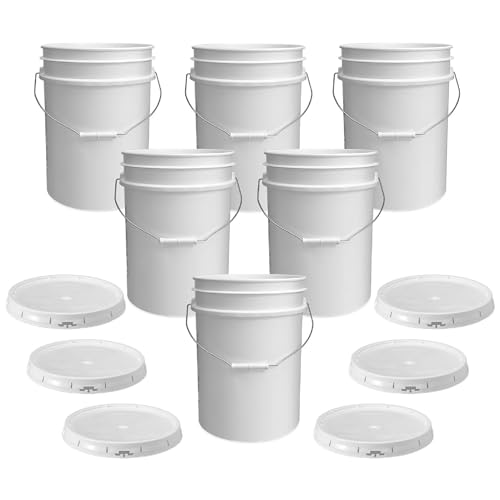
1Bucket and lid
ePackageSupply 5 Gallon Food Grade Buckets, 6 Pack
BPA free food grade pails with lids, enough for several buckets.
-
2Net pots
Cz Garden 3 Inch Net Pots, 25 Pack
Heavy duty wide rim cups listed for DWC and Kratky lids, enough for several buckets.
-
3Air pump for one or two buckets
Two outlets, so one small pump runs two buckets; the maker rates it for 20 to 200 gallon tanks.
-
4Air stones
VIVOSUN 4 x 2 Inch Air Stones, 2 Pack
Large cylinder stones that sit flat on the bucket floor and spread the air across the roots.
-
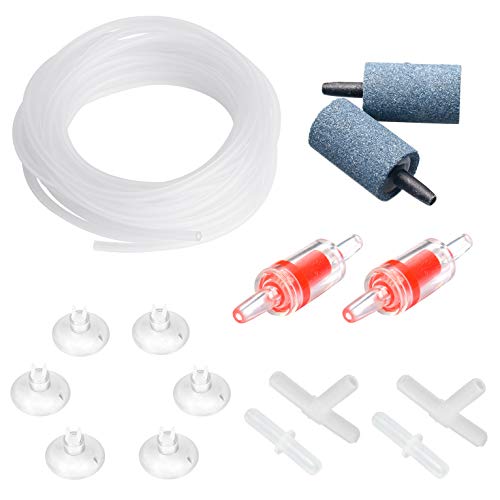
5Tubing and check valves
Pawfly 13 Foot Airline Tubing Kit
Airline tubing with check valves and connectors for several buckets.
-
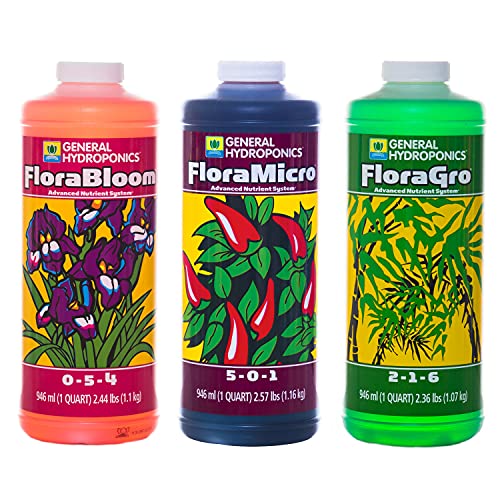
6Nutrients
General Hydroponics Flora Series
Three liquid parts mixed in different ratios for leaves or for fruit.
-
7pH control
General Hydroponics pH Control Kit
pH up, pH down and a liquid test indicator in one box.
-
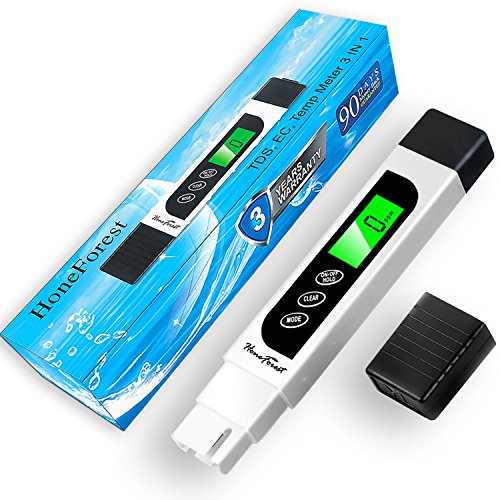
8EC and TDS meter
Reads nutrient strength and water temperature, the two numbers you check most in DWC.



How to Set Up a DWC Hydroponic System in a Bucket
These steps are for a 5 gallon bucket with three leafy plants. For a cross section drawing and drilling details, see build 2 in our DIY hydroponic system guide.
DWC Bucket Setup, Step by Step
-
Pick the spot first
A full 5 gallon bucket weighs over 40 pounds. Set it on a level surface near a GFCI protected outlet, out of direct sun that would warm the water.
-
Test the air line dry
Connect pump, tubing, check valve (arrow toward the stone) and air stone, then run it in a glass of water to confirm even bubbles.
-
Prepare the lid
Cut holes so the net pots sit snugly by their rims, plus a small notch for the airline. Every gap lets in light and algae.
-
Fill and mix
Fill with water and measure its EC as your baseline. Add nutrients to your target, then adjust pH last, because nutrients move it. Read both again after a few minutes of bubbling.
-
Set the water level
For seedlings, the solution touches the bottom of the pots. Once roots reach well into the water, lower it an inch or two to leave a damp air space under the lid.
-
Plant and start the clock
Set rooted seedlings into the pots with rinsed clay pebbles and switch the air pump on for good: it runs 24 hours a day. Note the date, EC and pH on the bucket.
-
Check daily for the first week
Look at the bubbles, root color and water temperature daily for the first week, then read pH and EC every two to three days and top up as the level drops.
How to Size the Air Pump for DWC
Open extension guides give no air per gallon figure for home buckets, only the goal: Cornell targets 7 ppm of dissolved oxygen, says lettuce grows satisfactorily at 4 ppm or more and shows stress at 3 ppm, and notes that for small systems an air pump and aquarium air stone work, though below what pure oxygen achieves. So oversize a little and watch the plants.
Start From the Stone, Not the Pump
Each bucket needs its own stone lying flat on the bottom, with bubbles rising across the whole root mass. Choose a pump that drives all your stones with air to spare at bucket depth, since depth adds back pressure.
One Pump for Several Buckets
A two outlet pump such as the HITOP suits one or two buckets. For four to eight, a multi port pump with valves, like the Pawfly 254 GPH or the EcoPlus ECOair 1 with its six valve manifold, lets you balance the air. Spare capacity helps on hot days.
Signs You Need More Air
- Roots turn tan or brown and slimy instead of white.
- Plants wilt in the afternoon with a full bucket.
- The solution smells sour, or bubbles rise from only part of the stone.
| Air pump | HITOP 4W 1 to 2 buckets | Pawfly 254 GPH | EcoPlus ECOair 1 |
|---|---|---|---|
| Product | 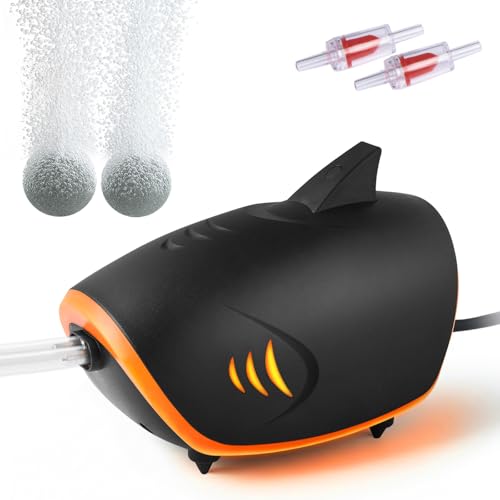 |  |  |
| Maker's rating | 110 GPH, 4 W, 2 outlets | 254 GPH, multi port with lever valves | 793 GPH, 18 W, 6 valve manifold |
| Good for | One or two buckets | A row of buckets or an RDWC setup | Many buckets, a raft bed or an aquaponics tank |
| Price tier | $ | $ | $$ |
| Check price | Check price | Check price |
1 to 2 buckets
HITOP 4W
- Maker's rating
- 110 GPH, 4 W, 2 outlets
- Good for
- One or two buckets
- Price tier
- $
Pawfly 254 GPH
- Maker's rating
- 254 GPH, multi port with lever valves
- Good for
- A row of buckets or an RDWC setup
- Price tier
- $
EcoPlus ECOair 1
- Maker's rating
- 793 GPH, 18 W, 6 valve manifold
- Good for
- Many buckets, a raft bed or an aquaponics tank
- Price tier
- $$
Water Temperature, Oxygen and Root Rot
Most failed DWC buckets fail at the roots, and most root failures start with warm water, which holds less oxygen and favors disease.
Warm Water Holds Less Oxygen
The U.S. Geological Survey's stream water quality summary (Smith, Alexander and Lanfear, 1994) notes that dissolved oxygen falls as water warms, from about 14 mg/L at freezing to about 7 mg/L at 86°F (30°C). Warm roots also respire faster, so a bucket that is fine in spring can run short in July.
Target Water Temperature
Cornell's set points keep its lettuce pond water no higher than 25°C (77°F). At home, aim for the low to mid 70s °F and treat anything near 80°F as a warning: keep buckets off sunny floors and top up with cool water in summer.
Pythium Root Rot
Pythium is a water mold that attacks hydroponic roots. A University of Technology Sydney PhD thesis, Pythium and Phytophthora Associated With Root Disease of Hydroponic Lettuce (Alhussaen, 2006), found root rot developed after inoculation at 24 to 27°C but not at 16 to 17°C. If rot appears, Cornell's commercial advice is to drain, sacrifice the crop and clean everything with a 2% bleach solution; at home, trim brown roots, replace the solution and cool the water, and start clean if it spreads.
Nutrients, pH and EC in Deep Water Culture
pH
pH decides whether nutrients are available to the roots. Cornell treats 5.8 as optimum for lettuce and 5.6 to 6.0 as acceptable. Adjust a few drops at a time and read again after the bubbles have mixed the bucket.
EC
EC measures dissolved salts, in practice nutrient strength. Cornell's lettuce target is 1,150 to 1,250 µS/cm above the source water, so measure your tap water first. As plants feed, EC falls; as water evaporates, it rises. Add plain water when it climbs and a little concentrate when it drops.
Topping Up vs Changing the Solution
Top up with plain or weak solution between changes. Plants take some nutrients faster than others, so the mix drifts even when EC looks right; a full change every two to three weeks is a common hobby schedule, sooner if the water clouds or smells.
Best Plants for DWC
Leafy Greens and Herbs
OSU Extension names lettuce, spinach and kale, and herbs such as basil, cilantro, mint and parsley, as suited to deep water culture. They grow fast and are harvested before roots crowd the bucket. Our hydroponic lettuce guide covers varieties and timing.
Fruiting Plants
Tomatoes, peppers and cucumbers need a bucket each, a 6 inch pot, strong light, stem support and a bloom nutrient ratio once flowers appear. Their roots fill a bucket, so watch oxygen and temperature closely. Strawberries are more often grown in NFT channels; see our hydroponic strawberries guide.
What to Avoid
Root crops such as carrots, potatoes and beets need a medium to form their roots. Large perennials and vines outgrow a bucket quickly.
DWC Kits vs DIY Buckets
A scratch build costs less per bucket, especially if several buckets share one pump. A kit saves sourcing a matching lid, pot and air line for a first bucket. Details below come from the makers' listings; we have not tested these kits.
| DWC kit | 5 Gallon DWC Bucket Kit Easiest start | Hydrofarm Root Spa |
|---|---|---|
| Product | 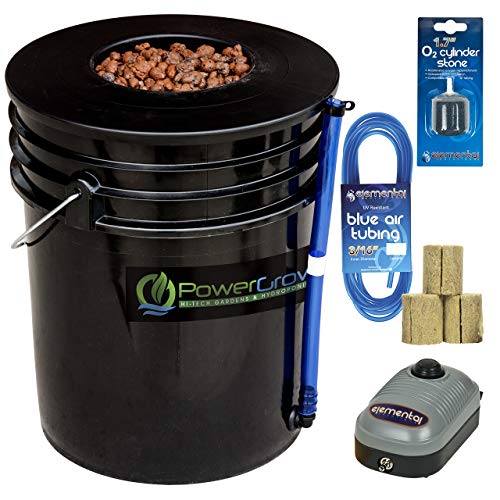 | 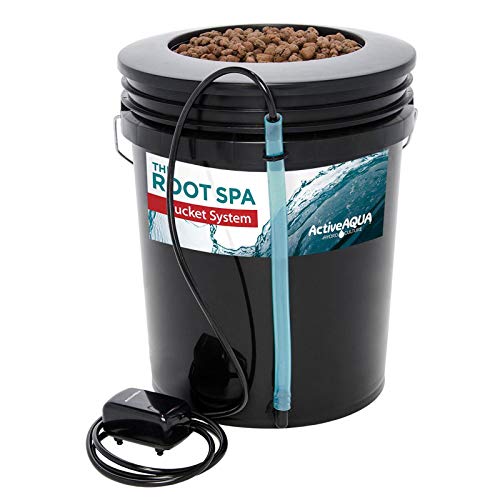 |
| What it is | 5 gallon DWC bucket kit with a 6 inch net pot lid | 5 gallon black DWC bucket system from Hydrofarm |
| Best for | One large plant, or a first bucket with parts matched for you | One large plant in an opaque bucket from an established hydroponics brand |
| Still to buy | Nutrients, pH kit, EC meter | Nutrients, pH kit, EC meter, growing medium |
| Price tier | $ | $ |
| Check price | Check price |
Easiest start
5 Gallon DWC Bucket Kit
- What it is
- 5 gallon DWC bucket kit with a 6 inch net pot lid
- Best for
- One large plant, or a first bucket with parts matched for you
- Still to buy
- Nutrients, pH kit, EC meter
- Price tier
- $
Hydrofarm Root Spa
- What it is
- 5 gallon black DWC bucket system from Hydrofarm
- Best for
- One large plant in an opaque bucket from an established hydroponics brand
- Still to buy
- Nutrients, pH kit, EC meter, growing medium
- Price tier
- $
DWC Problems and Solutions
| Symptom | Likely cause | First fix |
|---|---|---|
| Brown, slimy, smelly roots | Root rot after warm water or weak air | Cool the water, replace the solution, trim dead roots |
| Wilting with a full bucket | Roots short of oxygen | Clean the stone, add a stone or a larger pump |
| Green film on bucket or roots | Light reaching the solution | Seal lid gaps, paint or wrap the bucket |
| Pale or yellow new leaves | pH locking out nutrients | Bring pH back to 5.6 to 6.0, recheck EC |
| Burnt leaf tips | Solution too strong | Top up with plain water |
| Water in the air tube | Missing or reversed check valve | Fit one, arrow toward the stone |
When the Power Goes Off
Without air, oxygen runs down, faster in warm water. Where outages are common, a battery backup air pump is cheap insurance.
Algae and Biofilm
OSU recommends covering the water with opaque material sized to the reservoir, which cuts evaporation and algae. Scrub any slime off the wall and stone at the next change.
Aquaponics With Rafts: DWC With Fish
Deep water culture is also one of the main ways to grow plants in aquaponics: the water comes from a fish tank, where bacteria turn fish waste into nitrate, and plants float on rafts in a trough aerated for both roots and bacteria. Our guide to what aquaponics is explains how the cycle works, and aquaponics vs hydroponics compares the two approaches.
DWC Hydroponic System FAQ
DWC means deep water culture, a hydroponic method where plant roots hang directly in a container of nutrient solution. An air pump and air stone bubble oxygen through the water so the submerged roots can breathe. Plants sit in net pots in the lid or on a floating raft, with no soil and usually no water pump.
For a small home setup, DWC is usually better because its large volume of water buffers pH, nutrient strength and temperature, and roots stay wet if the power fails. NFT uses less water and scales well along walls and racks for many small plants, but it needs a water pump running constantly and leaves roots almost no reserve.
DWC depends on electricity for aeration, so a pump failure in warm water can starve roots of oxygen quickly. Buckets are heavy once full, warm solution invites Pythium root rot, and any light leak grows algae. You also need to check pH and EC every few days, and in recirculating setups one diseased bucket can infect the rest.
Leafy greens and herbs do best: Oregon State Extension lists lettuce, spinach, kale, basil, cilantro, mint and parsley as suited crops. They grow fast and are harvested before roots crowd the bucket. Tomatoes, peppers and cucumbers also work, one per bucket, while root crops such as carrots and potatoes are poor choices.
Yes, a single DWC bucket is one of the easiest active systems to start with. It needs one air pump, a few cheap parts and an afternoon to set up, and its generous water volume forgives small mistakes. Beginners should focus on three habits: keep the air running, keep the water cool and read pH and EC regularly.
Building it yourself is usually cheaper, especially for several buckets, because food grade pails, net pots and one multi outlet air pump can be shared across them. A kit costs more per bucket but arrives with a matched lid, pot and air line. Either way, nutrients, a pH kit and an EC meter are bought separately.
Related: build it from scratch in our DIY hydroponic system guide, try the no power Kratky method, or add fish with aquaponics.
Grow along with us
New guides and seasonal tips for fish, plants and DIY builds, about once a month.