Fish guide
Aquaponics Tilapia: How to Raise Tilapia in Your System
As an Amazon Associate we earn from qualifying purchases. How we choose products.
On this page
- Why Tilapia Are the Classic Aquaponics Fish
- Is It Legal to Raise Tilapia Where You Live?
- How Many Tilapia per Gallon?
- What Water Temperature Do Tilapia Need?
- Water Quality for Tilapia
- What to Feed Tilapia
- How Fast Do Tilapia Grow?
- Breeding Tilapia in Aquaponics
- Can You Grow Tilapia in an Aquarium?
- Is Home-Raised Tilapia Safe to Eat?
- Common Tilapia Problems and Fixes
- Aquaponics Tilapia FAQ
Tilapia are the easiest food fish for aquaponics, as long as you can keep the water warm. They grow best at 81 to 86°F (27 to 30°C), stop eating below about 63°F and start dying in the low 50s. For a beginner system, plan on no more than one pound of fish for every 6 gallons of water, which works out to about 40 harvest-size tilapia per 264 gallons (1,000 liters), and expect fingerlings to reach eating size in around six months in good conditions.
Those numbers come from the FAO manual Small-scale aquaponic food production, written for home and small-farm growers, cross-checked against US extension guides from Texas A&M, New Mexico State University and others linked below. One thing to settle before you order fish: tilapia are not native to the US, and several states regulate who can keep them. We cover that first, then stocking, temperature, feeding, breeding and the gear that keeps a tilapia tank healthy. If you are still choosing a species, start with our guide to the best fish for aquaponics.
Why Tilapia Are the Classic Aquaponics Fish
New Mexico State University’s guide H-170 calls tilapia the most common species in both home and commercial aquaponics, and Texas A&M AgriLife guide EHT-148, Aquaponics: Fish Species Selection ranks them in its top category, “Excellent”. The reasons are practical:
- They are tough. FAO describes tilapia as resistant to many pathogens, parasites and handling stress, and Texas A&M notes they survive a pH range of 5 to 10, low oxygen and high ammonia for short periods. That margin forgives the mistakes every new system makes.
- They grow fast. In ideal conditions FAO puts growth from a 50 g fingerling to a 500 g adult at about six months.
- They eat almost anything. Tilapia are omnivores, so they do well on ordinary floating pellets and can take some plant-based feeds such as duckweed.
- They are good to eat. A mild white fillet that most families already buy.
The downside is just as clear: tilapia are tropical fish. In most of the US you will heat the water for part of the year, and that heating bill, more than anything else, decides whether tilapia suit your setup.
Which Tilapia Species to Raise
FAO lists three main commercial species and their hybrids: Nile tilapia (Oreochromis niloticus), blue tilapia (O. aureus) and Mozambique tilapia (O. mossambicus). Texas A&M says Nile and blue are preferred because they reach the 1 pound market size that gives a restaurant-size fillet. Blue tilapia also handle cold better: the Texas A&M guide says they can tolerate 48°F, while many species, including Mozambique, start dying below 54°F. If you live somewhere cool and your state allows it, blue tilapia or a blue hybrid buys you a little safety margin.
Is It Legal to Raise Tilapia Where You Live?
This is the step most guides skip, and it is the one that can get you fined. Tilapia are a non-native species in the US, and each state decides whether you can import, keep, transport or sell them. Two examples from extension guides show how different the rules can be:
- Texas: Texas A&M says only three tilapia species are legal in Texas (Nile, blue and Mozambique), and that tilapia culture requires an exotic species permit from Texas Parks and Wildlife Department.
- New Mexico: NMSU’s guide H-170 says culture of tilapia or any non-native species is controlled by the New Mexico Department of Game and Fish, and an “Application for Importation of Exotic Species” must be accepted before you import or start growing them.
Other states have their own lists, and some do not restrict tilapia at all. We are not going to guess at the rules for your state: call or check the website of your state fish and wildlife agency (or your county extension office) before you order, and buy from a hatchery that is licensed to ship to your state. FAO adds one rule that applies everywhere: never release non-native fish into ponds, lakes or streams.
How Many Tilapia per Gallon?
Stocking density is a weight, not a head count. FAO recommends 10 to 20 kg of fish per 1,000 liters of tank water and strongly advises beginners not to go above 20 kg, especially where the power supply is not guaranteed, because at high densities a short outage can kill every fish within an hour. In US units, 20 kg per 1,000 liters is about 44 lb per 264 gallons, or roughly 1 lb of fish per 6 gallons.
Two adjustments from the same manual matter for small setups. For tanks under 500 liters (about 132 gallons), FAO halves the rate to 1 kg per 100 liters. And it does not recommend growing fish for eating in a tank smaller than 500 liters at all. We applied those rules to common tank sizes, counting harvest-size tilapia at 500 g (1.1 lb), the reference weight FAO uses:
| Fish tank | Liters | FAO maximum fish weight | Harvest-size tilapia (about) |
|---|---|---|---|
| 100 gallons | 379 | 3.8 kg (8 lb), half rate | 7, but FAO advises against food fish below 132 gal |
| 150 gallons | 568 | 11.4 kg (25 lb) | 22 |
| 200 gallons | 757 | 15.1 kg (33 lb) | 30 |
| 275 gallon IBC tote | 1,041 | 20.8 kg (46 lb) | 41 |
| 300 gallons | 1,136 | 22.7 kg (50 lb) | 45 |
| 500 gallons | 1,893 | 37.9 kg (83 lb) | 75 |
| 1,000 gallons | 3,785 | 75.7 kg (167 lb) | 150 |
FAO’s own worked example agrees: a 1,000 liter tank holding 10 to 20 kg of fish is “about 40 harvest-size tilapia”.
Why Commercial Farms Stock More
You will see much higher numbers online. Texas A&M says tilapia tolerate up to 3/4 pound per gallon at high aeration rates, more than four times the FAO beginner ceiling. Farms reach those densities with heavy aeration, solids filtration, backup power and daily testing. In a backyard system, staying near FAO’s number is what keeps a pump failure from turning into a fish kill.
Count Fish at Harvest Weight, Not at Stocking
Fingerlings weigh a few ounces, so a new tank looks empty. Work backwards from the harvest weight: if your tank’s ceiling is 45 fish at 1.1 lb, buy no more than that, and fewer if some will grow larger. FAO also recommends stocking lightly while a system is young and suggests staggered stocking, adding a new batch of fingerlings every few months and harvesting the biggest fish, so the total weight in the tank stays steady.
Match the Fish to Your Grow Beds
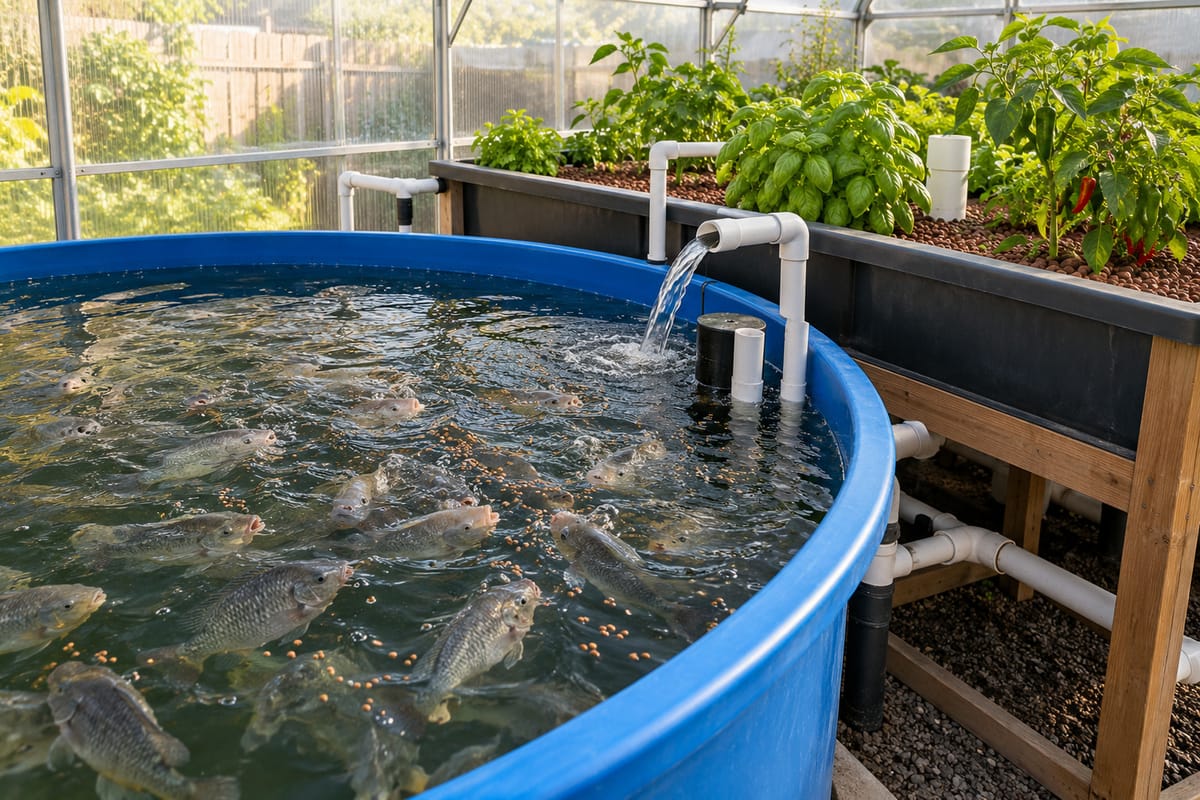
The fish feed is what fertilizes the plants, so the two have to be in balance. FAO’s feed rate ratio is 40 to 50 g of fish feed per day for each square meter of leafy greens and 50 to 80 g for fruiting crops. Fish eat about 1 to 2% of their body weight a day, so 20 kg of tilapia eating 1% (200 g of feed) supports about 4 to 5 square meters, or 43 to 54 square feet, of lettuce and herbs. Too little bed for the fish and nitrate builds up; too much and the plants go hungry. Our grow bed guide covers sizing and depth.
What Water Temperature Do Tilapia Need?
Temperature is the single biggest factor in raising tilapia. The sources agree on the shape of the curve and differ by a few degrees at the cold end:
| Water temperature | What happens | Source |
|---|---|---|
| 81 to 86°F (27 to 30°C) | Ideal range for good growth | FAO; NMSU gives 81 to 85°F for maximum growth |
| Below 70°F | Growth slows dramatically, breeding stops, disease becomes more likely | NMSU Circular 680 |
| Below about 63°F (17°C) | Tilapia stop feeding and growing | FAO; Texas A&M |
| 57°F (14°C) | Tolerated only briefly, for a few days | FAO; Texas A&M |
| About 50 to 54°F (10 to 12°C) | Most tilapia die; blue tilapia are reported to tolerate 48°F | FAO (12°C), NMSU (50°F), Texas A&M (54°F, blue 48°F) |
| Up to 97°F (36°C) | Upper extreme, tolerated briefly | FAO |
In practice: treat anything in the 60s as a warning, not a resting state. A tank that drifts down to 65°F overnight is still alive, but the fish are not growing and their immune system is slower.
How to Keep a Tilapia Tank Warm
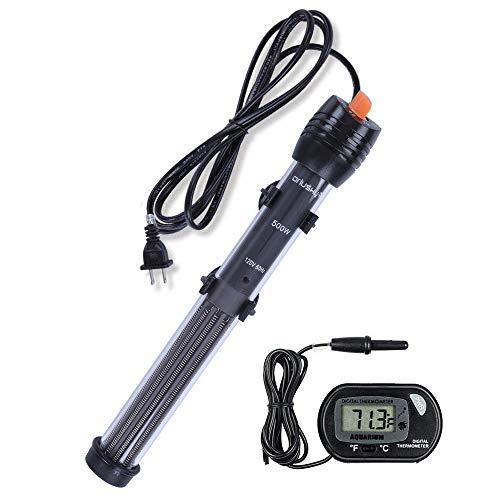
- Submersible heaters are the simplest option indoors. Check the maker’s size chart: Orlushy, for example, rates its 500 W heater for 40 to 75 gallon aquariums, so a 200 gallon tilapia tank needs several heaters or a different heat source.
- Insulate and cover the tank. Most heat is lost from the surface and the walls. A lid, foam board around the tank and a spot away from drafts cut the load.
- Put the system where it is already warm: a basement, a heated garage or a greenhouse.
- Change species with the seasons. FAO suggests a cool-climate alternative: raise tilapia in the warm months and switch to carp or trout for winter.
A Note on Plants and Warm Water
Warm water suits tilapia better than it suits lettuce. FAO says leafy greens grow best in cooler conditions and bolt at 26°C (79°F) and above. With a tilapia tank at 82°F, lean on warm-season crops such as basil, peppers, tomatoes and cucumbers, and grow lettuce in the cooler months. Our list of the best plants for aquaponics sorts them by temperature and nutrient demand.
Water Quality for Tilapia
Tilapia tolerate more than other fish, but the plants and bacteria in your system do not, so you run the water for the whole system. FAO publishes both: what tilapia can take, and the compromise range for a whole aquaponics unit.
| Parameter | Nile tilapia (FAO Table 7.1) | Whole aquaponics system (FAO Table 3.2) |
|---|---|---|
| Temperature | 27 to 30°C optimal (81 to 86°F) | 18 to 30°C (64 to 86°F) |
| Total ammonia nitrogen | Below 2 mg/L | Below 1 mg/L |
| Nitrite | Below 1 mg/L | Below 1 mg/L |
| Dissolved oxygen | Above 4 mg/L | Above 5 mg/L |
| pH | 5 to 10 survivable (Texas A&M) | 6 to 7 |
One milligram per liter is the same as one ppm, the unit on hobby test kits. New Mexico State University Circular 680 sets the practical pH window a little wider, 6.4 to 7.4, and recommends testing a new system daily, then weekly once it is stable. FAO warns that a pH swing of 0.3 within 12 to 24 hours can be a problem for fish, so correct slowly. If the system is new, read our guide to fishless cycling before any tilapia go in: the bacteria that turn ammonia into nitrate need three to six weeks to establish.
Oxygen and Aeration
FAO’s rule of thumb is 5 to 8 liters of air per minute for each cubic meter of water, from at least two air stones in different parts of the tank. The clearest warning sign is fish gulping at the surface, which FAO calls piping and treats as an emergency. A battery backup for the air pump is cheap insurance.
What to Feed Tilapia
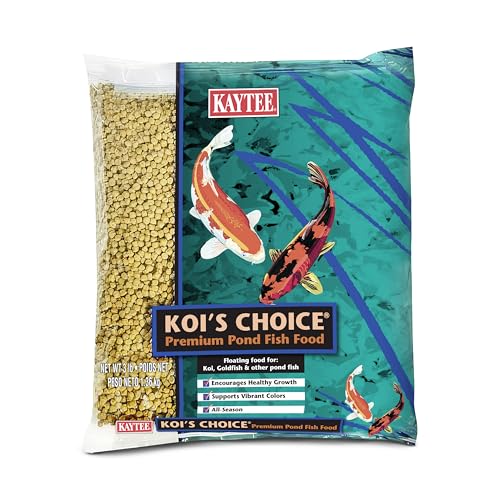
FAO lists a crude protein requirement of 28 to 32% for Nile tilapia, and Texas A&M says tilapia do well on 26 to 32% protein with 4 to 6% fat. A floating pellet is easiest, because you can see how much the fish actually eat. Kaytee’s Koi’s Choice, which its maker lists at 35% protein with fish meal as the first ingredient, is a widely sold floating pellet that sits close to that range; fry and small fingerlings need a smaller crumble.
How Much to Feed
FAO’s guide is 1 to 2% of body weight per day, with 1% for fish over 100 g. Spread it over two or three feedings and scoop out whatever floats untouched, because uneaten feed rots into ammonia. Feed less when the water cools: below about 63°F tilapia stop feeding anyway.
Supplementing With Duckweed and Greens
FAO notes that tilapia have been fed duckweed, Azolla, moringa and other high-protein plants, but warns that the diet must stay nutritionally complete. Treat home-grown greens as a supplement to pellets, not a replacement.
How Fast Do Tilapia Grow?
FAO’s growth table for Nile tilapia gives 600 g (about 1.3 lb) in 6 to 8 months during grow-out, and Texas A&M puts harvest at 6 to 8 months, with the potential for two harvests a year when temperature is managed. Both assume warm water the whole time. A tank that spends months in the 60s will take much longer.
Texas A&M gives 1 to 1.25 lb as the usual market size. For home use, many growers start harvesting the largest fish once they reach a pound and leave the rest to grow, which also keeps the tank weight under control.
Breeding Tilapia in Aquaponics
Tilapia breed readily, which is a gift and a problem. FAO says they spawn most easily in warm, oxygenated, shaded and quiet water, and that two males paired with six to ten females is a common ratio to start spawning. Most species are mouthbrooders: the female carries eggs and fry in her mouth, and Texas A&M notes she cannot feed properly while she does, which costs growth.
- Separate sizes. FAO says tilapia under 15 cm (6 inches) eat smaller fish, including their own young, so move fry to their own tank.
- All-male grow-out. Males grow larger and faster. Farms produce them with hormone-treated feed, a method FAO says is widely used in Asia and the Americas but not in Europe, or by hand-sexing fingerlings from about 40 g by looking at the genital papilla.
- Mixed-sex is fine for a home system. FAO says mixed groups can be raised until they mature at about five months; harvest the females first, from 200 g, and let the males keep growing.
If you breed your own, the rules on possession and transport in your state still apply to every fish you hatch.
Can You Grow Tilapia in an Aquarium?
You can keep a few small tilapia in a large aquarium, but you will not grow much food. FAO does not recommend growing fish for eating in tanks under 500 liters (132 gallons), and a typical 55 gallon aquarium would hold only a handful of harvest-size fish at its reduced rate. For a living-room setup, ornamental fish such as goldfish or guppies make more sense; see our guide to the aquaponics fish tank for small systems that work.
Is Home-Raised Tilapia Safe to Eat?
Tilapia is on the FDA and EPA “Best Choices” list in their advice about eating fish, the lowest-mercury group. The “don’t eat tilapia” warnings that circulate online are generally about how some imported tilapia are farmed, not about the fish itself. In your own system you control the feed and the water. One trade-off worth knowing: Texas A&M points out that most medications cannot be used in aquaponics because they would harm the plants or end up in your food, so prevention through good water quality is the whole strategy.
What you need for a tilapia tank
Fish food, heat, oxygen and a way to read the water. Everything else is the tank and grow beds you already planned.
-
1Floating pellets
Kaytee Koi's Choice Floating Fish Food
Listed at 35% protein with fish meal first, close to the 28 to 32% FAO gives for Nile tilapia; floating, so you see what gets eaten.
-
2Heater
Orlushy 500W Submersible Aquarium Heater
Adjustable from 68 to 89°F per the listing, which covers the 81 to 86°F tilapia range; the maker rates one unit for 40 to 75 gallons.
-
3Air pump
Pawfly 254 GPH Aquarium Air Pump
A multi-outlet pump the maker rates for ponds up to 300 gallons, so you can run two or more air stones as FAO recommends.
-
4Water test kit
API Freshwater Master Test Kit
Tests pH, high-range pH, ammonia, nitrite and nitrate, the five readings you track in a tilapia system.
-
5Dechlorinator
Removes chlorine and chloramine from tap water, which NMSU says must be removed before municipal water goes into the system.


Common Tilapia Problems and Fixes
- Fish stop eating: check the temperature first. Below about 63°F, that is normal tilapia behavior, not illness.
- Fighting and torn fins: FAO notes males are territorial and can be aggressive at low densities. A few more fish, or removing the bully, usually settles it.
- Gasping at the surface: low oxygen. Add air stones, check the pump, and feed less until it is fixed.
- Ammonia or nitrite above 1 ppm: stop feeding for a day, do a partial water change with dechlorinated water, and check that the biofilter and pump are working.
- pH creeping down: nitrification acidifies the water over time. NMSU suggests alternating calcium hydroxide and potassium hydroxide in small doses to bring it back toward 7.
- Fry everywhere: your tilapia are mature and comfortable. Harvest the largest fish or separate the sexes.
Planning the rest of the system? See how to build an aquaponics system, size your aquaponics pump, or compare ready-made aquaponics kits.
Aquaponics Tilapia FAQ
Grow along with us
New guides and seasonal tips for fish, plants and DIY builds, about once a month.