Planning
How Much Does an Aquaponics System Cost? The Numbers Behind a Home Build
As an Amazon Associate we earn from qualifying purchases. How we choose products.
On this page
The honest answer to how much an aquaponics system costs is: a few hundred dollars in parts for a single IBC tote build, and then a small but permanent monthly bill for power, feed and water. The two best published budgets agree on the scale. The University of Maryland Extension prices its one-tote system at 405.35 dollars in materials at 2023 prices, and FAO puts its small media bed unit at 700 dollars to build and about 26 dollars a month to run.
This guide takes both lists apart line by line, converts the running costs to current US electricity prices, and shows the extras that neither list includes but most first systems end up buying. Every figure below is named to its source. Where we did the arithmetic ourselves, we say so and show the inputs, so you can redo it with your own prices.
How Much Does an Aquaponics System Cost? The Short Answer
Cost scales with three things: the volume of the fish tank, the area of grow bed, and whether you buy parts new or reuse them. A desk kit on an aquarium sits in the budget tier ($ to $$) and grows a tray of herbs. A food-producing backyard system starts around the size of one IBC tote and costs hundreds, not tens. A greenhouse system with heating runs into thousands before the first fish goes in.
| System | Fish tank | Grow area | Build cost | Source |
|---|---|---|---|---|
| Desktop aquarium kit | 1 to 10 gallons | A tray | Budget tier ($ to $$) | Our kit comparison |
| One-tote DIY system | About 250 gallons | The cut top of the same tote | 405.35 dollars (2023) | University of Maryland Extension |
| Small media bed unit | 1,000 liters (about 264 gallons) | 3 m² (about 32 sq ft) | 700 dollars | FAO Fisheries and Aquaculture Technical Paper 589 |
| Greenhouse or heated system | Hundreds of gallons | Whole beds | Thousands | See our greenhouse guide |
The two published systems are close in size, so the gap between them is mostly about what each list counts. We come back to that below.
Start-Up Costs, Line by Line: the UMD One-Tote System
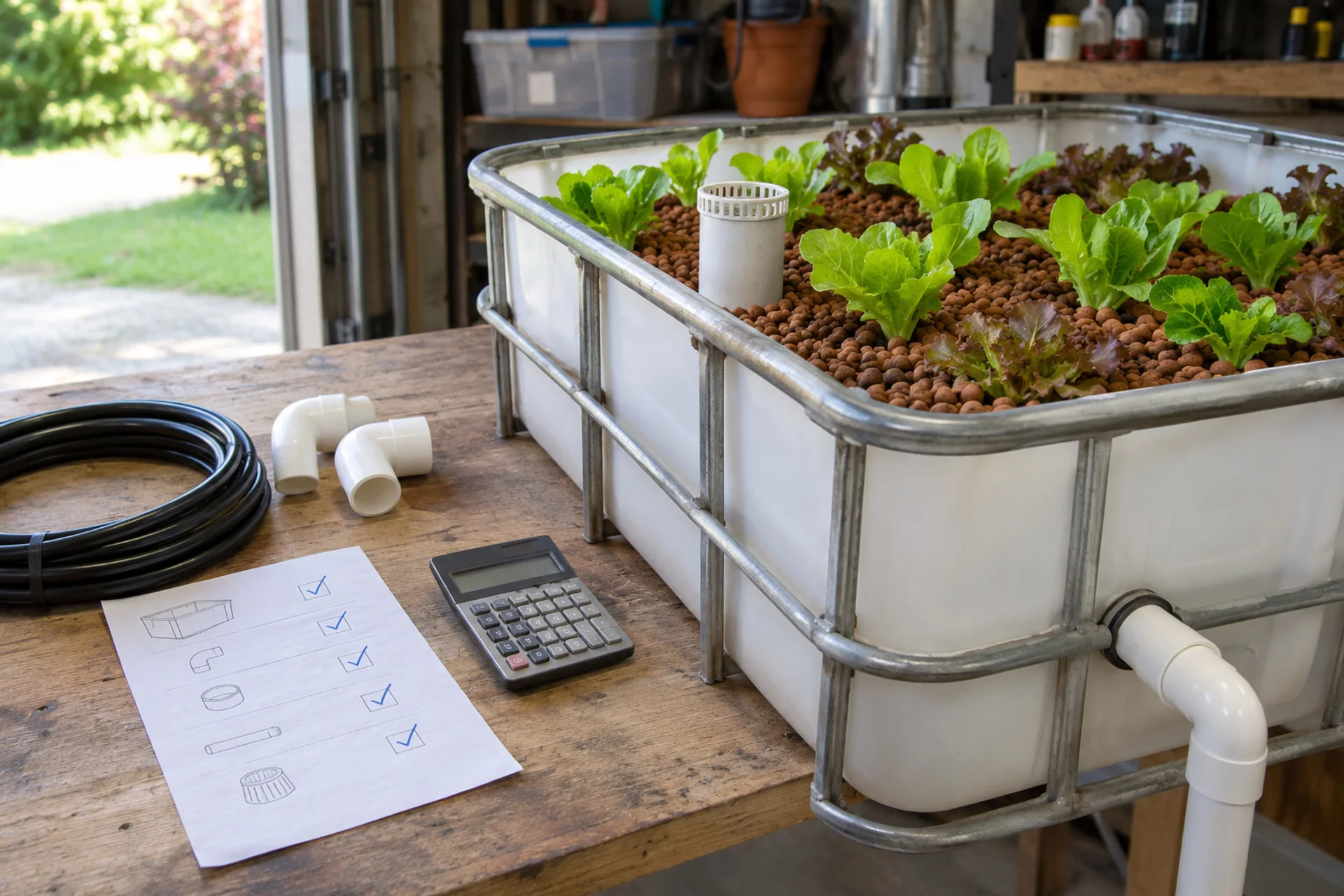
The University of Maryland Extension publication EM-2023-0698 (Franchini, Izursa and Little, October 2024) builds the whole system from one repurposed 275 gallon food-grade IBC. The tank holds about 250 gallons and the grow bed is the top section of the same tote, cut about 12 inches from the top. UMD lists its prices as approximate and 2023 values.
| Part | Qty | Line total (USD, 2023) | Share of total |
|---|---|---|---|
| Grow media: Hydroton clay pebbles, 50 liter bag | 4 | 149.44 | 37% |
| Biofilter kit (pump, bio balls, sponges, tubing) | 1 | 75.67 | 19% |
| Air pump | 1 | 74.60 | 18% |
| Repurposed 275 gallon food-grade IBC | 1 | 65.00 | 16% |
| PVC pipe, elbows, fittings and caps | 14 pieces | 26.64 | 7% |
| Treated 2x4 lumber, 5 ft | 2 | 10.00 | 2% |
| Air stone and 4 ft of air tubing | 2 | 9.00 | 2% |
| Stones for weight | 2 | 0.00 | 0% |
| Total as stated by UMD | 405.35 |
The shares are our arithmetic on UMD's table. One detail if you check the sums yourself: UMD's own line items add up to 409.35, four dollars more than the total the publication prints. The difference does not change any conclusion.
The Tank Is the Cheap Part
A used IBC is the reason this system is affordable. UMD paid 65 dollars for one, and it serves as both the fish tank and, once cut, the grow bed. FAO notes in its manual that fish tanks can account for up to 20 percent of the cost of an aquaponic unit, and a reused tote is one of the easiest ways to push that share down. Make sure it held food-grade contents, and read our IBC aquaponics guide before you buy one.
The Grow Media Is the Expensive Part
Four 50 liter bags of expanded clay are the largest single line, at 149.44 dollars. FAO describes light expanded clay aggregate as very comfortable to work with but relatively expensive. Volcanic gravel is FAO's other main recommendation and is usually cheaper where it is sold locally, but it is heavier. Our clay pebbles guide shows how to work out how many liters a bed needs before you buy.
Pump and Air: Two Lines You Cannot Skip
The biofilter kit includes a 400 gallon per hour water pump, and the air pump and stone add oxygen. Together they are about 37 percent of the budget. Do not save money here: the fish die quickly without moving, oxygenated water. Our aquaponics pump guide covers sizing by flow and head height.
The FAO Small Media Bed Unit: 700 Dollars
FAO's manual, Small-scale aquaponic food production (Somerville and colleagues, Fisheries and Aquaculture Technical Paper 589, 2014), prices the media bed unit it teaches throughout the book: a 1,000 liter fish tank with 3 square meters of growing space. Its Table A7.1 groups the costs like this:
| Item | USD |
|---|---|
| IBC tanks | 200 |
| Electrical equipment: water pump, air pump and connections | 120 |
| Volcanic gravel (biofiltration medium) | 120 |
| Miscellaneous: fish net, plumber's tape, shading material and so on | 100 |
| Media bed support: concrete blocks and wood planks | 80 |
| Plumbing: pipe, fittings and connections | 80 |
| Total | 700 |
FAO says plainly that these figures are guidelines for new users, and its running-cost prices were set for Israel. Treat the structure as the useful part: tanks, power, media, plumbing and a support frame are the five buckets every build fills.
Why the Two Totals Differ
The FAO unit uses more than one IBC, a separate grow bed on a block and plank stand, and a miscellaneous line for nets, tape and shade cloth. The UMD system squeezes tank and bed out of a single tote and lists only what it bought. Neither includes fish, seeds, a heater, a test kit or a greenhouse, so both are a floor, not a ceiling.
Cost per Square Foot of Grow Bed
Divide build cost by grow area and the two systems land in the same range. FAO's 700 dollars over about 32 square feet is roughly 22 dollars per square foot. The UMD bed is the top of a 48 by 40 inch tote, a little over 13 square feet, which puts its 405 dollars at about 30 dollars per square foot. Both are our arithmetic. Smaller systems cost more per square foot, because the pump, air pump and plumbing do not shrink with the bed.
Two purchases worth budgeting from day one
Neither published parts list includes a way to read the water, and the media is the line most people underestimate.
-
1Water test kit
API Freshwater Master Test Kit
Reads pH, ammonia, nitrite and nitrate, the four numbers that tell you whether the system is cycling. Missing from both budgets above.
-
2Grow media
Mother Earth Hydroton Original, 50 Liter
The same 50 liter bag size UMD bought four of. Count the liters your bed needs before ordering.


Monthly Running Costs
Build cost is paid once. Running cost is paid every month the fish are alive, and it is where home systems quietly get expensive. FAO's Table A7.2 is the clearest published budget for a small unit:
| Input | Per month | FAO total (USD) |
|---|---|---|
| Fish feed | 4.5 kg | 11.25 |
| Fingerlings | 5 fish | 5.00 |
| Seedlings | 35 | 3.50 |
| Electricity | 25 kWh | 2.50 |
| Water | 450 liters | 1.20 |
| Total | 26.45 |
FAO priced each input in Israel and tells readers to replace the unit prices with local ones. Here is how each line behaves in a US home.
Electricity
FAO's unit needs a pump moving 2,000 liters an hour at 1.5 meters of head, and it says a submersible pump of that size draws 25 to 50 watts. Running all day, every day, that is 18 to 36 kWh a month. The US Energy Information Administration put the average residential price at 18.16 cents per kWh in August 2026, so the pump alone costs roughly 3.30 to 6.50 dollars a month, and FAO's 25 kWh total comes to about 4.50 dollars. Your own rate is on your power bill; multiply it by the watts on your pump and air pump.
Fish Feed
Feed is the largest line in FAO's budget. Its unit is fed 150 grams a day, which is 4.5 kg a month, and FAO sizes that amount to the grow bed rather than to the number of fish. Price your own bag of a 32 percent protein pellet and multiply. Our grow bed guide explains how the feed rate links fish to bed area.
Fingerlings and Seedlings
FAO's model harvests about 60 fish of 500 grams a year, so it restocks about 5 fingerlings a month, plus 35 seedlings for a bed that is half leafy greens and half fruiting plants. Raising your own seedlings cuts the second line to the cost of seed.
Water
Water is cheap but not free. UMD estimates that about 10 percent of the water is lost to evaporation every week, so its 250 gallon tank needs roughly 25 gallons of dechlorinated top-up weekly in warm weather. FAO budgets 450 liters a month for its unit.
What You Get Back
FAO also models the harvest. For its established unit it expects 360 heads of lettuce, 54 kg of tomatoes and 30 kg of fish a year, which it values at 758.40 dollars at Israeli market prices from 2013. Take away the yearly running cost of 317.40 dollars and FAO reports a net return of 441 dollars a year, which pays back the 700 dollar build in 19 months.
Why Your First Year Will Look Worse
FAO warns that these figures assume staggered production in an established system. A new system stocked with young fish of the same age produces less, and FAO suggests the first fish harvest can start only from the third or fourth month. Add the time spent cycling the system before fish arrive and a first-year budget will show more cost than harvest.
What Makes the Numbers Better
FAO lists three levers: reduce the build cost with recycled tanks, reduce the running cost by supplementing fish feed, or increase the value of what you grow. In a home system the third lever is the easiest. Basil, salad leaves and herbs replace expensive supermarket purchases, while a tank of goldfish feeds the plants without ever reaching the table. Our list of the best plants for aquaponics is a good place to choose.
Hidden Costs Most Budgets Miss
The published lists are honest about what they include. These are the lines we see missing most often in first budgets.
Water Testing
A liquid test kit for ammonia, nitrite, nitrate and pH is not optional during cycling. See our pick of the best water test kits.
Backup Air and Safe Power
A power cut stops the pump and the air at the same time. A battery-backed air pump is cheap insurance for the fish, and every outlet near the water should be ground-fault protected.
Fish, Permits and Delivery
Fish are not in either build cost. Some species, tilapia among them, are regulated by state, and buying from a licensed hatchery can add delivery charges. Check which fish suit your system before you price them.
Shelter and Season
Outdoors, shade cloth and covers keep algae and heat down in summer, and a cold winter means a greenhouse, insulation or a pause. Our backyard aquaponics guide walks through the season-by-season extras.
Kit or DIY: Which Costs Less?
UMD says building it yourself may save money compared with turnkey systems, and it lets you learn on a small setup before investing in a larger one. A kit costs more per gallon of tank but saves sourcing time and comes with parts that are already matched. The deciding number is not the headline price but the cost per gallon of fish tank and per square foot of grow bed, because those two set how much food the system can grow. Compare ready-made options in our aquaponics kits guide, and the build steps in how to build an aquaponics system.
Where Most Builds Overspend
The common mistake is buying a pump, tank and bed that do not match each other: a tank too big for the bed, a bed too big for the feed, or a pump sized for a tank you do not own. Each mismatch means a second purchase. Sizing on paper first costs nothing and prevents most of it.
Aquaponics Cost FAQ
Next steps: build an aquaponics system, IBC aquaponics, grow bed sizing and the pros and cons of aquaponics.
Grow along with us
New guides and seasonal tips for fish, plants and DIY builds, about once a month.