Fish feed guide
Duckweed: What It Is, How to Grow It, and Whether to Feed It to Your Fish
As an Amazon Associate we earn from qualifying purchases. How we choose products.
On this page
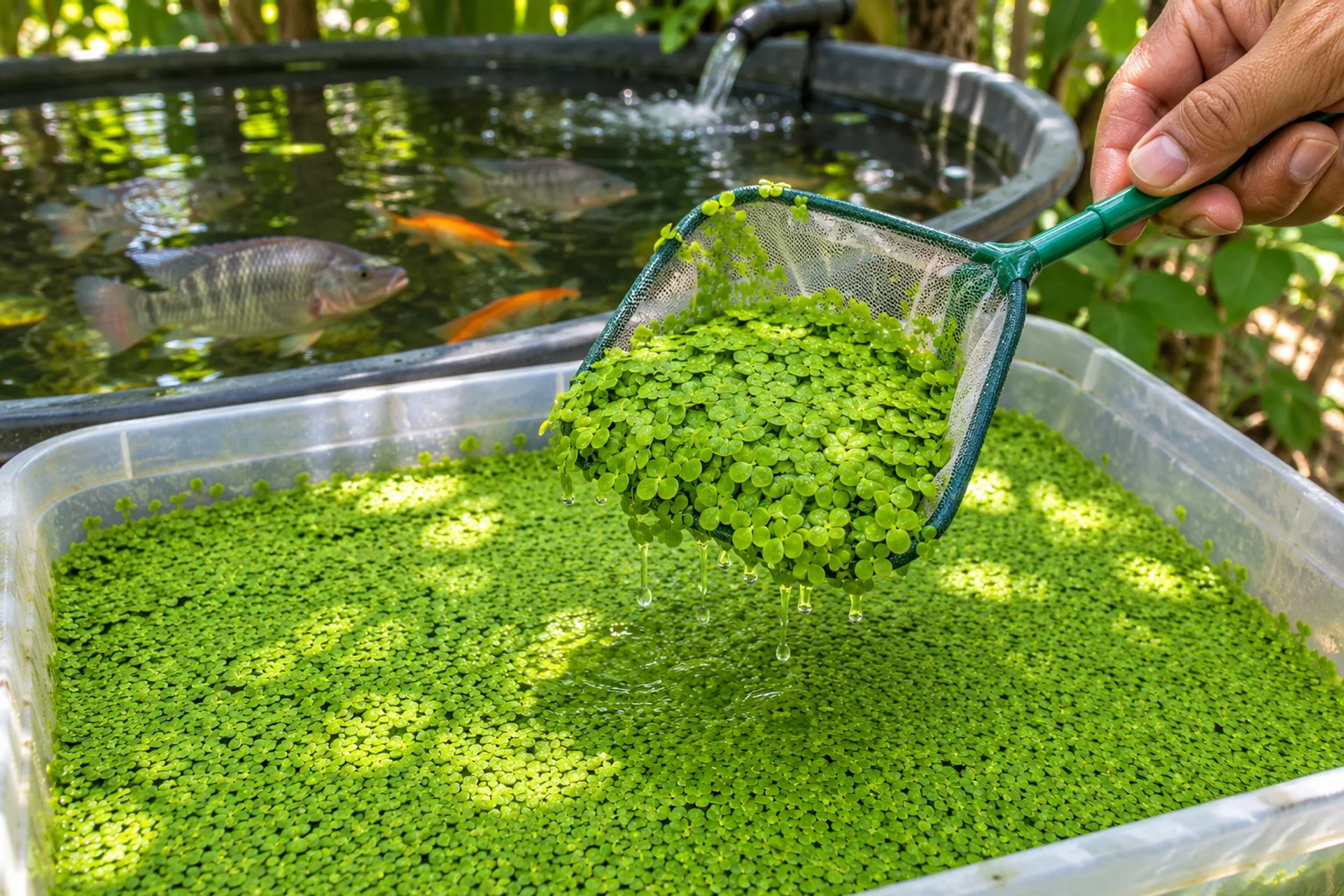
Duckweed is the smallest flowering plant most people will ever see: a floating green leaf a few millimeters across, often with a single root hanging underneath, that multiplies until it covers still water like a green carpet. Common duckweed is Lemna minor; giant duckweed is Spirodela polyrhiza; the related watermeal, Wolffia, is smaller still. Pond owners usually meet duckweed as a weed. Aquaponics growers and backyard fish keepers increasingly grow it on purpose, because it turns spare nutrients into a protein-rich green feed that tilapia, koi and goldfish will eat.
Both views are right. This guide covers what the research says about how fast duckweed grows and how much protein it holds, how to grow a steady supply in a tub, how much of a fish's diet it can replace, and how to keep it from smothering a pond or aquarium. The figures come from a review by R. A. Leng and colleagues in Livestock Research for Rural Development (1995), a 2008 tilapia feeding trial from Brazil, and Texas A&M AgriLife's AquaPlant guide.
What Is Duckweed?
Duckweeds are a family of tiny floating aquatic plants. Each plant is a flat oval frond, which works as both leaf and stem, usually with one or more small roots below. Texas A&M AgriLife's AquaPlant describes the leaves as round or egg-shaped, in clusters of two to five or more. Duckweed rarely flowers; it spreads by budding new fronds from the old ones, which is why one plant becomes a mat so quickly.
Common Types
| Name | Latin name | What to know |
|---|---|---|
| Common duckweed | Lemna minor | The one sold for aquariums and feed; small round fronds |
| Giant duckweed | Spirodela polyrhiza | Larger fronds with several roots and a red underside |
| Watermeal | Wolffia species | Rootless and grain-sized; often mixed in with Lemna |
Is Duckweed Bad or Good?
It depends where it is. In a fish pond with nothing to stop it, duckweed can cover the whole surface, block light to submerged plants and, as AquaPlant puts it, cause oxygen depletion and fish kills. In a tub where you harvest it, the same habit makes it one of the most productive plants there is, and it soaks up nutrients that would otherwise feed algae. The rule is simple: grow it where you control it, and keep it out of water you cannot rake.
How Fast Does Duckweed Grow?
Fast enough that the numbers are hard to believe. In their review Duckweed: a potential high-protein feed resource for domestic animals and fish, Leng, Stambolie and Bell write that duckweeds can double their mass in between 16 hours and 2 days under optimal nutrient availability. Managed well, they put yields at 10 to 30 tons of dry matter per hectare per year, and closer to 10 to 20 tons under real-world conditions.
What Controls the Growth Rate
- Nutrients. The review says ammonium is the nitrogen source duckweed prefers, which is exactly what fish excrete.
- Temperature. Duckweeds grow at water temperatures between 6 and 33°C (about 43 to 91°F), according to the same review.
- pH. They survive from pH 5 to 9 but grow best between 6.5 and 7.5, which overlaps the range most aquaponic systems run at.
- Density. Too crowded and growth stops; too thin and algae take over. More on this under harvesting.
- Still water. AquaPlant notes duckweed is most invasive in quiet, nutrient-rich waters. Strong current or splashing breaks up the mat.
How to Grow Duckweed
Growing duckweed takes a shallow container, a nutrient source, light and regular harvesting.
Pick a Container
Duckweed grows on the surface, so surface area matters and depth does not. A plastic storage tub, a kiddie pool, a stock tank or a spare grow bed lined to hold water all work. Six to twelve inches of water is plenty and keeps the temperature steadier than a few inches would.
Feed the Water
The easiest feed is fish water. Top the tub up with water from your fish tank or aquaponics sump, or run a small trickle of it through the tub, and the ammonium and nitrate the fish produce become duckweed. Without fish, a weak hydroponic nutrient solution works. Keep it weak: duckweed on rich water grows faster and holds more protein, but a sudden overdose clouds the water with algae.
Light and Shelter
Outdoors, partial sun is ideal, with some shade in the hottest part of a summer day so the water stays below the low 90s °F. Indoors, a shop light or a grow light over a tub works through the winter. Keep the surface still: no airstone bubbling right under the mat and no strong spray from a return line.
Seed It and Wait
Start with a cup or two of duckweed from a clean source, ideally one sold for aquariums, and spread it over the surface. Inspect it first: sellers such as South Shore Retail say live duckweed is not guaranteed snail-free and recommend quarantine before it goes near an established aquarium. Within a week or two the fronds should be visibly multiplying.
A Duckweed Tub for Fish Feed, Step by Step
-
Set up a shallow tub
Use a tub with as much surface area as you can spare, 6 to 12 inches deep, in partial sun or under a light.
-
Fill it with fish water
Use water from your fish tank or sump, or a weak hydroponic nutrient mix. Check that pH is roughly 6.5 to 7.5.
-
Add a starter portion
Spread a cup or two of rinsed, inspected duckweed over the surface. Keep fish out of this tub.
-
Top up with fish water weekly
Replace evaporation with tank water so the nutrients keep coming, and skim out any dead leaves or debris.
-
Harvest to hold density
Once the surface is covered, scoop off the excess with a fine net so a single full layer remains.
-
Feed it fresh
Rinse and drop the harvest into the fish tank, in an amount the fish clear within a few hours.
Harvesting Duckweed
Harvesting is what keeps duckweed productive. Leng and colleagues suggest harvesting to maintain approximately 1 kg of fresh duckweed per square meter, about 0.2 pounds per square foot, which in practice looks like one complete, unbroken green layer. They describe the upper limit as the density at which crowding limits growth, and the lower limit, below about 0.6 kg per square meter, as the point where growth is no longer enough to prevent algal blooms.
How Often
In warm weather with plenty of nutrients, every day or two. When the fronds start piling on top of each other, you are behind. When patches of open water appear, harvest less.
Fresh or Dried
Fresh duckweed is mostly water, so a big net-full is a small meal by dry weight. You can feed it fresh, or spread it thin in the sun to dry for storage. The 2008 tilapia trial below used dried duckweed.
Duckweed as Fish Feed
How Much Protein Duckweed Has
Protein is the reason anyone grows duckweed for feed, and it varies with the water. Leng and colleagues report that duckweed in an effectively managed system contains up to 43% crude protein on a dry matter basis, while a wild colony growing on nutrient-poor water typically holds 15 to 25%. In other words, duckweed fed on rich fish water is a much better feed than duckweed raked off a clean pond.
How Much of the Diet It Can Replace
The best direct test for backyard growers is a 2008 trial on Nile tilapia fingerlings by Tavares and colleagues at the Federal University of Santa Catarina, published in Biotemas. Over 50 days, fish fed a 50/50 mix of dried duckweed and a 40% crude protein commercial feed grew as well as fish on commercial feed alone. Fish fed only duckweed had the lowest weight gain and growth rate. The authors concluded that duckweed can replace up to half of the commercial feed for at least 50 days without reducing growth.
Leng's review goes further and says duckweed may be used without processing as a complete feed for fish, but the controlled trial is the safer guide for a home system: treat duckweed as a way to cut the pellet bill, not to replace pellets.
Which Fish Eat Duckweed
| Fish or animal | Eats duckweed? | Source |
|---|---|---|
| Tilapia | Yes, readily | Texas A&M AquaPlant; Tavares et al. 2008 |
| Koi and goldfish | Yes, and can eat a starter portion quickly | South Shore Retail listing |
| Ducks | Yes, but seldom control it | Texas A&M AquaPlant |
Tilapia are the classic duckweed eaters, and our aquaponics tilapia guide covers them in detail. Koi and goldfish graze it eagerly too, which is why the duckweed tub needs to be separate from the fish. Carnivores such as trout and bass are not duckweed eaters; see the best fish for aquaponics for what each species eats.
How Much to Feed
Start with what the fish clear in a few hours and cut the pellet ration by a similar share, watching growth and water quality. Uneaten duckweed in the tank is harmless at first but rots if it sinks. In an aquaponic system, remember that the feed is what feeds the plants: replacing pellets with duckweed grown on the same water mostly recycles nutrients, so it does not reduce what the grow beds receive the way simply feeding less would.
Starting a Duckweed Supply
A starter culture, the pellets duckweed supplements rather than replaces, and air for the fish tank.
-
1Starter culture
South Shore Retail Duckweed (Lemna minor), 1,200 Plants
Live Lemna minor, not seeds; the seller advises inspecting and quarantining before it joins an aquarium.
-
2Base feed
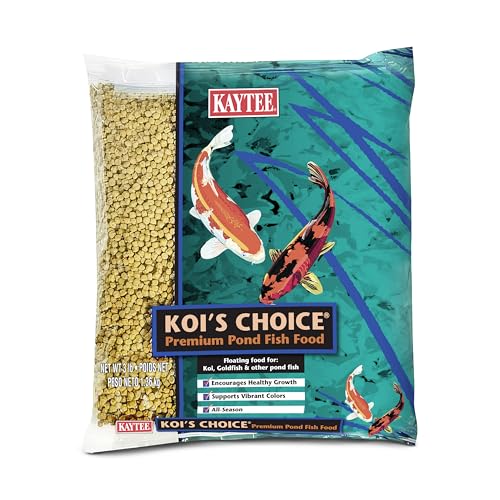
Kaytee Koi's Choice Floating Fish Food
A floating pellet for koi, goldfish and pond fish, to keep as the main ration while duckweed tops it up.
-
3Aeration
Duckweed on a fish tank cuts gas exchange at the surface, so keep an air stone running in the fish tank.


Duckweed in Aquaponics
Grow It on the Side, Not in the System
Duckweed loves fish water, so it is tempting to let it grow on the fish tank or sump. Do not. Fronds get pulled into pumps, clog bell siphons and standpipes, and a full mat on the fish tank cuts the oxygen exchange the fish depend on. Grow it in a separate tub topped up with system water, or in a raft bed you can isolate, and carry the harvest to the fish.
It Competes With Your Vegetables
Duckweed takes up the same ammonium and nitrate your lettuce and basil want. A large duckweed area on a small system starves the beds; a small one alongside a well-fed system is a useful extra crop. Size it as you would another grow bed.
Use It to Polish Water
A duckweed tub on the return line of a pond or an outdoor system takes up nutrients that would otherwise feed algae, much as the plants in a vegetable bed do. Leng's review links duckweed density directly to algae: below about 0.6 kg per square meter, it no longer grows fast enough to keep algal blooms down.
How to Get Rid of Duckweed
If duckweed has taken over a pond or aquarium you did not want it in, removal is mostly patience.
Rake, Skim or Net It Out
AquaPlant says duckweed can be removed by raking or seining it from the pond's surface. On an aquarium, a fine net and a few minutes every day work; leaving even a few fronds means it comes back.
Starve It
Duckweed thrives on excess nutrients. Feed fish less, remove sludge, and add plants or a vegetable bed that take nutrients out of the water. Moving water helps too, because duckweed prefers it still.
Let Fish Eat It
AquaPlant lists tilapia as duckweed eaters but notes they are a warm-water fish that cannot survive below 55°F, so in most of the US they work only for the summer, and stocking them in a pond may need a permit. Koi and goldfish graze it in ponds where they already live.
Think Before You Introduce It
AquaPlant warns that duckweed can be very invasive in quiet, nutrient-rich waters and that careful consideration should be taken before introducing it to ponds. Keep your culture in a container, and never tip it into a natural pond or stream.
Duckweed FAQ
Related: tilapia in aquaponics, goldfish in aquaponics, the best fish for aquaponics and backyard aquaponics.
Grow along with us
New guides and seasonal tips for fish, plants and DIY builds, about once a month.