Fish guide
Aquaponics Goldfish: How to Set Up and Care for Them
As an Amazon Associate we earn from qualifying purchases. How we choose products.
On this page
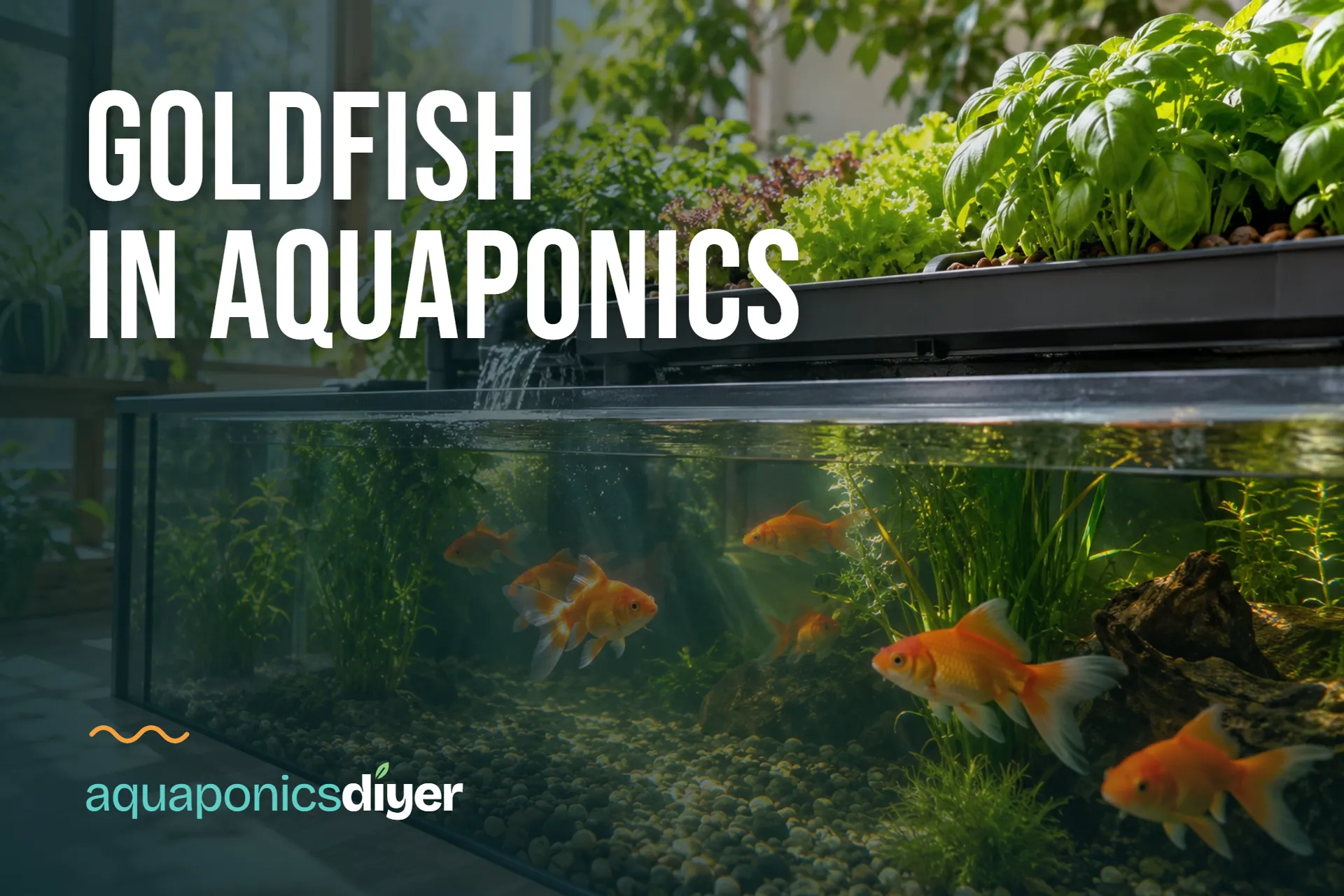
Yes, aquaponics goldfish systems work, and goldfish are one of the cheapest and most forgiving fish you can start with. They cope with cool water, they are sold in every pet store, and they produce plenty of waste for plants to feed on. The trade-offs are just as clear: goldfish are an ornamental fish, not a food fish, and they need more tank space than most beginners expect. Here is how to set one up, what water they need and how to avoid the usual mistakes.
The figures below come from the FAO manual Small-scale aquaponic food production, Texas A&M AgriLife guide EHT-148, New Mexico State University guide H-170 and the goldfish care sheet from the Ornamental Aquatic Trade Association (OATA). If you want to compare goldfish with every other option, see our guide to the best fish for aquaponics.
Why Goldfish Work in Aquaponics
Goldfish are not the textbook choice, but they earn their place in small and indoor systems. NMSU’s guide H-170 includes goldfish in its list of warmwater and coldwater species well adapted to recirculating aquaculture, and notes that some growers keep ornamental fish such as goldfish instead of edible ones. The FAO manual says gold and koi carps are mainly produced for the ornamental fish industry and have a high tolerance to a variety of water conditions, which makes them good candidates for an aquaponic system.
Hardy in a Wide Temperature Range
The OATA care sheet lists a temperature range of 4 to 25°C (39 to 77°F), pH 6.0 to 8.0 and soft to moderately hard water. That is a wide window. The FAO manual gives 18 to 30°C (64 to 86°F) as the compromise range for a whole aquaponics system, so the overlap, roughly 64 to 77°F (18 to 25°C), is where a goldfish system sits comfortably. For comparison, Texas A&M puts koi at 32 to 95°F with an ideal range of 65 to 75°F, a similar picture. If your tank lives indoors at room temperature, you probably do not need a heater at all.
Heavy Waste, Good for Plants
Goldfish are messy. Uneaten food and fish waste break down into ammonia, bacteria turn it into nitrite and then nitrate, and plants take up the nitrate. A fish that makes a lot of waste is a problem in an aquarium and a feature in aquaponics, because the plants get a steady supply of nutrients. The catch is that the biofilter has to keep up. Overfeeding or overstocking a goldfish tank is the fastest way to a water quality crisis, as the problems section below shows.
The Trade-Off: Not a Food Fish
Goldfish are not grown for eating. Texas A&M lists comet goldfish under “poor species for aquaponics”: homeowners and hobbyists can and do use them, but on a commercial scale they have no real market value, and the farm gate price does not cover the cost of feed. FAO adds that ornamental carps are a popular choice for vegetarian aquaponic growers. If your goal is fish for the table, look at tilapia or one of the other species in our fish comparison. If your goal is plants, a pretty tank and a low-cost start, goldfish make sense.
Goldfish vs Koi vs Tilapia
Koi are the other ornamental option and tilapia the classic food fish. The table pulls together what the extension sources say about each. Goldfish and koi figures come from OATA, FAO and Texas A&M; the tilapia row is from our tilapia guide.
| Fish | Main purpose | Temperature | Main catch |
|---|---|---|---|
| Goldfish | Ornamental, hobby systems | 39 to 77°F (4 to 25°C), OATA | Needs space and a strong biofilter; no food value |
| Koi | Ornamental, large pond fish | 32 to 95°F tolerated, 65 to 75°F ideal, Texas A&M | Susceptible to many parasites and diseases per Texas A&M; grows large |
| Tilapia | Food fish | 81 to 86°F (27 to 30°C) for best growth, FAO | Needs warm water and may need a state permit |
Texas A&M adds a useful contrast: unlike goldfish, koi can be sold at a profit, though it calls the koi market poorly defined and highly variable. For a home grower, tank space and disease risk matter more than resale value, and Texas A&M points out that koi are susceptible to many parasites and viral diseases. If you want eating-size fish, tilapia are the better fit, and the best fish guide covers the rest.
Setting Up a Goldfish Aquaponics System
A goldfish system is a normal recirculating aquaponics system with a small fish tank. Water moves from the tank through a filter, up to the plants and back. The steps below are the same ones used for any fish; the goldfish-specific part is the tank size and the filtration, because of the waste they make. If you are new to the layout, our guide on how to build an aquaponics system has the full plan.
Tank Size
Buy the biggest tank you reasonably can. OATA says an adult goldfish needs at least a 100 liter (26 gallon) tank, plus 50 liters (13 gallons) for each additional adult, and that goldfish can reach about 25 cm (10 inches) in an aquarium. By that rule, a 10 gallon tank is a nursery for young fish at best, not a permanent home. Our guide to the aquaponics fish tank covers tank types, shapes and materials in detail.
Grow Bed or Raft
Both work. A media-filled grow bed filters solids and hosts bacteria; a floating raft gives plants a deep-water root zone but needs a separate solids filter. For a small goldfish setup, a grow bed is simpler. FAO’s feed rate ratio is a good sizing guide: it recommends 40 to 50 grams of fish feed per square meter of grow bed per day for leafy greens and 50 to 80 grams for fruiting plants. Keep the feed and the bed area in balance and the plants will clean up what the fish produce. See the aquaponics grow bed guide for sizing and media.
Filtration and Aeration
Solid waste from goldfish clogs beds quickly, so give the tank a mechanical filter or a settling stage before the water reaches the plants. FAO warns that at higher stocking densities mechanical filtration can be overwhelmed and beds can clog. Warm water holds less oxygen, so add air stones, run the pump around the clock and keep a backup if power cuts are common. FAO is blunt about oxygen: it has the most immediate and drastic effect on an aquaponics system, and fish can die within hours when it runs low.
How to start a goldfish aquaponics system
-
Choose a tank of at least 40 gallons
Use OATA’s rule of 100 liters for the first adult and 50 liters for each extra one. A 40 gallon tank (about 151 liters) fits two adults by that rule.
-
Set up the pump, filter and grow bed
Place the grow bed above or beside the tank so water can flow through and drain back. See the grow bed guide.
-
Cycle the system before adding fish
Grow the bacteria first, following our fishless cycling guide, so ammonia never builds up around live fish.
-
Add plants and a few small fish
Start with fewer fish than the limit and let the biofilter catch up. OATA warns that adding fish too fast can cause new tank syndrome.
-
Feed lightly and test weekly
Feed once a day, only what the fish eat in a few minutes, and test ammonia, nitrite, nitrate and pH every week.
How Many Goldfish per Gallon?
Stocking density is a weight, not a head count. FAO recommends a maximum of 20 kg of fish per 1,000 liters (about 1 lb per 6 gallons) for any tank over 500 liters (132 gallons), and strongly advises new growers not to exceed it. For tanks under 500 liters it halves the rate to 1 kg per 100 liters, which is about 1 lb of fish per 12 gallons. FAO writes these rules for food fish, so treat them as a ceiling for goldfish, not a target. The reason is safety: at high densities a short power cut can kill every fish within an hour.
Goldfish are sold by the fish, not by the pound, and we found no extension source that gives a typical adult weight, so we cannot honestly convert these limits into a number of fish. Use OATA’s space rule as the count check and FAO’s weight cap as the upper limit. The table shows both for common tank sizes.
| Tank | Liters | Adult goldfish by OATA rule | FAO weight ceiling (half rate under 500 L) |
|---|---|---|---|
| 10 gallons | 38 | None (under the 100 L minimum) | 0.4 kg (0.8 lb) |
| 20 gallons | 76 | None (under the 100 L minimum) | 0.8 kg (1.7 lb) |
| 40 gallons | 151 | 2 | 1.5 kg (3.3 lb) |
| 55 gallons | 208 | 3 | 2.1 kg (4.6 lb) |
| 100 gallons | 379 | 6 | 3.8 kg (8.4 lb) |
| 275 gallon IBC tote | 1,041 | Space rule allows more than the weight cap does | 20.8 kg (46 lb) |
Weights are rounded. When the two rules disagree, use the lower number. And remember that fish grow: a handful of small goldfish that fit today will weigh far more in a year. For wider tank advice see the fish tank guide.
Water Quality for Goldfish
Goldfish tolerate more than many fish, but the plants and bacteria in the system set the final limits. The table compares the OATA goldfish figures with FAO’s compromise range for a whole aquaponics system.
| Parameter | Goldfish (OATA care sheet) | Whole aquaponics system (FAO Table 3.2) |
|---|---|---|
| Temperature | 4 to 25°C (39 to 77°F) | 18 to 30°C (64 to 86°F) |
| pH | 6.0 to 8.0 | 6 to 7 |
| Ammonia | Zero | Below 1 mg/L |
| Nitrite | Zero | Below 1 mg/L |
| Nitrate | No more than 20 mg/L above tap water | 5 to 150 mg/L |
In practice, aim for zero ammonia and nitrite on your test kit and treat anything above 1 ppm as an emergency. FAO says carp and tilapia can show symptoms of ammonia poisoning at 1.0 mg/L, damaging the gills and nervous system. Keep pH around 6.5 to 7 so it suits both goldfish and plants. One milligram per liter is the same as one ppm, the unit on hobby test kits, and a liquid kit such as the API Freshwater Master Test Kit reads all of these. If pH keeps drifting, see how to lower pH in an aquarium.
Tap water needs treating first: chlorine and chloramine harm both fish and bacteria. Let the new system settle with no fish for a few weeks using the steps in our fishless cycling guide.
Feeding Goldfish in Aquaponics
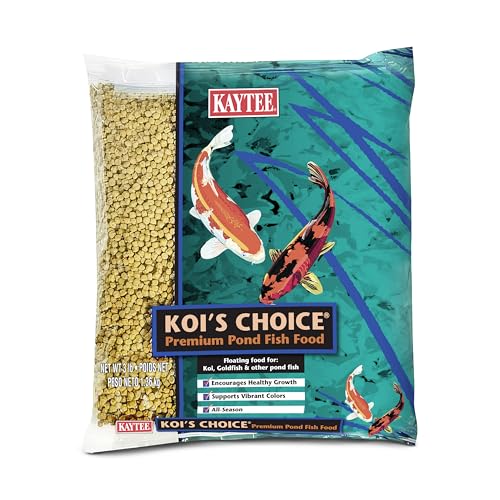
Feed a quality goldfish-specific flake or pellet. OATA notes that goldfish need more carbohydrate than many other species. A small floating pellet makes it easy to see how much the fish actually eat. The listing for Kaytee Koi’s Choice names goldfish among the fish it suits, so it is a reasonable pellet for a goldfish tank, though any good goldfish or koi pellet will do.
OATA recommends feeding once a day, only what the fish eat within a few minutes. Overfeeding leaves uneaten food that breaks down into toxic waste. In aquaponics the stakes are higher, because every gram of feed adds ammonia to the whole system. Scoop out what floats untouched and skip a feeding if the fish seem uninterested.
The feed also drives the plants, since FAO’s feed rate ratio ties daily feed in grams to grow bed area. If your plants look pale, test the water before increasing the feed. If the water tests fine and the plants are still hungry, raise the feed slowly over a few weeks instead of in one jump.
Common Goldfish Aquaponics Problems
Overstocking
This is the number one mistake. Goldfish grow to about 25 cm (10 inches) in an aquarium, and a tank that looked roomy with five small fish is crowded a year later. Signs are ammonia that will not stay at zero, fish gasping at the surface and cloudy water. Fix it by rehoming fish, adding aeration and cutting the feed. Do not add chemicals as a substitute for space.
Breeding Too Fast
Goldfish spawn readily. OATA says breeding is more likely with a 2 to 1 ratio of males to females, can be triggered by slowly raising the temperature to about 20°C (68°F), often after a partial water change, and that eggs hatch within three days. The same source warns that goldfish readily eat their eggs and fry, which keeps numbers in check in most tanks. If you do not want fry, avoid sharp temperature rises and keep your stock to a single sex or a small group.
Plants Eaten
No extension source we opened covers this, so treat it as a precaution: fish can pick at soft roots and seedlings, so keep plant roots out of reach. Grow in a bed fed from the tank rather than letting roots hang into the fish water, and screen the intake and outlet so fish cannot get into the media.
One more point from OATA: do not mix comet goldfish with fancy varieties, because comets swim faster, outcompete them for food and may nip their fins. Pick one type.
Goldfish Aquaponics Kits
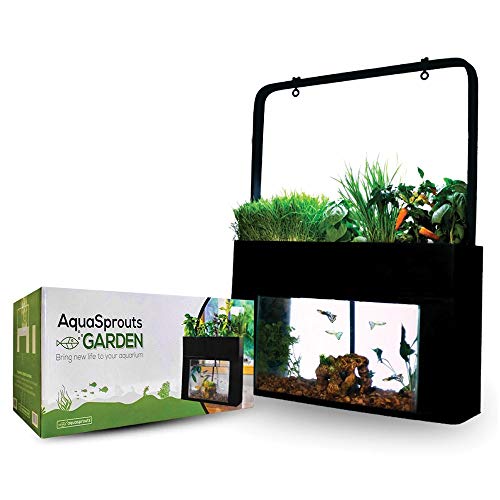
You can start from parts or from a kit. A desktop kit is a good first step, but check the tank size against OATA’s 100 liter minimum. Most countertop kits come with a tank that suits a few small fish, not a full-grown goldfish. Our aquaponics kits page compares ready-made options and says plainly what each can grow, and the aquaponics fish tank guide shows how to turn a standard aquarium into a working system. The kit below lists the gear a goldfish setup needs on top of the tank and plants.
What you need for a goldfish tank
Food, air, a way to read the water and a starting tank. Size the tank to OATA’s rule before you commit.
-
1Floating pellets
Kaytee Koi's Choice Floating Fish Food
The listing names goldfish among the fish it suits, and a floating pellet shows you how much actually gets eaten.
-
2Water test kit
API Freshwater Master Test Kit
Reads pH, ammonia, nitrite and nitrate, the readings that tell you if the biofilter is keeping up with goldfish waste.
-
3Air pump
Pawfly 254 GPH Aquarium Air Pump
A multi-outlet pump the maker rates for tanks up to 300 gallons, so you can run more than one air stone.
-
4Starter tank
Tetra LED 10 Gallon Complete Fish Tank Kit
A 10 gallon tank is below OATA’s minimum for an adult goldfish, so use it for a nursery, a quarantine tank or a cycling trial, not a permanent home.
-
5Desktop grow tray
A countertop grow tray that our kits page lists as needing a 10 gallon tank, suited to young or few fish and herbs, not a large goldfish.


Planning the rest? See the best fish for aquaponics, the tilapia guide, fish tank options and aquaponics kits.
Aquaponics Goldfish FAQ
Grow along with us
New guides and seasonal tips for fish, plants and DIY builds, about once a month.