Hydroponics
Hydroponic System for Beginners: How to Choose Your First Setup
As an Amazon Associate we earn from qualifying purchases. How we choose products.
On this page
The right hydroponic system for beginners is the one that forgives mistakes while you learn two numbers: pH and nutrient strength. Every system grows plants in water without soil, but some need a pump running all day and daily checks, while others need nothing after the first fill. Picking the forgiving kind first is the difference between a salad in five weeks and a bucket of brown roots.
This guide compares the main systems, shows how to match one to your space and time, lists the few things you need to buy, and walks through the first month. If you would rather build than buy, our DIY hydroponic system guide has the step-by-step builds.
What Is the Easiest Hydroponic System for Beginners?
The easiest hydroponic system for beginners is the Kratky method: a lidded container of nutrient solution with seedlings in net cups, and no pump at all. The University of Florida's "Set It and Forget It" Hydroponic Lettuce (UF/IFAS HS1488, 2025) calls it simple, affordable and easy to troubleshoot, and says there is rarely a need to monitor or adjust the pH or nutrient solution once it is set up. Its limit is crop size: it suits lettuce and herbs, not big fruiting plants.
Second easiest is a single deep water culture (DWC) bucket, which is the same idea with an air pump bubbling oxygen through the solution. That one addition lets you top up, adjust and grow larger plants. Third, for people who want the least effort indoors, is an all-in-one countertop unit with a built-in light and pump.
The Main Hydroponic Systems Compared
| System | How it works | Power | Upkeep | Best first crops | Beginner fit |
|---|---|---|---|---|---|
| Kratky | Fill once; plants drink the level down | None | Almost none until harvest | Lettuce, bok choy, herbs | Excellent |
| Deep water culture (DWC) | Roots in aerated solution | Air pump | Check pH and EC every few days, top up | Greens, herbs, one large plant | Very good |
| Countertop all-in-one | Small tank, pump and LED in one unit | Light and pump | Top up water, add nutrients | Herbs, lettuce | Very good indoors |
| Floating raft bed | Foam raft on a shallow tank | None or air pump | Low | Lots of lettuce | Good if you have space |
| NFT | Thin film flows through channels | Water pump, continuous | Daily flow checks | Lettuce, herbs, strawberries | Better as a second system |
| Ebb and flow, drip | Pump and timer feed a medium | Pump and timer | Timers, clogs, media | Tomatoes, peppers | Better as a second system |
For how each one is put together, see our DIY builds; for the passive method in depth, see the Kratky method guide.
How to Choose Your First System
Start With What You Want to Grow
Lettuce is the classic first crop because it is low maintenance, low profile and short-cycle, as UF/IFAS puts it. Herbs, bok choy, kale and chard are similar. All of these suit any system on this page. Tomatoes, peppers and cucumbers need more nutrients, more light and a larger root zone, and Growing Lettuce in Small Hydroponic Systems (UF/IFAS HS1422) notes that long-term crops of more than 60 days are more difficult in NFT or floating systems. Grow greens first; add a fruiting crop in a DWC bucket or drip system later.
Check Your Light
Plants grown in water still need as much light as plants in soil. Outdoors, grow in your local lettuce season; in Florida, UF/IFAS gives October to March. Indoors, Growing Lettuce in Small Hydroponic Systems (UF/IFAS HS1422) says supplemental lighting may be needed for good lettuce growth, and UF/IFAS adds that indoor hydroponics works year-round with adequate lights and a fan. If you have no bright window, budget for a light or choose a countertop unit with one built in.
Be Honest About Your Time
If you travel or forget chores, choose Kratky: once planted, nothing needs doing until harvest. If you enjoy checking readings, DWC rewards you with bigger, faster plants. NFT and timer-driven systems need daily attention, because a stopped pump or a clogged line can ruin a crop quickly.
Space and Weight
Water is heavy: a filled 5-gallon bucket weighs about 40 pounds, and UF/IFAS warns it is hard to move once filled. Choose the spot before you fill anything. A countertop unit fits a kitchen; buckets suit a patio, porch or spare room; a raft bed or NFT rack needs floor space and a level surface.
Budget
A bucket system costs little beyond the bucket, cups, nutrients and a pH kit. A DWC kit costs more but includes the pump and fittings. Countertop units with lights and apps sit in a higher price tier. The recurring costs for all of them are nutrients, pH adjusters, seeds and electricity for any pump or light.
Starter Kits Worth Considering
If you would rather not source parts, these are widely bought starting points in three styles. Picks are based on the manufacturers' listings and how widely each is bought; we have not tested them, and none of them replaces a pH check.
| Starter kit | PowerGrow Systems DWC Bucket Kit Best first bucket | Hydrofarm Root Spa 5 Gallon | LetPot LPH-SE 12 Pod System |
|---|---|---|---|
| Product | 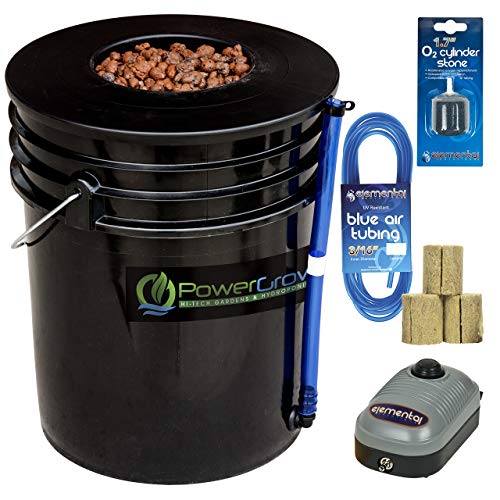 | 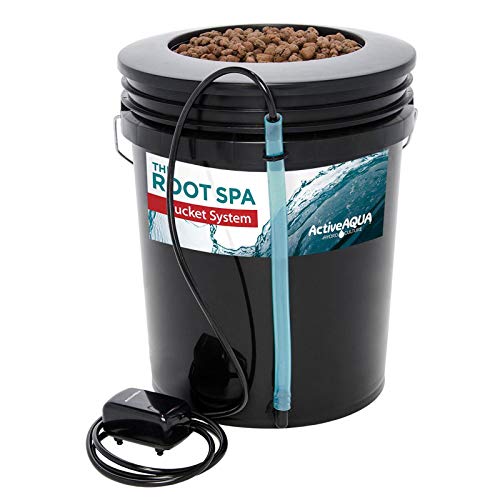 |  |
| Type | DWC bucket | DWC bucket | Countertop all-in-one |
| What is included | Bucket, 6 inch basket lid, air pump, tubing, air stone, medium, rockwool plugs | Bucket, 8 inch basket, air pump, hose and fittings | Tank, 12 pods, 24 W LED, pump, sponges, A and B nutrients |
| You still need | Nutrients, pH kit | Nutrients, pH kit, clay pebbles | Seeds |
| Best for | A first bucket on a patio or in a grow room | One large plant such as a tomato | Herbs and greens on a kitchen counter |
| Price tier | $ | $ | $$ |
| Buy | Check price | Check price | Check price |
Best first bucket
PowerGrow Systems DWC Bucket Kit
- Type
- DWC bucket
- What is included
- Bucket, 6 inch basket lid, air pump, tubing, air stone, medium, rockwool plugs
- You still need
- Nutrients, pH kit
- Best for
- A first bucket on a patio or in a grow room
- Price tier
- $
Hydrofarm Root Spa 5 Gallon
- Type
- DWC bucket
- What is included
- Bucket, 8 inch basket, air pump, hose and fittings
- You still need
- Nutrients, pH kit, clay pebbles
- Best for
- One large plant such as a tomato
- Price tier
- $
LetPot LPH-SE 12 Pod System
- Type
- Countertop all-in-one
- What is included
- Tank, 12 pods, 24 W LED, pump, sponges, A and B nutrients
- You still need
- Seeds
- Best for
- Herbs and greens on a kitchen counter
- Price tier
- $$
The PowerGrow kit is the most complete of the bucket kits: the listing includes the growing medium and rockwool plugs, plus a water level indicator and drain. The Root Spa has a larger 8 inch basket that suits a single big plant. The LetPot is a different kind of product: a 12-pod countertop garden with a 24 W LED, a 5.5 liter tank, an automatic timer and app control, according to the maker, so it needs no separate light.
What Else You Need
A Complete Hydroponic Nutrient
Plants in water get every nutrient from you, so use a fertilizer made for hydroponics. UF/IFAS explains that hydroponic formulations contain extra nutrients not usually found in soil fertilizers, and that liquid, granular and two-part products all work. Three common routes:
- Liquid multi-part: General Hydroponics Flora Series (FloraMicro, FloraGro, FloraBloom), mixed in different ratios for leafy or fruiting growth.
- One-part powder: General Hydroponics MaxiGro, the simplest to measure for leafy crops.
- Three-part dry kit: MasterBlend 4-18-38 Complete Combo Kit, with calcium nitrate and Epsom salt in the right proportions, economical once you grow a lot.
A Way to Measure pH
pH decides whether plants can absorb what you feed them. SRAC 454 gives 5.5 to 6.5 as the acceptable hydroponic range, with most plants best at 5.8 to 6.2. A liquid test kit such as the General Hydroponics pH Control Kit, which includes pH up and down, is enough to start. A digital pen such as the Apera AI209 pH tester kit is faster and comes with calibration buffers.
A Way to Measure Strength
An EC or TDS meter tells you how strong the solution is. UF/IFAS aims for about 1,250 µS/cm, or about 800 ppm TDS, for lettuce. The Cornell lettuce handbook advises subtracting the reading of your plain tap water first. A simple pen like the HoneForest TDS and EC meter does the job.
Seeds and Starter Cubes
Start seeds in rockwool or similar grow cubes, keep them humid, and move them into net cups after one to three weeks. Pre-drilled 1.5 inch rockwool cubes make it easy.
Your First Month: A Simple Routine
- Week 0: sow seeds in grow cubes. Set up the system, mix nutrients to the label rate, and adjust pH.
- Weeks 1 to 3: transplant seedlings once roots show through the cubes. In DWC, start the air pump and leave it on.
- Every few days (DWC and countertop): check pH and EC, and top up with plain water if EC is rising or a weak nutrient mix if it is falling.
- Kratky: do nothing. Do not refill once roots hang in the air gap.
- Weeks 4 to 7: harvest lettuce. Kratky reports leaf lettuce at about 6 to 7 weeks from seeding, and UF/IFAS lettuce was ready three to four weeks after transplanting.
Beginner Mistakes to Avoid
Skipping the pH Check
Nutrients are only available to plants within a pH range. SRAC 454 notes iron, manganese, copper, zinc and boron become less available above pH 7.0, while phosphorus, calcium and magnesium drop sharply below 6.0. Yellow or stunted plants in a new system are usually a pH problem.
Mixing Too Strong
More fertilizer is not faster growth. Follow the label or a meter. Salts also concentrate as water evaporates, which is why the Cornell handbook dilutes with plain water when EC rises.
Ignoring Your Water
Hard or salty tap water adds to the dissolved salts before you add any fertilizer, and the salts concentrate as plants drink. Kratky (2009) links this to tipburn and recommends rainwater where water quality is poor. Measure your tap water's EC once so you know your baseline.
Starting With the Wrong Crop
Tomatoes and cucumbers are tempting, but they take months and big containers. Lettuce and herbs teach the basics in a few weeks.
Not Enough Light or Air
Leggy, pale seedlings mean too little light. Indoors, add a grow light and a small fan; UF/IFAS lists airflow among the basic needs of a hydroponic plant, along with light, water, a pH-balanced nutrient solution and support.
Hydroponics or Aquaponics?
Once a hydroponic bucket is running well, some growers add fish, so that fish waste replaces most of the fertilizer. That is aquaponics: more to manage, but a second harvest. Compare the two in aquaponics vs hydroponics, or browse our aquaponics kits to see small fish-powered systems.
Grow along with us
New guides and seasonal tips for fish, plants and DIY builds, about once a month.