Build guide
Aquaponics Pump: How to Size It and Which One to Buy
As an Amazon Associate we earn from qualifying purchases. How we choose products.
On this page
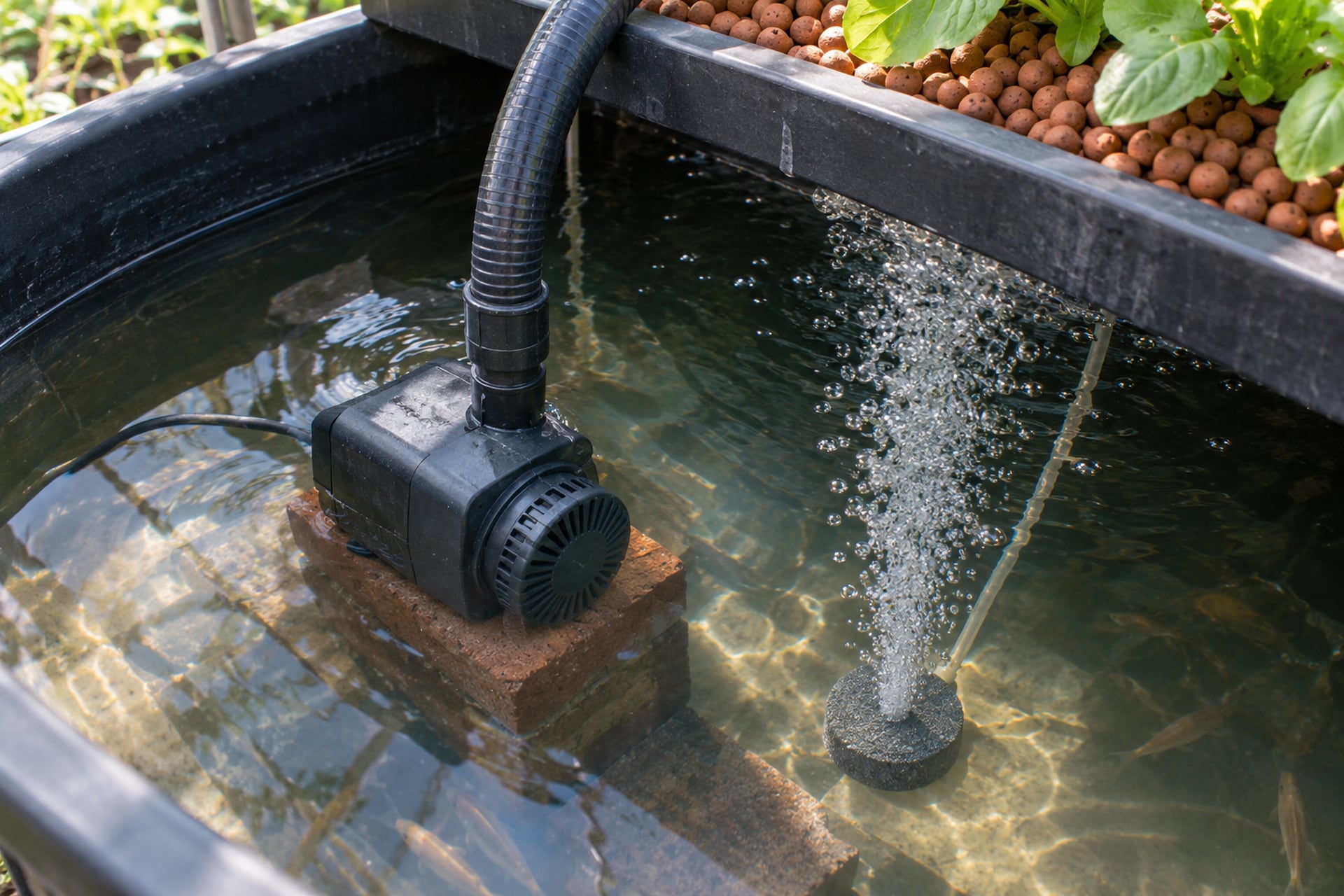
The aquaponics pump is the heart of the system. It lifts water from the fish tank or sump to the grow beds, and gravity brings it back. If it stops, FAO's manual warns, dissolved oxygen falls and waste builds up in the fish tank, and without the filters working fish can suffer and die within a few hours. So it is worth choosing well, and worth sizing correctly.
This guide gives you a pump size chart in gallons per hour, explains why the number on the box is not the flow you will get, compares submersible pumps, inline pumps and airlifts, and ends with the pumps and air pumps we would put in a home system. There is no calculator here, because the sizing rule is simple enough to fit in a table.
How Much Flow Does an Aquaponics System Need?
The sizing rule comes from FAO's manual (Somerville et al., Small-scale aquaponic food production, FAO Technical Paper 589, 2014): a commonly cited guideline for densely stocked systems is to cycle the total water volume two times per hour, while with lightly stocked fish once per hour is enough. FAO's example is a 1,000 liter unit, which needs a flow of 2,000 liters per hour to turn over twice.
Two other figures help you check your plan. If you flood and drain with a timer, FAO says the entire fish tank volume should pass through the grow beds every hour. If you use a bell siphon, FAO's tested design feeds each bed 200 to 500 liters per hour (about 53 to 132 gallons per hour), and the University of Hawaii suggests setting the flow so each bed completes a cycle every 15 to 20 minutes.
Aquaponics Pump Size Chart
Add up the water in the fish tank, the sump and the grow beds (water only, not the media), then read across. The flow columns are the turnover rule above; the power column uses FAO's rule of thumb that a submersible pump moves about 40 liters per hour for every watt, which it notes some models claim to beat by double.
| Total water in the system | Flow at 1 turnover per hour | Flow at 2 turnovers per hour | 2 turnovers in liters per hour | Rough pump power for 2 turnovers |
|---|---|---|---|---|
| 20 gal (a large aquarium) | 20 GPH | 40 GPH | 151 L/h | about 4 W |
| 50 gal | 50 GPH | 100 GPH | 379 L/h | about 9 W |
| 100 gal | 100 GPH | 200 GPH | 757 L/h | about 19 W |
| 150 gal | 150 GPH | 300 GPH | 1,136 L/h | about 28 W |
| 200 gal | 200 GPH | 400 GPH | 1,514 L/h | about 38 W |
| 300 gal (Oklahoma State's average small system) | 300 GPH | 600 GPH | 2,271 L/h | about 57 W |
| 500 gal | 500 GPH | 1,000 GPH | 3,785 L/h | about 95 W |
These are flows at the height you pump to, which is the part most pump listings leave out. Oklahoma State's Principles of Small-Scale Aquaponics notes that small systems usually keep the fish tank under 500 gallons, with 300 gallons as the average.
Head Height: Why the Box Number Lies
Every pump is rated by its maximum flow, in gallons per hour (GPH) or liters per hour, and by its maximum lift, also called head height. The maximum flow is what the pump moves when it lifts the water no height at all. As the lift rises, the flow falls; VIVOSUN says it plainly on its own listing: as the lift height increases, the flow rate decreases. Near the maximum lift, very little water comes out.
How to Measure Your Head Height
Measure the vertical distance from the water surface where the pump sits to the highest point the water has to reach, usually the inlet over the top grow bed. Horizontal runs add friction rather than height, but they still cost flow.
How to Pick for Your Head Height
- Look for a flow chart or table in the manual or listing that gives the flow at 2, 4 or 6 feet. Pick a pump whose flow at your height meets the chart above.
- If the maker only gives the maximum flow and maximum lift, keep your head height well below the maximum lift, and plan to trim the extra flow with a valve.
- FAO's own small units call for 2,000 liters per hour (about 530 GPH) at a head of 1.5 meters (about 5 feet), from a pump that draws 25 to 50 watts.
Measure the Real Flow With a Bucket
Once the pump is plumbed in, point the outlet into a bucket of known size and time how long it takes to fill. Gallons divided by seconds, multiplied by 3,600, gives you the real GPH. A 5 gallon bucket that fills in 30 seconds means 600 GPH at that height.
Pipes and Fittings
FAO puts numbers on the plumbing losses: up to 5 percent of the flow can be lost at every pipe connection, so use as few as possible between the pump and the tanks, and a 30 mm pipe carries twice the flow of a 20 mm pipe from the same pump. In inches, that is roughly 1 1/4 inch against 3/4 inch. Oklahoma State gives the same advice from the maintenance side: use oversized pipes wherever possible to avoid clogging.
Types of Aquaponics Pumps
| Type | How it works | Best for | Trade-offs |
|---|---|---|---|
| Submersible impeller pump | Sits under water in the sump or fish tank | Most home systems; the type FAO recommends | Clogs if the intake is not cleaned; never run it dry |
| Inline (external) pump | Sits outside the tank, plumbed into the line | Larger systems with more complex plumbing | Harder to plumb; Clemson notes they are typically more powerful and efficient |
| Airlift | An air pump pushes bubbles up a pipe, carrying water with them | Very low lifts of 30 to 40 cm (about 1 foot), deep tanks | Weak at any real height; FAO says it gains power in tanks deeper than 1 meter |
| Human power | Buckets or a header tank filled by hand | Places without reliable electricity | Only for very small systems; often low oxygen |
Clemson Cooperative Extension's Aquaponics: System Layout and Components (Beecher, 2021) says submersible pumps are often used in smaller systems where plumbing experience is not needed, and advises buying one rated for continuous use to extend its life. FAO adds that a good pump keeps its capacity for at least 1 to 2 years and lasts 3 to 5 years overall, while cheap ones lose power sooner.
The airlift's appeal is that one air pump can both aerate and move water, and FAO points out that airlifts do not clog the way impeller pumps do. For a typical backyard system with beds a few feet above the water, though, a submersible pump is the practical choice.
Where to Put the Pump
- At the lowest point. Oklahoma State says a single airlift or oil-free submersible pump should sit at the lowest point, the bottom of the sump. In a two tank design with no sump, it goes in the fish tank.
- Where you can reach it. FAO says the pump's internal filter needs cleaning every 2 to 3 weeks, so do not bury it under plumbing.
- Off the bottom of the fish tank. If the pump lives in the fish tank, FAO's advice is to lift it off the bottom so the tank can never be pumped dry, and to use a standpipe that guarantees a minimum water level.
- With a siphon break. FAO's IBC plan drills a small hole near the top of the pipe that leaves the fish tank, so that if the pump stops, air gets in and the pipe cannot keep siphoning water out. FAO calls this step not optional.
- Never dry. FAO is blunt: submersible pumps break if they run without water. Size the sump so it never empties while the beds are full.
Should the Pump Run All the Time?
With a bell siphon or a constant flow bed, yes: the pump runs 24 hours a day and the siphon does the timing. With the timer method, the pump switches on and off, and FAO warns that the reduced circulation means less filtration and less aeration in the fish tank, so it is less suited to heavily stocked tanks and needs extra air. If you go that way, a mechanical outdoor 24 hour timer with 30 minute steps is the simple option.
Add an Air Pump Anyway
Clemson calls aeration critical for the fish, the bacteria and the plants, and describes the standard setup: an air pump, tubing to the bottom of the tank, and air stones. Oklahoma State considers dissolved oxygen above 5 ppm ideal, and recommends one air stone for every 10 square feet in a raft bed. FAO goes further: many systems, it says, have been saved from collapse by an abundance of dissolved oxygen, and a combined AC/DC air pump that keeps running in a power cut is worth having.
Plan for a Power Cut
Oklahoma State's troubleshooting table for media bed systems (Nitrification and Maintenance in Media Bed Aquaponics) gives two fixes when the power goes off: pour water from the sump into the fish tank every 1 to 2 hours to put oxygen back in, or keep a 200 liter (about 53 gallon) container above the fish tank that releases a slow stream of water.
The Best Pumps for Aquaponics
We picked from the submersible pumps sold on Amazon with the most buyer reviews and a solid average rating, and confirmed each one is currently sold on Amazon US. All four are VIVOSUN pumps in different sizes, which makes it easy to step up or down. The specifications below are the maker's own, from the listings; flow is the maximum at zero lift.
Editor's Choice
VIVOSUN 800 GPH Submersible Water Pump
Covers two turnovers an hour for systems up to roughly 300 gallons at a modest lift. The listing gives 800 GPH (3,000 L/h) maximum flow, up to 10 feet of lift, 50 W and a flow control knob.
-
Smaller systems
VIVOSUN 400 GPH Submersible Pump
400 GPH, 5.3 feet of lift, 15 W according to the listing.
-
IBC and large builds
VIVOSUN 1600 GPH Submersible Pump
1,600 GPH, up to 15 feet of lift, 100 W, usable submerged or inline.
| Pump | VIVOSUN 800 GPH Editor's Choice | VIVOSUN 400 GPH | VIVOSUN 1600 GPH | VIVOSUN 210 GPH |
|---|---|---|---|---|
| Product |  |  |  |  |
| Max flow | 800 GPH (3,000 L/h) | 400 GPH (1,500 L/h) | 1,600 GPH (6,000 L/h) | 210 GPH (800 L/h) |
| Max lift | 10 ft | 5.3 ft | 15 ft | 3.3 ft |
| Power | 50 W | 15 W | 100 W | 8 W |
| Flow control | Knob | Not listed | Fixed flow | Regulating valve |
| Fits (2 turnovers an hour, low lift) | About 150 to 300 gal | About 50 to 150 gal | 300 gal and up, IBC builds | Aquarium systems |
| Check price | Check price | Check price | Check price |
Editor's Choice
VIVOSUN 800 GPH
- Max flow
- 800 GPH (3,000 L/h)
- Max lift
- 10 ft
- Power
- 50 W
- Flow control
- Knob
- Fits (2 turnovers an hour, low lift)
- About 150 to 300 gal
VIVOSUN 400 GPH
- Max flow
- 400 GPH (1,500 L/h)
- Max lift
- 5.3 ft
- Power
- 15 W
- Flow control
- Not listed
- Fits (2 turnovers an hour, low lift)
- About 50 to 150 gal
VIVOSUN 1600 GPH
- Max flow
- 1,600 GPH (6,000 L/h)
- Max lift
- 15 ft
- Power
- 100 W
- Flow control
- Fixed flow
- Fits (2 turnovers an hour, low lift)
- 300 gal and up, IBC builds
VIVOSUN 210 GPH
- Max flow
- 210 GPH (800 L/h)
- Max lift
- 3.3 ft
- Power
- 8 W
- Flow control
- Regulating valve
- Fits (2 turnovers an hour, low lift)
- Aquarium systems
VIVOSUN 800 GPH Submersible Pump (Editor's Choice)
This is the size that fits the most home systems. VIVOSUN lists a maximum flow of 800 GPH (3,000 L/h), a maximum lift of 10 feet and 50 watts, with a knob to turn the flow down and interchangeable nozzles. At 50 watts it sits at the top of FAO's 25 to 50 watt range for a pump moving 2,000 L/h at 1.5 meters.
The maker says it comes apart without tools for cleaning, which matters when FAO expects you to clean the intake every 2 to 3 weeks, and that it can sit flat or be fixed at an angle or upright. Because the box flow is measured at zero lift, plan on less at your bed height and use the knob or a valve to tune the beds.
VIVOSUN 400 GPH Submersible Pump (Best for Small Systems)
For a stock tank or a single bed over a 50 to 150 gallon tank. The listing gives 400 GPH (1,500 L/h), a maximum lift of 5.3 feet and only 15 watts, with four suction cups and a 5 foot cord. The lower lift is the limit: with the grow bed more than a few feet above the water, step up to the 800.
VIVOSUN 1600 GPH Submersible Pump (Best for IBC and Large Systems)
For an IBC system with several beds, or anything near 500 gallons. VIVOSUN lists 1,600 GPH (6,000 L/h), up to 15 feet of lift, 100 watts, a detachable filter, a 20 foot cord and outlets for 3/4 or 1 inch tubing, and says it can run submerged or inline. It has a fixed flow, so add a ball valve on each bed line to balance them.
VIVOSUN 210 GPH Submersible Pump (For Aquarium Systems)
For a grow tray over a 10 to 40 gallon aquarium. The listing gives 210 GPH (800 L/h), 3.3 feet of lift and 8 watts, with a regulating valve from a trickle to full flow, which is exactly what a small tray with a mini siphon needs. For a ready-made tank and tray, see our aquaponics fish tank guide.
Air pumps and controls
The water pump moves water; these keep the oxygen up and the flow under control.
-
1Air pump for a backyard system
EcoPlus ECOair 1 Commercial Air Pump
The listing gives 793 GPH of air at 18 watts with a six-valve manifold, enough to run air stones in the fish tank, the sump and a raft bed.
-
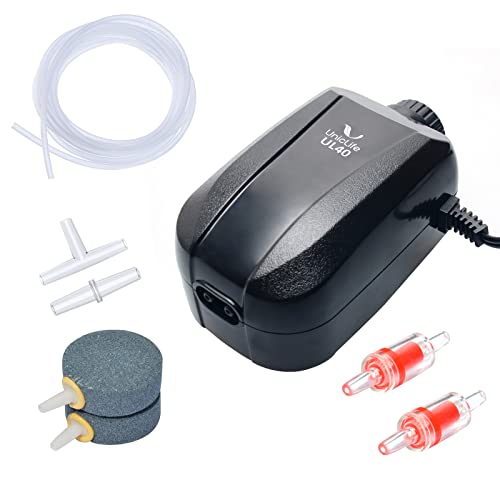
2Air pump for an aquarium system
Uniclife Dual Outlet Aquarium Air Pump
A 4 watt, two-outlet pump that comes with air stones, tubing and check valves; the maker rates it for 10 to 100 gallon tanks.
-
3Air stones
VIVOSUN 4 x 2 Inch Air Stones, 2 Pack
Large cylinder stones for fine bubbles. FAO recommends good air stones because smaller bubbles release oxygen better.
-
4Flow control
Homewerks 1 Inch PVC Ball Valve
One on each bed line lets you balance several beds from one pump and tune a bell siphon.



Aquaponics Pump FAQ
Add up all the water in the system, then aim to move that volume once an hour, or twice an hour for densely stocked fish, following FAO. Then check the flow at your lift height, not the maximum on the box: a 300 gallon system needs 300 to 600 GPH delivered at the height of the grow beds.
For aquaponics, size the pump to the total water volume rather than the number of plants: one to two turnovers an hour. A 100 gallon system needs about 100 to 200 GPH at your lift height. Small aquarium systems get by with a 200 GPH class pump turned down with its valve.
In aquaponics the answer is one to two times the system's water volume every hour, measured at the height the pump has to lift. For bell siphon beds, FAO's tested design sends 200 to 500 liters per hour, roughly 53 to 132 GPH, into each bed of 11 to 32 square feet.
For most home builds, a submersible impeller pump rated for continuous use, easy to open for cleaning, with enough flow at your lift height. FAO recommends this type for small systems. Our pick is the VIVOSUN 800 GPH for systems up to about 300 gallons, with the 1600 GPH for IBC builds.
With a bell siphon or a constant flow bed, yes, the pump runs all the time and the siphon handles the cycle. With a timer, it switches on and off, but FAO notes that means less filtration and aeration in the fish tank, so you need a separate air pump running continuously.
Yes, on a small scale. FAO describes airlifts, where an air pump pushes bubbles and water up a pipe, which work at lifts of about one foot and also add oxygen. It also mentions hand-filled header tanks for places without power, though those systems often run short of oxygen and produce less.
Related: set the cycle with a bell siphon, plan the grow beds, and put it all together in how to build an aquaponics system.
Grow along with us
New guides and seasonal tips for fish, plants and DIY builds, about once a month.