Build guide
Backyard Aquaponics: How to Plan an Outdoor System
As an Amazon Associate we earn from qualifying purchases. How we choose products.
On this page
Backyard aquaponics works, but an outdoor system lives by different rules than a tank on your kitchen counter. The sun heats and greens the water, the weather swings the temperature, cats and birds see your fish tank as lunch, and a power cut at the wrong moment has no room indoors to hide in. The fix is not complicated: put the fish tank in shade, put the plants in sun, cover everything that holds water, and match the fish to the temperatures your yard actually has.
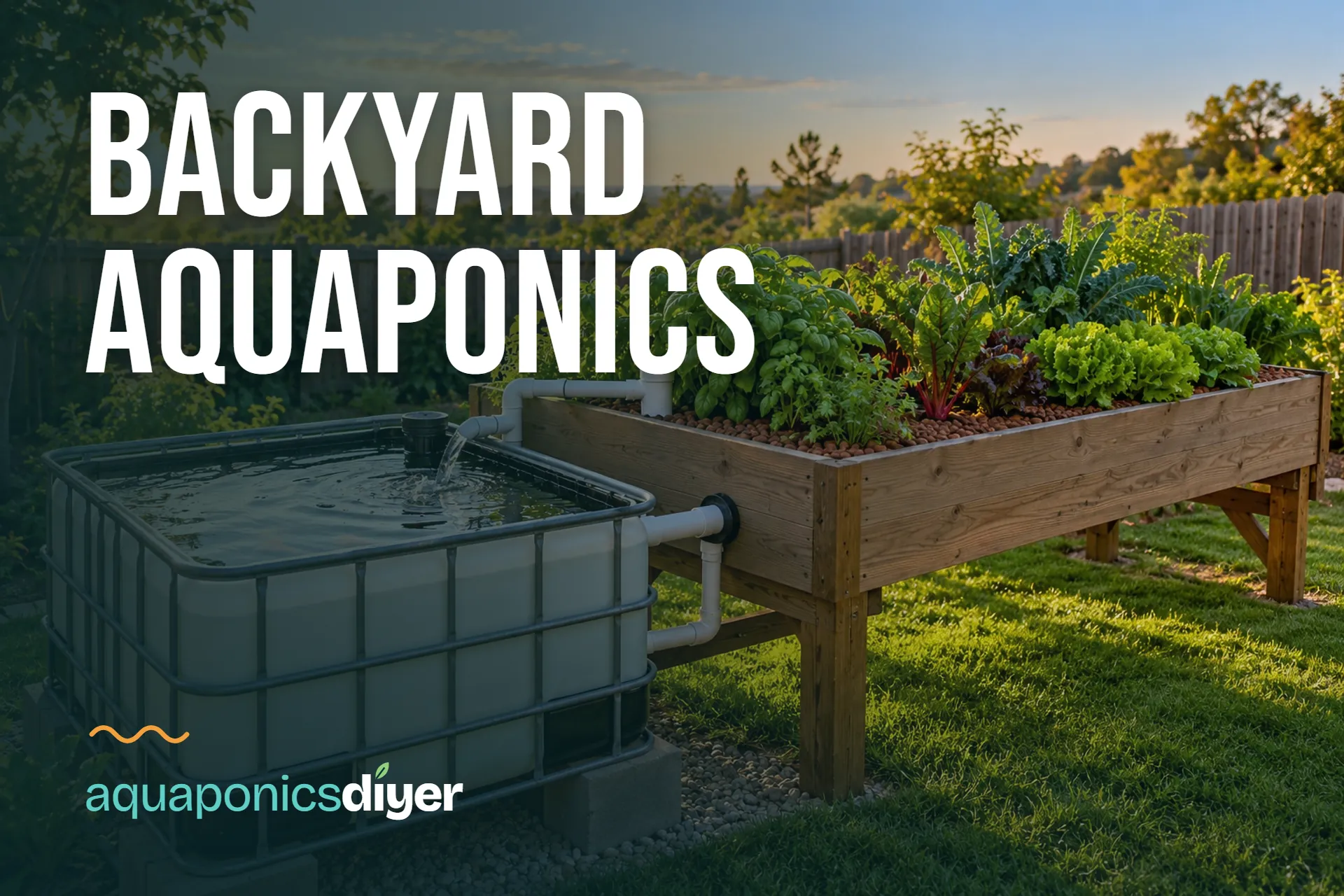
This guide covers the planning side of a backyard aquaponics system: whether your climate suits one, where to put it, which designs fit a yard, how big to make it, which fish to raise in which season, and what it costs. The advice leans on two free references written for home and small-scale growers, the FAO manual Small-scale aquaponic food production and the University of Maryland Extension build guide EM-2023-0698. A typical backyard unit is one 275 gallon tote or a few stock tanks with a few grow beds beside them, not a farm. For the step-by-step build, see our guide on how to build an aquaponics system.
Is Backyard Aquaponics Right for Your Climate?
Climate decides how much extra equipment you need, not whether you can try it. FAO's rule of thumb is to choose plants and fish already adapted to your local conditions, and then shade, insulate or heat only as much as the gap requires.
Warm Climates
Where nights stay mild, an open-air system is the simplest version of aquaponics. Tropical fish are comfortable at 72 to 90°F (22 to 32°C), according to FAO, and most vegetables grow well in full sun. The risk in a warm climate is not cold but the sun itself: the same sun that feeds the plants warms the water, grows algae and bolts lettuce. Your design work goes into shade, covers and keeping the daily temperature swing small.
Cold Winters: Greenhouse or Stop
FAO draws a clear line: if the winter average falls below 59°F (15°C) for more than three months, you need a strategy. It names three. First, insulate the tanks or warm the system passively, with a greenhouse or with coiled agricultural pipe heated by the sun. Second, switch to cold-water fish and cool-season plants for winter and go back to warm-water species in spring. Third, harvest the fish and plants at the start of winter and shut the system down until spring. All three are legitimate. Our aquaponics greenhouse guide covers the first one in depth. FAO also notes that greenhouses are not essential for small units, and that they bring capital and running costs, including fans for ventilation.
Hot Summers: Shade Everything
FAO is blunt about extreme heat: when summer temperatures go above 95°F (35°C), choose fish and plants suited to it and shade all containers and the plant growing space. Even before that point it recommends shielding the water surface of every tank, biofilter and grow unit from the sun, because stable water temperatures make for healthier fish. White tanks help too: FAO says they reflect sunlight and keep the water cool, and a darker tank can be painted white on the outside.
Choosing the Spot
FAO's site-selection advice for units built outdoors fits in one sentence: a stable, level surface, protected from severe weather but exposed to substantial sunlight. It adds a practical point that is easy to ignore on paper: the water and the grow media are heavy and hard to move, so build the system in its final location.
Sun and Shade
Most common aquaponic plants grow well in full sun, but FAO warns that lettuce, salad greens and some cabbages bolt and turn bitter in too much of it, and that a simple shade structure over the grow beds solves that. If the only spot you have is shady, FAO recommends growing shade-tolerant species. To use the sun efficiently, orient the longest side of the grow beds north to south; if you want less light, run them east to west. Also watch where tall plants cast shadows, so they do not shade low, light-sensitive ones.
Fish are the opposite. They do not need direct sunlight, and FAO says it is important for the fish tanks to be in the shade, ideally under a separate shading structure so the tank stays cooler during the day and algae stay down. Keep the system away from overhanging trees, since decaying leaves stain the water, change its chemistry and clog pipes.
Level Ground and Load
FAO flags stability first among the site factors. A tote full of water is heavy, and uneven ground or weak legs under a loaded grow bed are a recipe for a collapse. Pick ground that will not settle, and level the base before anything holds water.
Power, Water and Neighbors
You need an outlet for the water and air pumps. FAO says outlets should be shielded from water and fitted with a residual-current device (RCD, the same idea as a GFCI outlet in US wiring). You also need an easy water source, such as a hose bib or rain collection, and a plan for where overflow and water changes will go. Beyond the fence line, check whether your city, county or homeowners association has rules about water features, tanks or structures, and whether your state restricts the fish species you want. FAO's own advice is to check local regulations before bringing in any new species and never to release non-native fish into local water.
Backyard System Designs
Three designs cover most yards, plus ready-made kits. They share the same parts, a fish tank, a pump, a filter or grow bed and plumbing back to the tank, and differ mostly in how big and how permanent they are. Match the design to the space, the budget and the winter plan you chose above.
IBC Tote System
The most common backyard build repurposes a food-grade 275 gallon intermediate bulk container (IBC). The University of Maryland guide uses one tote as both the fish tank and the grow bed, with clay pebbles or similar media, a bell siphon and a pump, and says the fish tank holds around 250 gallons. Alabama Extension also publishes a six-part video series on building an IBC aquaponics system from readily available materials. For outdoor use, UMD suggests painting the sides of the containers with matte spray paint, tank sides only, until the paint blocks sunlight from reaching the inside, which stops algae. Our IBC aquaponics guide goes through the tote options in detail.
Stock Tank and Grow Beds
A plastic stock tank can serve as the fish tank, with separate grow beds beside it, or as a deep water culture raft bed. This layout is easy to expand, since you can add another bed without touching the fish tank, and it is easy to cover. A 50 gallon stock tank is small for raising fish to eat, so it suits a nursery, a sump or a grow bed better than a main fish tank; the small-scale units FAO describes hold about 1,000 liters (264 gallons) of fish tank water. For grow bed sizing and layout, see aquaponics grow beds.
Pond-Based Aquaponics
An existing garden pond can supply the fish side of a system, with a pump moving water to grow beds beside it and back to the pond. It looks the best of the three, and it comes with the most compromises. A pond is open to the sun and to falling leaves, which are exactly the algae and debris problems FAO warns about, and an open pond is exposed to predators. Any pond-based setup needs partial shade, a net or cover over part of its surface, and a pump sized for the lift to the grow beds. The sections below on predators and algae apply to a pond more than to any other design.
Kits for Outdoors
If you do not want to source parts, a kit gives you matched components. Check the kit's tank volume and plant space against your yard, whether it has a cover, and whether it was designed for outdoor use with sun and rain. Our best aquaponics kits comparison covers the options, and home aquaponics explains the smaller indoor and desktop systems that are not meant for the yard.
Sizing a Backyard System
Backyard systems fail from being out of balance more often than from any single bad part. FAO's answer is to size the system around the fish feed, not around the fish count.
Start From the Feed
FAO's feed rate ratio recommends 40 to 50 grams of fish feed per square meter of grow bed per day for leafy greens, and 50 to 80 grams per square meter for fruiting vegetables. In yard units that is roughly 4 to 5 grams per square foot per day for greens. A 4 by 8 foot bed (32 square feet) of lettuce would therefore be fed by about 4 to 5 ounces (120 to 150 grams) of feed a day. FAO calls the ratio a guide rather than an exact rule, since water temperature and season shift what is right. Use it to pick how much bed area your fish can support, then choose the tank.
Cap the Fish Weight
For the fish tank, FAO's advice to new growers is not to exceed 20 kilograms of fish per 1,000 liters of water, which is about 1 pound per 6 gallons, and to halve that for tanks under 500 liters (132 gallons). Applied to UMD's roughly 250 gallon IBC fish tank, that ceiling is about 42 pounds of fish at harvest weight. FAO attaches a safety reason to the cap: where electricity is not guaranteed, a brief interruption at high stocking density can kill all the fish within an hour. Outdoor systems should therefore start light. For the full build sequence once you have a size, go to how to build an aquaponics system.
Fish for Outdoor Systems by Season
The best outdoor fish is the one whose comfortable range matches your water temperature for most of the year. FAO's rule is that tropical fish thrive at 72 to 90°F (22 to 32°C) and cold-water fish prefer 50 to 64°F (10 to 18°C). Many backyard growers use that split to change fish with the seasons rather than heating the water. Our best fish for aquaponics comparison puts the species side by side.
- Summer and warm water: tilapia. FAO's table gives Nile tilapia a vital range of 57 to 97°F (14 to 36°C) and an optimum of 81 to 86°F (27 to 30°C). Check your state's rules first, since some regulate tilapia.
- Year-round hardy: catfish. FAO calls catfish extremely hardy, tolerant of wide swings in oxygen, temperature and pH, and the easiest species for beginners or for anyone whose electricity supply is unreliable. Its table gives channel catfish a vital range of 41 to 93°F (5 to 34°C) and an optimum of 75 to 86°F (24 to 30°C).
- A catfish companion: bluegill. FAO mentions bluegill sunfish as a common companion for catfish, since they use the upper part of the tank while catfish stay on the bottom.
- Winter and cool water: trout. FAO says rainbow trout prefer 50 to 64°F (10 to 18°C), with an optimum around 59°F (15°C), and that growth drops significantly above 70°F (21°C). It calls them ideal for temperate climates, especially in winter. They need a high-protein diet and clean, well-oxygenated water.
Whichever you choose, buy from a reputable local supplier. FAO stresses that the availability of healthy fish from reputable local hatcheries is critical when planning a system.
Protecting the System
An outdoor system faces three outdoor problems that an indoor one never meets. Each has a cheap, boring fix, and skipping any of them is how backyard systems end.
Predators
FAO's list of reasons to cover every fish tank includes keeping cats and birds from attacking the fish, and it adds that covers stop fish jumping out, which often happens with newly added fish or when water quality is poor. Shade netting, tarps or other screening do all of these jobs at once, and a net house keeps out birds and larger animals. A simple wooden frame holding the cover gives it weight and makes it easy to lift for feeding.
Algae and Sun
FAO says preventing algae is relatively easy: shade every water surface so that no water is in direct sunlight. Its fish tank covers are agricultural shade nets that block 80 to 90 percent of sunlight. FAO adds that tanks should not be fully dark either, since fish are stressed when a pitch-dark tank is suddenly uncovered, so indirect light through shading is the ideal. Lighter shade cloth in the 25 to 60 percent range suits plants, not tank covers. UMD's matte paint on the outside of the containers is the other proven option.
Power Outages
Electricity runs the water pump and the air pump, and an outdoor circuit can fail in a storm. FAO says backup aeration is a valuable asset and that simple battery backups for air pumps have saved countless fish. Keep the stocking density at or below the beginner cap, check that the outlet has an RCD, and remember that FAO also says never to let the fish tank lose its water: most catastrophic fish kills come from human error, such as a plumbing mistake that drains the tank. Catfish are the forgiving choice here, because FAO notes that air-breathing species such as African catfish do not die from a sudden drop in dissolved oxygen.
What you need for a backyard system
Parts for the shade, cover and plumbing side of an outdoor build. The fish, feed and test kit depend on the species you pick.
-
1IBC drain adapter
Cute 4 U 275 330 Gal IBC Tote Tank Food Grade Drain Adapter
Listed as a 2 inch coarse thread to garden hose adapter for 275 and 330 gallon totes, which gives you a drain or a pump connection on an IBC build.
-
2Tote cover
NEVERLAND Zipper IBC Tote Cover 275 Gallon
A 420D waterproof zippered cover made for a 275 gallon tote, a way to keep sun and rain off the container wall, in line with FAO's advice to shade tanks.
-
3Shade cloth for beds
e.share 40%-50% Black Garden Shade Cloth, 12 x 6 ft
A 40 to 50 percent mesh with grommets, in the range FAO gives for shading plants. For the fish tank cover, FAO's nets block 80 to 90 percent, so this is the grow bed shade, not the tank cover.
-
4Pump
VIVOSUN 800GPH Submersible Fountain Water Pump
Listed as an 800 GPH submersible pump for ponds and aquariums. Check its lift against the height of your grow beds before you buy.
-
5Pond kit
Aquascape AquaGarden Mini Pond Kit
A ready-made mini pond kit for a pond-based layout; add shade, a cover and a plant bed before you stock fish.


What It Costs
Cost depends on the design far more than on the yard. The best published breakdown for a build from scratch is the University of Maryland Extension materials list for a system made from one repurposed 275 gallon IBC tote: it totals a little over four hundred dollars at 2023 prices, and UMD warns that prices vary with sales and promotions. Stock tanks, a pond, a greenhouse, heating, shade structures and a backup air pump are not in that list and will add to it.
What Drives the Price
UMD lists the standing limitations of aquaponics as high startup costs, ongoing electric and energy costs, a clean water supply, daily attention and some knowledge of fish, plants and plumbing. It also estimates that around 10 percent of the water is lost to evaporation every week, which you replace with dechlorinated water. For a backyard system the extras are the ones people forget: shade cloth or a cover, a battery backup for the air pump, an RCD outlet, fish from a licensed hatchery and, in cold climates, the heating or greenhouse.
DIY Versus Kit
UMD says do-it-yourself construction may save money compared with turnkey systems and lets you learn before investing in a larger setup. A kit buys you matched parts and less time sourcing them. Whichever way you go, look at the cost per gallon of fish tank and per square foot of grow bed rather than the headline price, and read our kit comparison before paying for a ready-made system.
Running It Through the Year
A backyard system is a seasonal routine, not a set-and-forget appliance. This short calendar follows FAO's guidance on temperature and season.
Spring
As temperatures climb, FAO's seasonal strategy is to change over to warm-water fish and plants. Uncover and clean covers, check the pump and the RCD outlet, test the plumbing for leaks, and put the shade structures back up before the sun is strong.
Summer
Shade is the whole job. Watch the water temperature, keep every surface covered, and when it passes 95°F (35°C) follow FAO's advice to use fish and plants that suit the heat and shade all containers and the growing space. Lettuce and salad greens may bolt, so put them under shade or grow something else.
Fall
Decide your winter plan while the weather is still pleasant: install insulation or the greenhouse, plan the switch to cold-water fish, or schedule the harvest. Keep leaves out of the tanks.
Winter
If the average stays under 59°F (15°C) for months, you are running one of FAO's three options: a protected system, cold-water fish such as trout, or a shutdown after the fall harvest. Never leave warm-water fish in water below their range and hope.
Planning the rest? See how to build an aquaponics system, the IBC aquaponics build, an aquaponics greenhouse for cold winters, or home aquaponics for smaller indoor systems.
Backyard Aquaponics FAQ
Grow along with us
New guides and seasonal tips for fish, plants and DIY builds, about once a month.