Buying guide
Self-Cleaning Fish Tank: The Tanks That Do Most of the Work
As an Amazon Associate we earn from qualifying purchases. How we choose products.
On this page
A self-cleaning fish tank is a tank designed so that you clean it less often and with less effort. None of them cleans itself completely: fish keep producing waste, and something has to remove it. What the label really means is one of three things. Plants growing on top take up the dissolved waste, which is the aquaponic route; a filter is built so that water changes take two minutes instead of twenty; or the filtration is hidden and sized well enough that the tank stays clear between routine changes.
This guide explains what each approach actually does, compares five tanks that use them, and shows how to make the tank you already own nearly self-cleaning. The aquaponic route is our specialty, and it is the only one where the waste turns into something useful: herbs and houseplants on top of the tank.
Editor's Choice
Aqueon LED MiniBow with SmartClean (5 Gallon)
The closest thing to a self-cleaning aquarium in the usual sense: a complete small tank whose SmartClean filter is built for water changes in under two minutes, per Aqueon. Five gallons gives a betta or a few small fish room to stay healthy.
-
Best aquaponic tank (plants do the cleaning)
Back to the Roots Water Garden
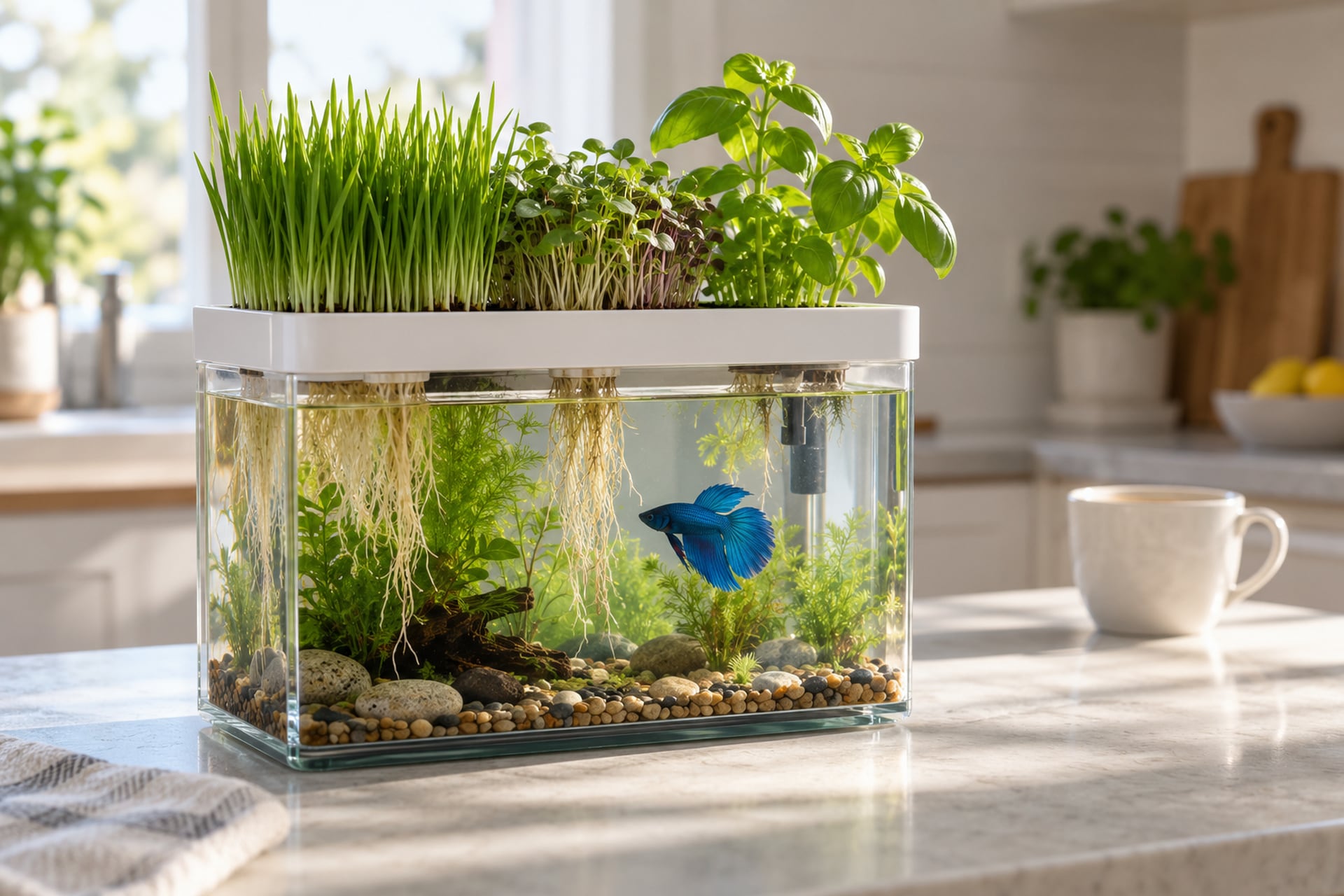
A 3 gallon tank with a grow tray on top: fish waste feeds the plants and the plants help clean the water.
-
Best 10 gallon
Aqueon 10 Gallon Starter Kit with SmartClean
The same easy-change filtration on a full 10 gallon glass tank, with heater and thermometer included.
-
Best looking
Three-stage filtration hidden behind the back panel of a tall glass tank.
What “Self-Cleaning” Really Means
To see why no tank is truly self-cleaning, follow the waste. Fish release ammonia through their gills and in their droppings, and uneaten food rots into more. Bacteria living on every surface turn the ammonia into nitrite and then into nitrate, which is far less toxic but builds up over time. On top of that there are solids: droppings, plant debris and food that settle on the bottom. A tank stays healthy when something removes the nitrate and something removes the solids. The three kinds of “self-cleaning” tank handle that differently.
Plants Do the Cleaning: Aquaponic Tanks
In an aquaponic tank the nitrate is not a problem to remove but food for the plants growing above the water, which take it up through their roots. Tanks like the Back to the Roots Water Garden grow plants in a tray over the water; passive ones like the Penn-Plax Aqua-Ponic let roots grow down into the water. This genuinely cuts how often you change water, because the plants are doing the job a water change does for nitrate. It does not remove solids, and a small tank with one plant has limits, so the makers still suggest partial water changes. The bigger the growing area relative to the fish, the more the plants can take on, which is how full aquaponics kits run for long periods on top-ups alone.
Filters Built for Quick Water Changes
The second meaning is mechanical. Aqueon's SmartClean tanks build the water change into the filter, so you drain and refill without a bucket and siphon routine; Aqueon says it takes less than two minutes. The tank does not clean less often, but cleaning stops being a chore you put off, and regular small changes are what keep a tank healthy.
Hidden, Oversized Filtration
The third is good filtration you never see. Tanks like the Marineland Portrait put a three-stage filter behind a false back wall, where mechanical media catch debris, carbon polishes the water and the media host bacteria. The water stays clear longer, which is what most people mean when they ask for a tank that cleans itself.
What No Tank Does for You
Whatever you buy, four jobs stay yours: removing settled waste from the bottom now and then, wiping algae off the glass, replacing water lost to evaporation with dechlorinated water, and testing. A tank that has been fine for months can turn in a week if a fish dies unseen or the feeding gets heavy.
Self-Cleaning Fish Tanks Compared
Three of these are aquariums with filtration designed to cut maintenance, and two are aquaponic tanks where plants do part of the work.
| Self-Cleaning Tank | Aqueon LED MiniBow SmartClean Editor's Choice | Back to the Roots Water Garden | Aqueon 10 Gallon SmartClean Kit | Marineland Portrait 5 Gallon | Penn-Plax Aqua-Ponic Tank |
|---|---|---|---|---|---|
| Product | 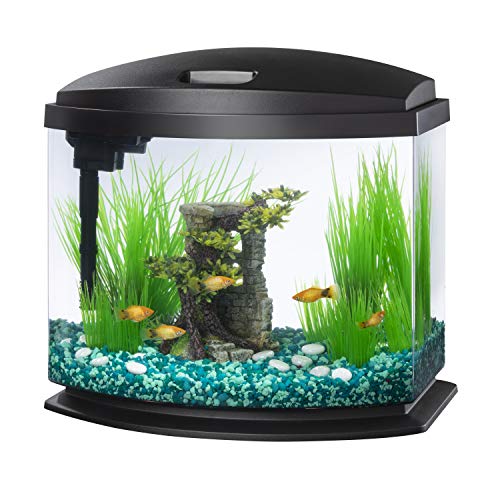 |  |  | 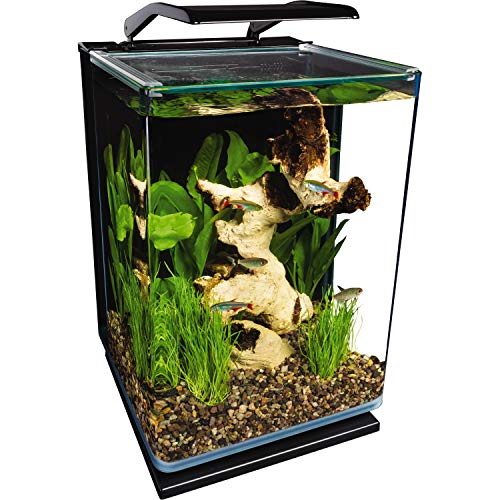 |  |
| How it cleans | SmartClean filter for fast water changes | Plants on top use the waste | SmartClean filter for fast water changes | Hidden 3-stage filter | Plant roots in the water |
| Size | 5 gal (2.5 gal model too) | 3 gal | 10 gal | 5 gal | 1.4 gal (0.5 gal model too) |
| Pump or filter | ✅ Power filter | Check listing | ✅ Internal power filter | ✅ Built in | ❌ None |
| Heater | ❌ No | ❌ No | ✅ Preset 50 W | ❌ No | ❌ No |
| Grows plants | ❌ No | ✅ Herbs, microgreens | ❌ No | ❌ No | ✅ One houseplant or herb |
| Best for | A betta or a few small fish | Kids, kitchens, gifts | A community of small tropicals | A living room or office | A desk with no outlet |
| Price | $ | $ | $$ | $$ | $ |
| Buy | Check price | Check price | Check price | Check price | Check price |
Editor's Choice
Aqueon LED MiniBow SmartClean
- How it cleans
- SmartClean filter for fast water changes
- Size
- 5 gal (2.5 gal model too)
- Pump or filter
- ✅ Power filter
- Heater
- ❌ No
- Grows plants
- ❌ No
- Best for
- A betta or a few small fish
- Price
- $
Back to the Roots Water Garden
- How it cleans
- Plants on top use the waste
- Size
- 3 gal
- Pump or filter
- Check listing
- Heater
- ❌ No
- Grows plants
- ✅ Herbs, microgreens
- Best for
- Kids, kitchens, gifts
- Price
- $
Aqueon 10 Gallon SmartClean Kit
- How it cleans
- SmartClean filter for fast water changes
- Size
- 10 gal
- Pump or filter
- ✅ Internal power filter
- Heater
- ✅ Preset 50 W
- Grows plants
- ❌ No
- Best for
- A community of small tropicals
- Price
- $$
Marineland Portrait 5 Gallon
- How it cleans
- Hidden 3-stage filter
- Size
- 5 gal
- Pump or filter
- ✅ Built in
- Heater
- ❌ No
- Grows plants
- ❌ No
- Best for
- A living room or office
- Price
- $$
Penn-Plax Aqua-Ponic Tank
- How it cleans
- Plant roots in the water
- Size
- 1.4 gal (0.5 gal model too)
- Pump or filter
- ❌ None
- Heater
- ❌ No
- Grows plants
- ✅ One houseplant or herb
- Best for
- A desk with no outlet
- Price
- $
The Best Self-Cleaning Fish Tanks
Aqueon LED MiniBow with SmartClean (Editor's Choice)
The MiniBow is a complete small aquarium: tank, hood with LED light, elevated base, power filter with cartridge, fish food, water conditioner and a setup guide, per Aqueon's listing. What earns it the self-cleaning tag is SmartClean, Aqueon's name for a filter set up so that a water change takes less than two minutes. It does not skip the water change; it removes the reason people skip it.
Choose the 5 gallon size if you can. Aqueon sells the same tank at 2.5 gallons, but more water stays stable longer, which is the real secret of a low-maintenance tank, and a betta or a few small fish have room to swim. The filter uses Aqueon's small replacement cartridges, so budget for those.
Best for: a betta or a small group of nano fish, with the least work. Missing: a heater for tropical fish, gravel and plants.
Back to the Roots Water Garden (Best Aquaponic Tank)
Back to the Roots sells its Water Garden as a self-cleaning fish tank that grows food, and of everything on this page it is the one where the cleaning has a by-product you can eat. Fish waste feeds radish, wheatgrass or herbs in the tray on top, and the plants take up what would otherwise build up in the 3 gallon tank. The kit includes seeds, grow medium, water conditioner, dechlorinator, fish food and a coupon for a fish.
Frank Wood set one up for our aquaponics kits guide and had it running in about ten minutes. Keep the expectations right: three gallons is a small volume, the plants handle dissolved waste but not solids, and a betta, the usual choice, generally wants a heater in a cool room.
Best for: a kitchen counter, a classroom or a child's first fish. Missing: the fish, and a heater for a betta.
Aqueon 10 Gallon Starter Kit with SmartClean (Best 10 Gallon)
If you want a self-cleaning 10 gallon fish tank, this is the most direct answer. Aqueon's starter kit is a 10 gallon glass rectangle with a low-profile hood, white LED lighting and a feeding door, the SmartClean internal power filter with an EcoRenew cartridge, a 50 W heater preset to 78°F, a thermometer, a net, fish food and water conditioner. The SmartClean filter makes water changes quick in the same way as on the MiniBow.
Ten gallons is the size where a tank starts to forgive mistakes, and the included heater means it is ready for common tropical community fish out of the box. It is also a good base for aquaponics later: take the hood off and set a grow bed on top, as our aquaponics fish tank guide explains.
Best for: a first community tank of small tropical fish. Missing: gravel, plants and a stand that can hold the weight.
Marineland Portrait 5 Gallon Glass Aquarium (Best Looking)
The Portrait is the tank for people who want clear water without seeing any equipment. Marineland hides a three-stage filter behind the back of a tall 5 gallon glass tank with rounded corners and a clear glass canopy, and the hinged LED light has white daylight and blue moonlight modes. Cartridges are Marineland's Rite-Size Z.
It is low-maintenance rather than self-cleaning: there is no quick-change feature, so water changes are a siphon and a jug. In exchange you get the cleanest look on this list and filtration that keeps a small tank clear between routine changes.
Best for: a living room or desk where looks matter. Missing: a heater, substrate and a gravel siphon.
Penn-Plax Aqua-Ponic Tank (No-Pump Option)
The Penn-Plax Aqua-Ponic tank is a clear round tank with a pot on top filled with ceramic planting media; a houseplant or herb roots down into the fish water and takes up waste. There is nothing to plug in. Penn-Plax suggests a betta, or one to three small fish in the 1.4 gallon model, and plants such as peace lily, lucky bamboo, English ivy, mint or chives, from established plants rather than seed.
It is the most honest “self-cleaning” tank on this list, because the maker says plainly that weekly partial water changes are still recommended on the smaller 0.5 gallon model. One plant helps; it does not replace the bucket.
Best for: a desk or shelf with no outlet. Missing: fish, plant, and a heater for a betta in a cool room.
How to Make Your Fish Tank Self-Cleaning (Almost)
You do not need a new tank to cut maintenance. These five changes work on any aquarium, and the first two matter more than any gadget.
1. Keep Fewer Fish in More Water
Waste scales with fish. Rutgers Cooperative Extension's aquaponics fact sheet FS1351 sizes tanks at about 10 gallons of water per pound of adult fish, and even a decorative aquarium stays clean far longer when it is stocked lightly. Feed what the fish finish in a minute or two; leftover food is the fastest way to foul a small tank.
2. Let Plants Take the Waste
Hang-on planters with pothos or lucky bamboo, floating plants, or a full grow bed over the tank all take up nitrate. The more plant mass, the slower nitrate builds. Our aquaponics fish tank guide shows three ways to add plants to a tank you already have, from a single planter to a pumped grow bed.
3. Add a Cleanup Crew
Snails such as nerites and small shrimp graze algae and eat leftover food, which helps between cleanings. They add a little waste of their own and need the same water quality as the fish, so they are helpers, not a substitute for maintenance. Check they are compatible with your fish first; a betta may hunt shrimp.
4. Make Water Changes Painless
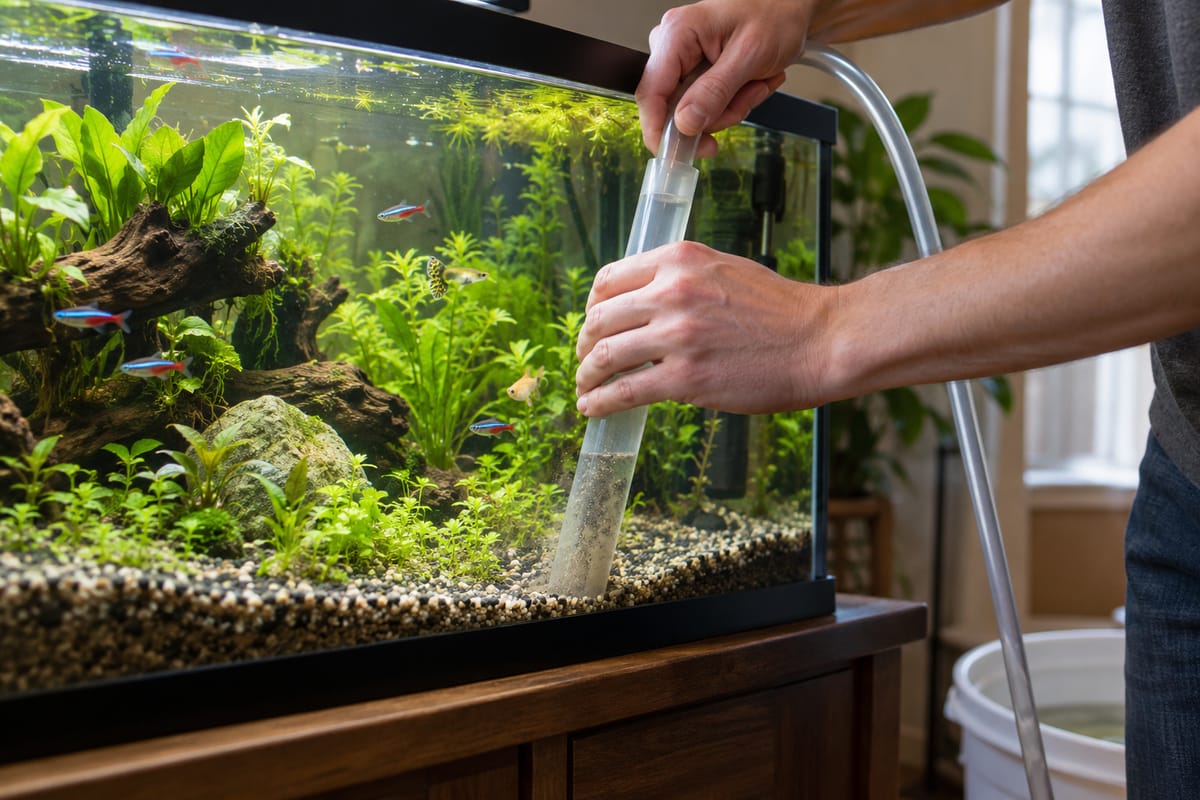
Most tanks are dirty because water changes are a chore. A hand siphon with a gravel tube pulls waste out of the substrate while it drains, and a faucet water changer removes the buckets entirely for larger tanks. Five minutes a week beats an hour a month.
5. Control Light
Algae needs light. Keep the tank out of direct sun and put the light on a timer; many keepers run it for 8 to 10 hours a day, and the glass stays clear for much longer. Hang-on plants on top, from our list of the best plants for aquaponics, also shade the water a little.
Tools That Make Any Tank Easier to Keep Clean
The kit that turns weekly maintenance into a short job.
-
1Gravel siphon
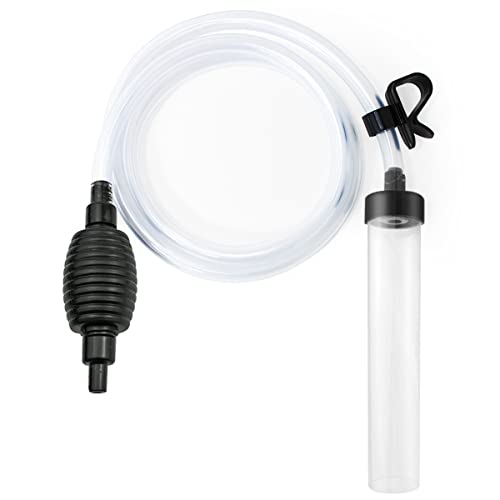
Laifoo 5 ft Aquarium Siphon Vacuum
A squeeze-bulb siphon with a gravel tube and a filter screen, so it starts without mouth priming and does not swallow small fish.
-
2Water changer
Python No Spill Clean and Fill (25 ft)
Drains and refills from the faucet with no buckets, using the tap's flow to create suction. Worth it from about 20 gallons up.
-
3Water tests
API Freshwater Master Test Kit
Ammonia, nitrite, nitrate and pH: the readings that tell you whether the tank really is staying clean.


Self-Cleaning Fish Tank DIY
The do-it-yourself version of a self-cleaning tank is aquaponics on a small scale. Set a tray of clay pebbles over an established aquarium, pump tank water into it with a small submersible pump, and let it drain back; plant herbs or houseplants in the tray. The media traps solids and hosts bacteria, the plants take up the nitrate, and the tank needs far fewer water changes. Our aquaponics fish tank guide lists the parts, and if the tank is new, start with fishless cycling so the bacteria are in place before the fish arrive. For a vertical version on a larger tank, see the aquaponics tower.
Not completely. Tanks sold as self-cleaning either use plants to absorb dissolved fish waste, as aquaponic tanks do, or use filters that make water changes very quick. Every tank still needs solid waste removed, evaporated water replaced and the water tested, just less often and with less effort than a basic tank.
Lower the fish load, feed less, and add plants whose roots sit in the tank water, such as pothos in a hang-on planter or herbs in a grow bed over the top. Add snails to graze algae and use a gravel siphon for quick weekly changes. Together these cut cleaning to a few minutes.
Small self-cleaning fish tanks of one to five gallons, including the aquaponic desktop kits, are in the budget tier. A complete 10 gallon kit with easy-change filtration and a heater, or a designer tank with hidden filtration, is mid-range. Replacement filter cartridges and fish food are the ongoing costs.
Yes. Aqueon's 10 gallon starter kit with SmartClean filtration is designed for water changes in minutes and includes a heater. For an aquaponic version, a grow bed such as the AquaSprouts Garden fits a standard 10 gallon aquarium and lets plants take up the fish waste.
A common routine for a 10 gallon tank is changing 10 to 25 percent of the water every week or two, vacuuming the gravel at the same time, and rinsing the filter media in old tank water about monthly. A lightly stocked or planted tank can stretch the interval; test the water to know for sure.
Not for long. Goldfish grow large and produce a lot of waste. By the Rutgers Extension sizing rule of about 10 gallons per pound of adult fish, a 10 gallon tank supports roughly a pound of fish in total, which three growing goldfish soon exceed. Plan on a much larger tank or a single small fish.
Grow along with us
New guides and seasonal tips for fish, plants and DIY builds, about once a month.