Fish guide
Fishless Cycling in Aquaponics: How to Cycle Your System
As an Amazon Associate we earn from qualifying purchases. How we choose products.

On this page
- The Nitrogen Cycle in Aquaponics, Explained
- Fishless Cycling vs Cycling With Fish
- What You Need for a Fishless Cycle
- How to Do a Fishless Cycle, Step by Step
- Fishless Cycling Timeline: What Your Tests Should Show
- Troubleshooting a Stalled Fishless Cycle
- Cycling a Small or Desktop System
- Fishless Cycling and Nitrogen Cycle FAQ
Fishless cycling means growing the bacteria your aquaponics system depends on before any fish go in. You add a measured ammonia source to the running system, keep the ammonia at about 1 to 2 ppm, test every two or three days, and wait. The cycle is finished when ammonia and nitrite both fall to zero or close to it within a day of dosing while nitrate keeps rising. New Mexico State University puts fishless cycling at 10 days to 3 weeks, against 4 to 6 weeks when you cycle with fish; the FAO aquaponics manual allows 3 to 5 weeks in normal conditions and up to two months in cool water.
This guide explains the nitrogen cycle in plain terms, then walks through a fishless cycle step by step, with dosing for the common ammonia products, a timeline of what your test kit should show, and fixes for a cycle that stalls. The figures come from the FAO manual Small-scale aquaponic food production and New Mexico State University Circular 680, Important Water Quality Parameters in Aquaponics Systems, with product doses taken from the makers’ own labels.
The Nitrogen Cycle in Aquaponics, Explained
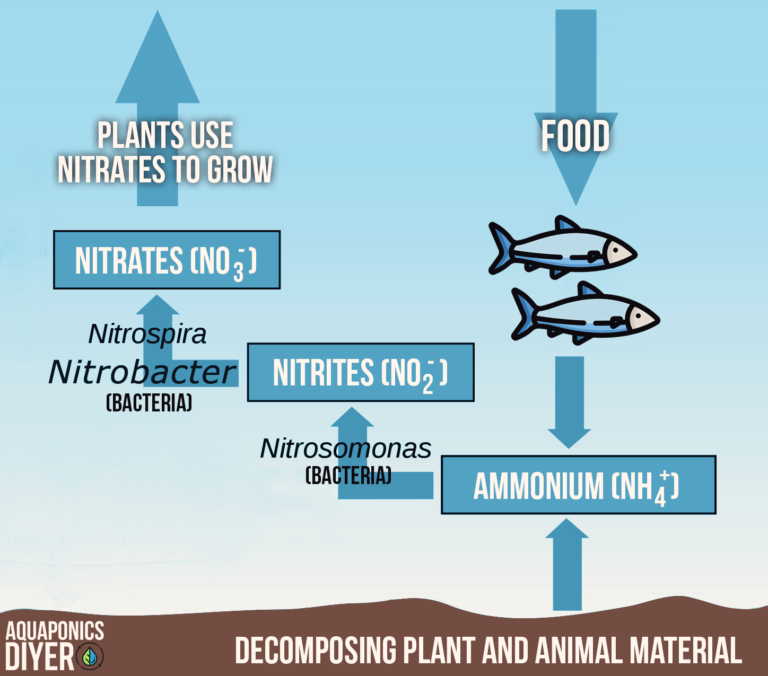
Fish excrete ammonia, mostly through their gills, and uneaten feed and waste break down into more ammonia. Ammonia is toxic to fish. In a working aquaponics system, bacteria living on the grow media and filter surfaces convert it in two steps, and the plants take up the end product. FAO describes the two bacterial groups:
- Ammonia-oxidizing bacteria (AOB), usually called Nitrosomonas after the most common genus, turn ammonia (NH3) into nitrite (NO2-).
- Nitrite-oxidizing bacteria (NOB), usually called Nitrobacter, turn nitrite into nitrate (NO3-).
- Plants take up nitrate as fertilizer, which keeps it from building up in the fish tank.
| Compound | Where it comes from | Risk to fish | Target in a cycled system |
|---|---|---|---|
| Ammonia (total ammonia nitrogen) | Fish gills, waste, rotting feed | Toxic; FAO says tilapia and carp can show symptoms from 1 mg/L | 0 to 1 ppm, ideally near 0 |
| Nitrite | AOB converting ammonia | Toxic; NMSU says toxic to fish at 5 ppm, and tilapia need 1 ppm or less | 0 to 1 ppm, ideally 0 |
| Nitrate | NOB converting nitrite | Far less toxic; FAO calls nitrite about 100 times more poisonous than nitrate | 5 to 150 ppm (FAO compromise range) |
Cycling is the process of growing enough of both bacteria to keep up. FAO notes that nitrifying bacteria double only every 10 to 15 hours, which is why it takes weeks rather than days, and why so many new aquariums fail when fish go in too early.
The Five Steps of the Nitrogen Cycle
Biology textbooks describe the wider nitrogen cycle in five steps. All of them happen somewhere in an aquaponics system, but only one, nitrification, is what “cycling” refers to:
- Nitrogen fixation: some bacteria turn nitrogen gas from the air into usable nitrogen. In aquaponics this happens around the roots of beans and peas, which is why FAO lists legumes among the low-nutrient-demand crops.
- Ammonification: decomposers break down waste, dead roots and uneaten feed into ammonia.
- Nitrification: the two-step conversion of ammonia to nitrite to nitrate described above. This is the step you are building when you cycle.
- Assimilation: plants absorb nitrate (and some ammonia) and build it into proteins.
- Denitrification: in pockets with no oxygen, bacteria turn nitrate back into nitrogen gas. NMSU flags a pH that stops falling, or rises, as a sign of oxygen-free zones in the system.
What the Bacteria Need
FAO lists five conditions for good nitrification. Get these right and the cycle runs on time:
- Surface area: grow media such as clay pebbles or gravel, or plastic bioballs in a separate filter.
- pH: the bacteria work from about 6 to 8.5 and prefer the high end; FAO gives 7.2 to 7.8 for Nitrosomonas and 7.2 to 8.2 for Nitrobacter. NMSU says nitrification basically stops below pH 6.
- Temperature: FAO gives 17 to 34°C (63 to 93°F); NMSU puts the optimum at 77 to 86°F. FAO adds that Nitrobacter is less tolerant of cold, so nitrite can build up in cool water.
- Oxygen: 4 to 8 mg/L is optimal, and FAO says nitrification stops below 2 mg/L.
- Shade: the bacteria are sensitive to sunlight until the colony is established, so cover the fish tank and any external biofilter.
Fishless Cycling vs Cycling With Fish
You can also cycle with a few fish producing the ammonia. FAO and NMSU both describe it, and both make the case for doing it without fish:
| Fishless cycling | Cycling with fish | |
|---|---|---|
| Time (NMSU) | 10 days to 3 weeks | 4 to 6 weeks |
| Risk to fish | None | High; FAO says the fish suffer high ammonia and nitrite throughout |
| Control over ammonia | Exact; you choose the dose | Indirect; you can only feed less or change water |
| Testing | Every 2 to 3 days | Daily, per NMSU |
| If you do it anyway | FAO: no more than about 1 kg of fish per cubic meter (264 gallons), fed very lightly |
FAO even notes that cycling with fish can take longer than a fishless cycle. Unless you already have fish that need a home, go fishless.
What You Need for a Fishless Cycle
An Ammonia Source
- Ammonium chloride (crystallized ammonia). NMSU lists it as a standard option. It is sold for exactly this job, so the dose is printed on the label.
- Pure liquid ammonia, sometimes sold as clear ammonia or ammonium hydroxide. Both NMSU and FAO stress it must be 100% ammonia, with no detergent, perfume, color or other additives; check the label and shake the bottle, and skip anything that foams.
- Ground fish food (“ghost feeding”). FAO calls finely ground fish food the best ammonia source because it is biologically safe and easy to control. It is slower and messier to measure, because the feed has to rot before it becomes ammonia.
- Animal manure: FAO warns that chicken manure can carry E. coli and Salmonella and must be sterilized first. In a system that grows food, we would not use it.
A Test Kit That Reads Ammonia, Nitrite, Nitrate and pH
You cannot see the cycle, only measure it. A liquid kit such as the API Freshwater Master Test Kit covers all four readings plus high-range pH. Strips are quicker but harder to read at the low numbers that matter here.
Dechlorinated Water
Chlorine and chloramine in city water kill the bacteria you are trying to grow. FAO says running the water for at least two days, with heavy aeration, lets chlorine dissipate. Chloramine does not gas off that easily, and NMSU says both must be removed, so use a water conditioner such as Seachem Prime if your utility uses chloramine.
Optional: Bottled Bacteria or Seeded Media
Bottled nitrifying bacteria, which NMSU says are sold under names such as Microbe-Lift, Cycle, Top Fin and Stress-Zyme, can speed things up. FAO says they can be expensive and are ultimately unnecessary, and that the better shortcut is to borrow a scoop of media or filter material from an established, healthy system, which “greatly decreases” the time needed.
How to Do a Fishless Cycle, Step by Step
1. Run the System and Fix Leaks
Fill the tank and grow beds, start the pump, and let everything run for two or three days before you add any ammonia, as FAO advises. Check every fitting, the bell siphon or timer, and the water level. Add water conditioner if you used tap water.
2. Set the Conditions
Warm the water toward the upper 70s if you can, add an air stone, cover the fish tank so light cannot reach it, and test the pH. During cycling, holding the pH around 7 to 7.5 keeps the bacteria near their preferred range; you will let it settle toward 6.5 to 7 once plants and fish are in.
3. Add Ammonia to 1 to 2 ppm
FAO’s target during cycling is 1 to 2 mg/L (ppm). It says a little too little is better than too much, and that if ammonia ever goes above 3 mg/L you should exchange water to dilute it, because high ammonia inhibits the very bacteria you are growing. Dose in small steps: add some, let the pump mix it for an hour, test, then top up.
The two products we list below print their own strength on the label, which makes the arithmetic easy:
| Product | Maker’s dose | For about 2 ppm | For about 1 ppm |
|---|---|---|---|
| Fritz Pro Aquatics Ammonium Chloride (crystals) | 4.5 g per 100 gallons gives about 4 ppm | About 2.25 g per 100 gallons | About 1.1 g per 100 gallons |
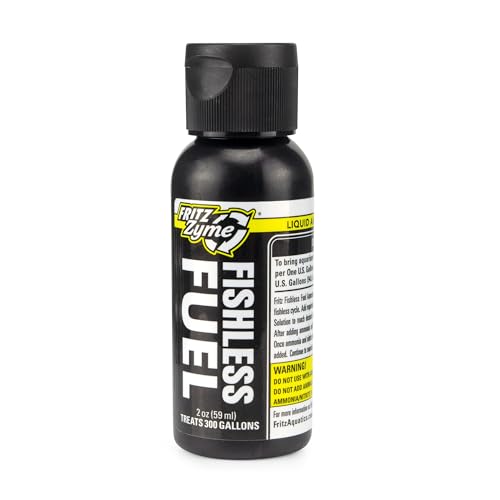
| Fritz Fishless Fuel (liquid) | 4 drops per gallon gives about 2 ppm | 4 drops per gallon | 2 drops per gallon |
The last two columns are our arithmetic from the labels. Count the water in the whole system (tank, sump and the water in the grow beds), not just the fish tank, and always confirm with a test rather than trusting the math. Household ammonia varies in strength from brand to brand, so dose it the same way: a few milliliters at a time, test, repeat.
4. Test Every Two or Three Days
Test ammonia, nitrite, nitrate and pH, and write the results in a notebook or spreadsheet. FAO recommends graphing them, because the pattern tells you exactly where the cycle is.
5. Keep Feeding the Bacteria
Once the ammonia starts dropping on its own, top it back up to 1 to 2 ppm. FAO says the ammonia source should be added “continuously, but cautiously” for the whole cycle; a colony that runs out of food stops growing.
6. Wait for Nitrite to Rise and Fall
According to FAO, the first bacteria start converting ammonia within 5 to 7 days of the first dose, and after another 5 to 7 days nitrite has risen enough to support the second group. Nitrite usually peaks above the scale for a while; that is normal. As the second group grows, nitrite falls and nitrate climbs.
7. Confirm the Cycle Is Complete
NMSU calls a system cycled when nitrate is measurable and ammonia and nitrite have both dropped to 0.5 ppm or lower; FAO’s definition is nitrate steadily rising, nitrite at zero and ammonia under 1 mg/L. A practical final check: dose to 2 ppm and test again the next day. If ammonia and nitrite are both back near zero, the bacteria are keeping up.
8. Add Fish Slowly and Stop Dosing
NMSU says to stop adding ammonia once fish are in, because they now supply it. Stock gradually rather than filling the tank on day one: FAO warns that a smaller second spike of ammonia and nitrite is common after stocking, and recommends water changes if either rises above 1 mg/L. If nitrate is high when you finish, do a partial water change before the fish arrive.
Fishless Cycling Timeline: What Your Tests Should Show
This is the typical pattern FAO describes for the first weeks of a recirculating system. Your dates will move with temperature and pH.
| Stage | Ammonia | Nitrite | Nitrate | What is happening |
|---|---|---|---|---|
| Days 1 to 7 | Held at 1 to 2 ppm by dosing | 0 | 0 | Ammonia-oxidizing bacteria are settling in |
| Roughly week 2 | Starts to fall between doses | Rising | Trace | AOB are working; nitrite feeds the second group |
| Roughly weeks 2 to 4 | Falls fast after each dose | Peaks, then falls | Rising | Nitrite-oxidizing bacteria catch up |
| Done (FAO: about 25 to 40 days in good conditions) | Near 0 within a day of dosing | 0 | Steadily rising | The biofilter is established |
| Cool water | Everything above runs slower | FAO: up to two months | ||
Troubleshooting a Stalled Fishless Cycle
| What you see | Likely cause | What to do |
|---|---|---|
| Ammonia never drops after two weeks | pH under 6, cold water, chlorine or chloramine, or no oxygen | Raise pH slowly toward 7 to 7.5, warm the water, add an air stone, dechlorinate any top-up water |
| Ammonia above 3 to 4 ppm | Overdosing | Partial water change to bring it back to about 2 ppm; FAO warns levels above 4 mg/L harm the bacteria |
| Nitrite stuck high for weeks | The second group is slow, often because of cool water or low pH | Keep dosing ammonia lightly, warm the water, check pH; a partial water change helps if nitrite is off the chart |
| pH keeps falling | Nitrification produces acid | NMSU suggests small, alternating doses of calcium hydroxide and potassium hydroxide; add base slowly |
| Green water | Light reaching the tank | Cover the tank and keep the biofilter shaded |
Should You Change Water During a Fishless Cycle?
Only when a reading gets too high. With no fish in the system, there is nothing to protect except the bacteria, and every water change removes some ammonia they are feeding on. Change water when ammonia goes above about 3 ppm, when nitrite stays off the scale for a long time, or before adding fish if nitrate has built up.
Can You Cycle a System in One Week?
From scratch, rarely. NMSU’s fastest estimate for fishless cycling is 10 days, and FAO’s bacteria need 10 to 15 hours just to double once. Seeded media from a healthy system is the shortcut that works. Bottled bacteria can help too; some makers say their product allows fish to be added immediately, but test before you trust any label.
Cycling a Small or Desktop System
A countertop aquaponics fish tank needs the same cycle, just with tiny doses. At 4 drops per gallon for about 2 ppm, a 5 gallon tank takes about 20 drops of Fritz Fishless Fuel, which is far easier than weighing a fraction of a gram of crystals. Small volumes swing quickly, so test more often, and keep the tank out of direct sun. Ready-made aquaponics kits often ship with a bottled bacteria starter; it still pays to test before the fish go in.
Fishless cycling kit
An ammonia source, a test kit and clean water are the essentials; bottled bacteria is optional.
-
1Test kit
API Freshwater Master Test Kit
Liquid tests for pH, high-range pH, ammonia, nitrite and nitrate, the four numbers that tell you where the cycle is.
-
2Ammonia source, larger systems
Fritz Pro Aquatics Ammonium Chloride, 500 g
Sold for fishless cycling; the label gives 4.5 g per 100 gallons for about 4 ppm, so one jar lasts for many cycles.
-
3Ammonia source, small systems
Liquid ammonia dosed by the drop: 4 drops per gallon for about 2 ppm per the maker, ideal for tanks under 50 gallons.
-
4Bacteria starter (optional)
API Quick Start Nitrifying Bacteria, 32 oz
A bottled nitrifying bacteria starter in a size that suits aquaponics volumes; use it with an ammonia source and keep testing.
-
5Water conditioner
Removes chlorine and chloramine from tap water before it reaches the bacteria; concentrated, so a bottle treats a lot of water.




Cycled and ready? Choose your fish in our best fish for aquaponics guide, or read our dedicated guides to aquaponics tilapia and shrimp and prawns.
Fishless Cycling and Nitrogen Cycle FAQ
Grow along with us
New guides and seasonal tips for fish, plants and DIY builds, about once a month.