Buying guide
Best Grow Lights for Hydroponics: How Much Light You Need and Which LED to Buy
As an Amazon Associate we earn from qualifying purchases. How we choose products.
Best Overall: Spider Farmer SF1000 (100 W) Check price on Amazon
On this page
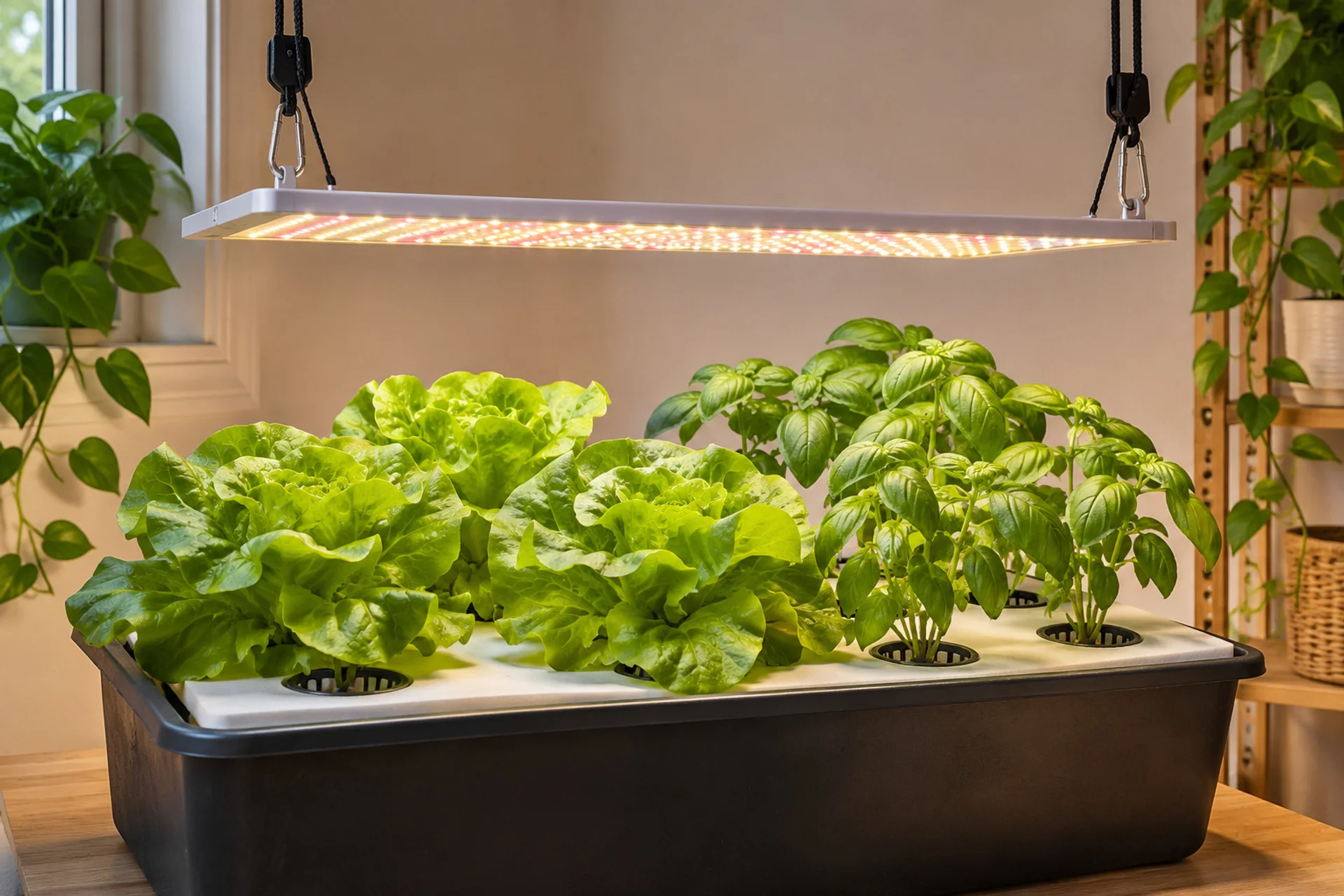
The best grow lights for hydroponics deliver enough usable light to the leaves, spread it evenly over the whole tray or tub, and do it on as few watts as possible, because they run up to 16 hours a day. For lettuce, herbs and other leafy crops, that means a full spectrum white LED sized to your growing area, hung at the right height and put on a timer.
This guide compares six LED grow lights sold on Amazon US, from linkable T5 strips for a shelf of seedlings to a 320 W bar light for a 2 by 4 ft tent. We compared the makers' published specifications and the Amazon listings rather than measuring the lights ourselves, and we explain the one number that matters most for leafy greens: the daily light integral, or DLI.
Best Overall
A fanless, dimmable 100 W full spectrum panel the maker sizes for a 2 by 2 ft area, with a listed system efficiency of 2.5 µmol/J and a 5 year warranty.
-
Best for shelves and seedlings
Eight 10 W linkable strips with their own switches, easy to fix under a shelf over trays, net cups or a Kratky row.
-
Best for a 2x4 tent
A bar-style light with a listed 2.85 µmol/J, app control and 10 to 100% dimming, for larger hydroponic setups.
How Much Light Does Hydroponics Need?
Plants respond to the number of photons they receive, not to how bright a light looks to us. Two measures make sense of the numbers on grow light listings.
PPFD: Light at the Leaf, Right Now
Photosynthetic photon flux density, written in µmol per square meter per second, is how much usable light lands on a surface at one moment. It falls as you raise the light and is usually lower at the edges of the footprint than in the middle, which is why makers publish PPFD maps at set heights.
DLI: Light Over the Whole Day
The daily light integral adds PPFD up over the photoperiod, in mol per square meter per day. The conversion is simple: DLI equals PPFD times hours of light times 0.0036. A canopy receiving 250 µmol for 16 hours gets 14.4 mol per day; at 300 µmol for 16 hours it gets 17.3.
Targets for Lettuce and Leafy Greens
In Growing Hydroponic Leafy Greens (GPN, October 2016), Neil Mattson of Cornell's Controlled Environment Agriculture group reports that at a DLI of 17, 5 to 6 ounce heads of lettuce were ready 24 days after transplanting, and that growth is directly proportional to light, so at half that DLI plants took twice as long, 48 days. He also warns that pushing head lettuce too hard with light can cause tipburn, and that without good vertical airflow a lower target of 13 to 14 is needed. For seedlings, the same article describes 22 mol per day, which it says can be met at 250 µmol for 24 hours or 375 µmol for 16 hours.
Fruiting Crops Want More
Tomatoes, peppers and cucumbers need considerably more daily light than lettuce to flower and set fruit, so a light that grows excellent salad can leave a tomato leggy. If you plan fruiting crops indoors, size up the light or shrink the area it covers. Our hydroponic strawberries guide covers a fruiting crop that fits under a modest LED.
Types of Grow Lights for Hydroponics
LED Panels
A flat board of diodes on an aluminum heat sink, such as the Spider Farmer SF1000, Mars Hydro TS1000 and VIPARSPECTRA P700. Panels concentrate light on a square footprint, which suits a DWC tub, a Kratky bin or a small tent. Most are fanless and dimmable.
LED Bars
Several long strips on a frame, such as the Spider Farmer G4500. Bars spread light more evenly at the edges of a rectangle and run cooler for their wattage, which is why they dominate larger tents.
T5 and T8 Style LED Strips
Linkable tubes such as the Barrina 2 ft and 4 ft packs. They are cheap, light and easy to mount under shelves, and they suit seed trays, microgreens and short leafy crops where the light can sit close to the plants.
What About Fluorescent and HPS?
Fluorescent tubes and high pressure sodium lamps still grow plants, but they convert less power into usable light and give off more heat than current LEDs. For a home hydroponic system there is little reason to start with them now.
Best Grow Lights for Hydroponics Compared
Picks are ordered by how well they suit a typical home grower with a tub, a tower or a small tent of leafy crops, not by price. Coverage and efficiency are the makers' figures.
| Light | Spider Farmer SF1000 Best Overall | Mars Hydro TS1000 Wider spread | VIPARSPECTRA P700 Budget panel | Barrina T5 2 ft (8) Shelves | Barrina T8 4 ft (6) Long racks | Spider Farmer G4500 2x4 tent |
|---|---|---|---|---|---|---|
| Light |  |  |  |  |  |  |
| Power draw | 100 W | 150 W | 70 W | 80 W (8 x 10 W) | 252 W (6 x 42 W) | 320 W |
| Coverage (maker) | 2x2 ft, 3x3 ft max | 2.5x2.5 ft, 3x3 ft max | 2x2 ft veg | Shelf or tray, by layout | Rack or tent, by layout | 2x4 ft, up to 3x5 ft |
| Efficiency (listed) | 2.5 µmol/J | Not stated | Not stated | Not stated | Not stated | 2.85 µmol/J |
| Dimming | Knob | 0 to 100% knob | 4 levels | Switch per strip | Switch per cord | 10 to 100%, app |
| Warranty | 5 years | Not stated | Not stated | Not stated | Not stated | 5 years |
| Price tier | $ | $$ | $ | $ | $$ | $$ |
| Buy | Check price on Amazon | Check price on Amazon | Check price on Amazon | Check price on Amazon | Check price on Amazon | Check price on Amazon |
Best Overall
Spider Farmer SF1000
- Power draw
- 100 W
- Coverage (maker)
- 2x2 ft, 3x3 ft max
- Efficiency (listed)
- 2.5 µmol/J
Show specifications
- Dimming
- Knob
- Warranty
- 5 years
- Price tier
- $
Wider spread
Mars Hydro TS1000
- Power draw
- 150 W
- Coverage (maker)
- 2.5x2.5 ft, 3x3 ft max
- Efficiency (listed)
- Not stated
Show specifications
- Dimming
- 0 to 100% knob
- Warranty
- Not stated
- Price tier
- $$
Budget panel
VIPARSPECTRA P700
- Power draw
- 70 W
- Coverage (maker)
- 2x2 ft veg
- Efficiency (listed)
- Not stated
Show specifications
- Dimming
- 4 levels
- Warranty
- Not stated
- Price tier
- $
Shelves
Barrina T5 2 ft (8)
- Power draw
- 80 W (8 x 10 W)
- Coverage (maker)
- Shelf or tray, by layout
- Efficiency (listed)
- Not stated
Show specifications
- Dimming
- Switch per strip
- Warranty
- Not stated
- Price tier
- $
Long racks
Barrina T8 4 ft (6)
- Power draw
- 252 W (6 x 42 W)
- Coverage (maker)
- Rack or tent, by layout
- Efficiency (listed)
- Not stated
Show specifications
- Dimming
- Switch per cord
- Warranty
- Not stated
- Price tier
- $$
2x4 tent
Spider Farmer G4500
- Power draw
- 320 W
- Coverage (maker)
- 2x4 ft, up to 3x5 ft
- Efficiency (listed)
- 2.85 µmol/J
Show specifications
- Dimming
- 10 to 100%, app
- Warranty
- 5 years
- Price tier
- $$
Figures come from the Amazon listings. «Not stated» means the listing gives no figure. Several of these listings compare their lights with older HPS or general bulbs; we leave those comparisons out because they are claims by the seller, not measurements.
Grow Light Reviews
Spider Farmer SF1000 (Best Overall)
The SF1000 is a 100 W fanless panel with a dimming knob. Spider Farmer lists a system efficiency of 2.5 µmol/J, a spectrum of 3000K and 5000K white plus 660 nm red and 760 nm infrared, coverage for a 2 by 2 or 3 by 3 ft tent, and a 5 year warranty with US service. The newer diode layout gathers diodes toward the edges, which the maker says evens out PPFD across the footprint.
For one DWC tub, a couple of Kratky bins or a small tower, it is the best balance of efficiency, footprint and price on this page. It is the panel to start with if you are not sure: dim it right down for seedlings, then raise the output as plants fill out.
- ✅ Highest stated efficiency among the small panels here
- ✅ Fanless and silent
- ✅ 5 year warranty
- ❌ A 2 by 2 ft footprint is small for a long NFT run
- ❌ Red and infrared add little for lettuce
Mars Hydro TS1000 (Wider Spread)
The TS1000 draws 150 W through 354 LEDs and adds a white reflector hood that Mars Hydro says is patented and refracts light at a 120 degree angle. The maker gives coverage as 2.5 by 2.5 ft, up to 3 by 3 ft, with an external driver that dims from 0 to 100% and works on 120, 240 or 277 V.
It suits growers who want a little more output than the SF1000 over a slightly larger square, for example a pair of DWC tubs side by side. The listing does not give an efficiency figure, so for a fair comparison check the maker's PPFD map at your hanging height.
- ✅ Reflector hood concentrates light on the canopy
- ✅ Fanless with an external dimmer
- ✅ Slightly larger stated footprint
- ❌ No efficiency figure on the listing
- ❌ More watts than the SF1000 for a similar space
VIPARSPECTRA P700 (Budget Panel)
The P700 is a 70 W fanless panel with a 4 level dimmer and a spectrum of 3000K and 5000K white plus 660 nm red. The listing pitches it for seedlings and vegetative growth over a 2 by 2 ft area, which matches what lettuce and herbs need.
It is the cheapest way to light one small hydroponic tub or a seed shelf properly. Because it is lower powered, it has less headroom than the SF1000 if you later try fruiting crops.
- ✅ Low power draw for long photoperiods
- ✅ Sized and marketed for seedlings and leafy growth
- ✅ Budget tier
- ❌ Four fixed dimming steps, not a smooth knob
- ❌ Little spare output for tomatoes or peppers
Barrina T5 2 ft, 8 Pack (Best for Shelves and Seedlings)
Eight 2 ft strips at 10 W each, 400 LEDs in total, in 5000K white. Each strip has its own switch, up to 16 can be linked in series, and the pack includes clips, tape, connectors and cable ties for mounting under a shelf. The listing notes they are not magnetic.
Strips win when you grow on shelves: seed trays before transplanting into a DWC system, microgreens, or a row of jars. They can sit a few inches above the leaves, which gives short crops plenty of light without a tall frame.
- ✅ Easy to mount under shelves
- ✅ Switch on every strip
- ✅ Low cost per foot of light
- ❌ Must sit close to the plants to deliver enough light
- ❌ Not suited to tall crops
Barrina T8 4 ft, 6 Pack (Best for Long Racks)
Six 4 ft strips at 42 W each, 252 W and 1152 LEDs in total, in 5000K white with V-shaped reflectors and aluminum housings. Up to six link in series, and the pack includes three switched power cords.
They fit the length of a 4 ft shelf or an NFT rack, where one panel would leave the ends dim. Hang them parallel to the channels and space them evenly so every plant site sits under a strip.
- ✅ Covers long, narrow growing areas evenly
- ✅ Reflectors aim light down
- ✅ Linkable with switched cords
- ❌ 252 W in total if you run all six
- ❌ Needs a rack or frame to mount
Spider Farmer G4500 (Best for a 2x4 Tent)
The G4500 is a 320 W bar light with Bridgelux diodes and a listed efficiency of 2.85 µmol/J, the highest on this page. Spider Farmer gives coverage as 2 by 4 ft, up to 3 by 5 ft, with 10 to 100% dimming, app scheduling with sunrise and sunset, daisy chaining and a 5 year warranty. The spectrum runs from 3200K to 5000K white plus 650 to 665 nm red.
This is the light for a bigger indoor setup: two or three DWC tubs, a tall tower in a tent, or a first try at tomatoes indoors. For a single tub of lettuce it is more light than you need.
- ✅ Highest stated efficiency here
- ✅ Bar layout covers a rectangle evenly
- ✅ App timer and dimming
- ❌ Too big for one small tub
- ❌ Mid tier, more than a beginner needs
Which Grow Light Should You Buy?
For One DWC or Kratky Tub
A 70 to 100 W panel over a 2 by 2 ft area is enough for lettuce, basil and other herbs. The SF1000 is the pick; the P700 is the budget choice. See our hydroponic lettuce guide for spacing.
For Seed Trays and Shelves
T5 strips such as the Barrina 2 ft pack, mounted a few inches above the trays.
For a Long NFT Run or Rack
Strips run along the channels, such as the Barrina 4 ft pack, so the light matches the shape of the system. Our tower garden roundup covers towers that come with their own lights.
For a Tent or Fruiting Crops
A bar light such as the G4500, with enough output to push the DLI higher.
Setting Up a Grow Light, Step by Step
-
Hang it from something adjustable
Use rope ratchets or chain so you can raise the light as plants grow. Start at the height the maker recommends for seedlings, usually higher and dimmer than for mature plants.
-
Set the timer
Plug the light into a timer. A 16 hour day is a common starting point for leafy crops; work out the DLI from the maker's PPFD at your height.
-
Raise the output in steps
Dim the light low for the first days after transplanting and raise it over a week or two. Bleached or crisp leaf tips mean too much; long, pale stems mean too little.
-
Keep light off the water
Cover reservoirs and fill unused holes in rafts and channels. Light reaching nutrient water feeds algae.
-
Move air
Run a small fan so leaves move gently. Cornell's leafy greens work links good airflow with being able to run higher light on head lettuce without tipburn.
What a Grow Light Costs to Run
Running cost is watts times hours, so it is easy to estimate. A 100 W panel on for 16 hours uses 1.6 kWh a day, or about 48 kWh a month. Multiply by your electricity rate per kWh to get the monthly cost. The same sum for the 320 W G4500 gives about 154 kWh a month, which is why it only makes sense when you fill its whole footprint.
Efficiency Is the Number to Compare
Efficiency in µmol/J tells you how much plant light you get per watt. Between two lights of the same wattage, the one with the higher figure puts more light on the plants for the same bill. Only two listings on this page state it: 2.5 for the SF1000 and 2.85 for the G4500.
Heat
Every watt becomes heat in the room. In a small closed tent that can warm the nutrient solution, and warm water holds less oxygen. Check reservoir temperature during the first week under a new light.
Related: grow salad with hydroponic lettuce, set up a DWC hydroponic system, or feed it with the best hydroponic nutrients.
Grow along with us
New guides and seasonal tips for fish, plants and DIY builds, about once a month.