Buying guide
Aquaponics Fish Tank: Kits, DIY Setups and Sizes
As an Amazon Associate we earn from qualifying purchases. How we choose products.
On this page
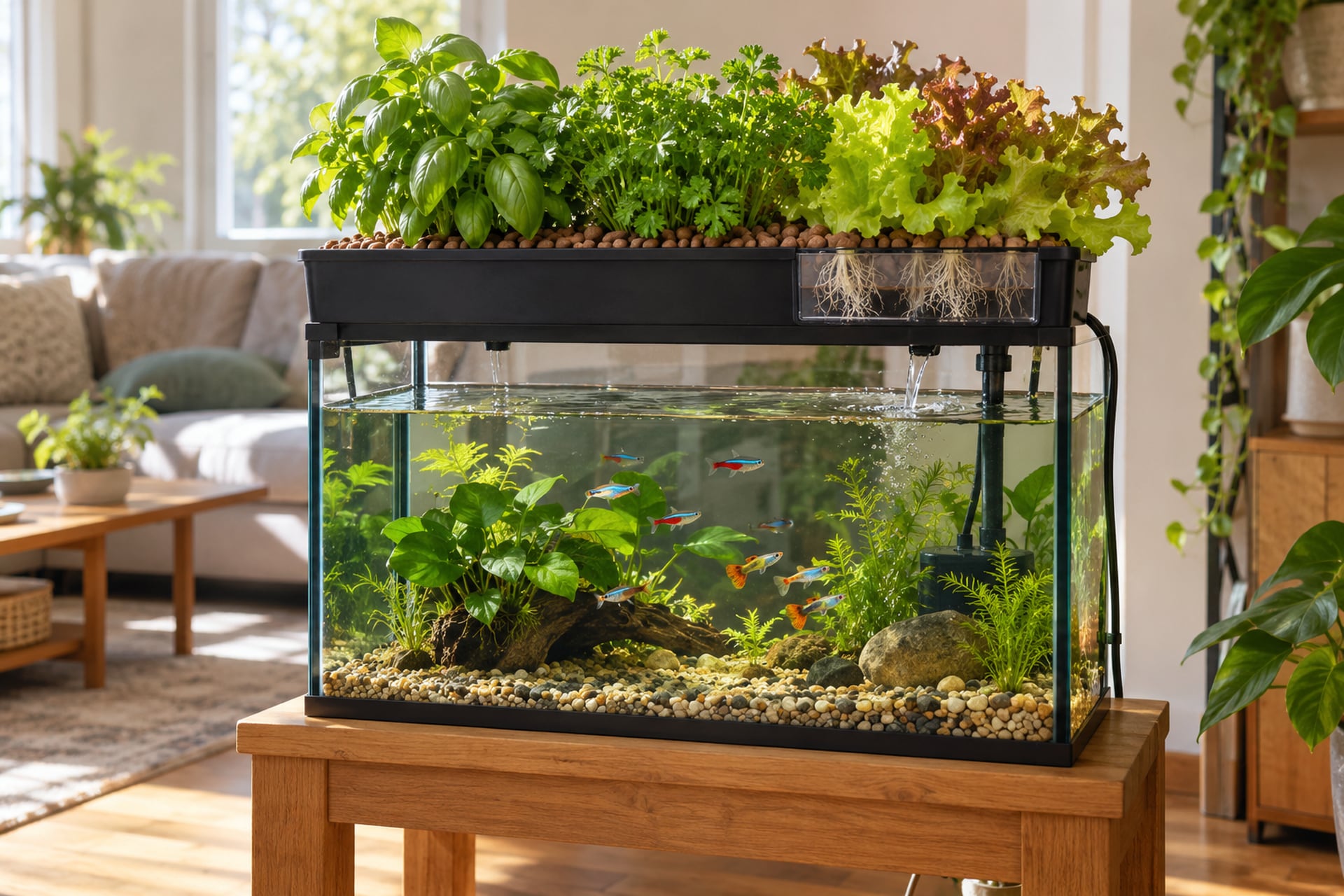
An aquaponics fish tank is the half of the system that holds the fish, and it decides almost everything else: how many fish you can keep, how much plant growing area they can feed, and where the whole thing can sit. An aquaponics aquarium is the same idea at living-room scale. Any tank that is watertight, safe for fish and big enough will do. Indoors that usually means a glass aquarium of 10 to 29 gallons with a grow bed on top; outdoors and in garages it means a poly stock tank or an IBC tote.
This guide covers how to choose an aquaponics tank, the three tanks we would buy for it, the three ways to turn a fish tank you already own into a small aquaponic garden, and how a ready-made kit compares with a DIY build at 10, 20 and 55 gallons. If you would rather buy the whole system in one box, our guide to the best aquaponics kits compares the complete ones.
What Makes a Good Aquaponics Fish Tank
Four things matter, in this order: volume, material, shape and light. Looks come last, though for an indoor tank they are often the reason to do aquaponics at all.
Volume: Size the Tank to the Fish
Rutgers Cooperative Extension's fact sheet FS1351, an introduction to aquaponics systems, sizes fish tanks at about 10 gallons of water for every pound of fish at maturity or harvest size. That rule is the quickest way to see what a tank can do. A 10 gallon aquarium carries about a pound of adult fish in total, a few small tropicals or one goldfish at most. A 50 gallon stock tank carries around five pounds, which starts to feed a real grow bed. Fish you plan to eat, such as tilapia, belong in 100 gallons or more.
Bigger is also more forgiving. A small volume of water changes temperature and chemistry quickly, so a missed feeding or a dead snail shows up in a day. In a large tank the same mistake is diluted.
Material: Food-Safe and Fish-Safe
Clemson Cooperative Extension's guide to aquaponics system layout (Lance Beecher, 2021) lists the dependable tank materials as polypropylene, high-density polyethylene and fiberglass for preformed tanks, with PVC or EPDM liners for tanks you build. Glass is the indoor standard. The same guide warns that a recycled tank is often the cheapest choice but that you need to know its history, because a container that held chemicals can poison fish years later.
Shape: Round Beats Square
Rutgers prefers circular, oval or multisided tanks, because water circulates without dead corners and fish waste does not settle where the pump cannot reach it. If you use a rectangle, pick one with rounded edges. For an aquarium indoors this matters less, since you are keeping few fish and can siphon the gravel; for a stock tank outdoors, the oval shape is a quiet advantage.
Light: Fish Like Shade, Algae Likes Sun
A clear tank in sunlight grows algae fast, which competes with your plants for nutrients and clouds the view. Indoors, keep a glass aquarium out of direct sun, or put a background on its back and sides. Outdoors, opaque tanks and a cover over part of the surface keep the water cooler and the algae down.
Types of Aquaponics Fish Tanks
| Tank type | Typical size | Where it works | Grow bed on top or beside | Best for |
|---|---|---|---|---|
| Glass aquarium | 10 to 29 gal | Indoors | On top, ready-made beds fit | Herbs, greens, ornamental fish |
| Desktop aquaponic tank | 0.5 to 3 gal | Desk, counter | Built in | One small fish and a plant |
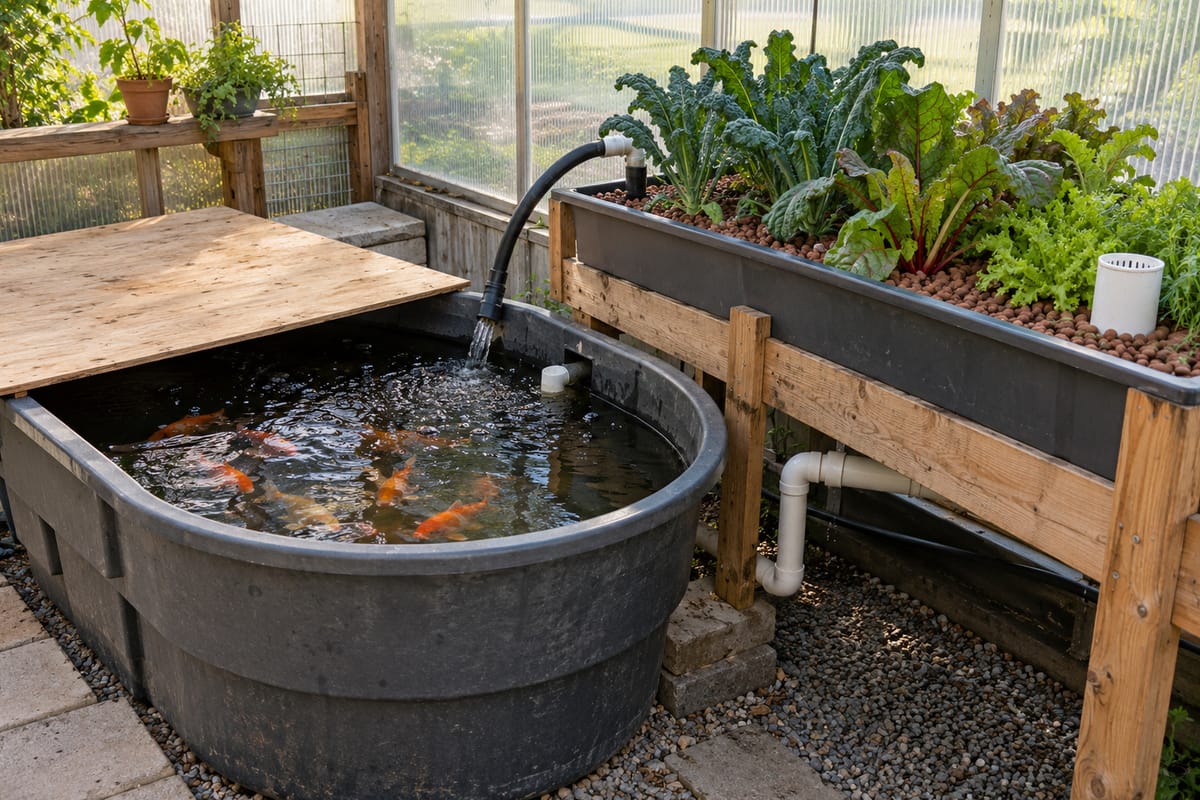
| Poly stock tank | 50 to 300 gal | Garage, patio, greenhouse | Beside, on a stand | Goldfish, bluegill, greens |
| IBC tote | 275 to 330 gal | Backyard, greenhouse | Cut top as grow bed | Food fish and vegetables |
Desktop tanks are covered in our guides to aquaponics kits and the self-cleaning fish tank, and IBC totes have their own guide to IBC aquaponics. This page focuses on the first and third rows: the tanks people actually build around.
Best Fish Tanks for Aquaponics
All three are standard tanks sold for fish or livestock, not aquaponics, which is the point: they are cheap for their size, easy to replace and made to hold water for years.
| Fish Tank | Tetra LED 10 Gallon Kit Best Indoor Start | Tetra ColorFusion 20 Gallon Kit | Tuff Stuff 50 Gallon Oval Tank |
|---|---|---|---|
| Product |  |  |  |
| Volume | 10 gal | 20 gal | 50 gal |
| Footprint | 20 x 10 x 12 in (tank) | 27.9 x 16.1 x 20.4 in (listed) | 52 x 31 x 12 in |
| Material | Glass | Glass | Structural foam plastic |
| Comes with | Hood with LED, internal filter, conditioner and food samples | Hood, LED, heater, Whisper 20 filter, decor | Tank only |
| Grow bed fit | Standard 10 gal footprint for aquarium-top beds | Build your own bed on top | Bed on a stand beside it |
| Best for | Herbs over a few small fish | More fish, a bigger homemade bed | Garage, patio or greenhouse systems |
| Price | $$ | $$ | $$ |
| Buy | Check price on Amazon | Check price on Amazon | Check price on Amazon |
Best Indoor Start
Tetra LED 10 Gallon Kit
- Volume
- 10 gal
- Footprint
- 20 x 10 x 12 in (tank)
- Material
- Glass
Show specifications
- Comes with
- Hood with LED, internal filter, conditioner and food samples
- Grow bed fit
- Standard 10 gal footprint for aquarium-top beds
- Best for
- Herbs over a few small fish
- Price
- $$
Tetra ColorFusion 20 Gallon Kit
- Volume
- 20 gal
- Footprint
- 27.9 x 16.1 x 20.4 in (listed)
- Material
- Glass
Show specifications
- Comes with
- Hood, LED, heater, Whisper 20 filter, decor
- Grow bed fit
- Build your own bed on top
- Best for
- More fish, a bigger homemade bed
- Price
- $$
Tuff Stuff 50 Gallon Oval Tank
- Volume
- 50 gal
- Footprint
- 52 x 31 x 12 in
- Material
- Structural foam plastic
Show specifications
- Comes with
- Tank only
- Grow bed fit
- Bed on a stand beside it
- Best for
- Garage, patio or greenhouse systems
- Price
- $$
Tetra LED 10 Gallon Complete Fish Tank Kit (Best Indoor Start)
A 10 gallon tank is where most indoor aquaponics starts, because the ready-made grow beds, the AquaSprouts Garden among them, are built for its standard 20 by 10 by 12 inch footprint, and Tetra's listing gives exactly those dimensions. The kit adds a low-profile hinged hood with LED lighting, an internal filter with cartridge, and samples of water conditioner and food.
For aquaponics you use the tank and keep the rest in a drawer for now: the grow bed replaces the hood, and once the bed is cycled the plants and the bacteria in its media take over most of the filter's job. The filter is still worth running for the first weeks while the bacteria establish. Ten gallons limits you to a few small fish such as guppies, platies or white cloud minnows, which is plenty to feed a bed of herbs.
Best for: a first aquarium-top system. Missing: a grow bed, a heater for tropical fish, and a grow light unless the tank sits by a bright window.
Tetra ColorFusion 20 Gallon Complete Aquarium Kit
Twenty gallons doubles the fish you can carry and gives a homemade grow bed more room to work. Tetra's listing names a 20 gallon glass aquarium with hood, a UL heater, a Whisper 20 filter, a color-changing LED and decor: two plant multipacks and an anemone. The heater is the useful part for aquaponics, since most of the small fish that suit a tank this size are tropical.
No ready-made aquaponics bed is sold for a 20 gallon footprint, so this is the tank for a build: a plastic tray or planter box with clay pebbles over the rim, fed by a small pump. The listed dimensions, 27.88 by 16.13 by 20.38 inches, are the overall kit size, so measure the glass itself before you cut a bed to fit. The color-changing light is decoration, not a plant light.
Best for: a larger indoor tank with a homemade bed. Missing: the grow bed, a plant light and the plants.
Tuff Stuff 50 Gallon Oval Tank
Stock tanks are the classic step up from an aquarium: tough, made to hold drinking water for animals outdoors, and shaped for easy cleaning. The Tuff Stuff 50 gallon oval tank is molded from recycled polyethylene that the listing describes as flexible and impact resistant, and it measures about 41 by 30 inches across and 15 inches high. That shallow shape is a double use: as a fish tank it suits a modest stock of goldfish or similar hardy fish, and the same tank also works as a wide grow bed set over a deeper fish tank.
Plan a stand or a bed beside it, a pump sized for the lift to your grow bed, and a cover over part of the surface to keep sun and leaves out. Check with the maker that the plastic is rated for fish before you stock it, and rinse it well first. For more depth, Tuff Stuff lists larger oval tanks as well.
Best for: a garage, patio or greenhouse system. Missing: grow bed, pump, plumbing and a cover.
How to Turn a Fish Tank Into an Aquaponics System
If you already keep an aquarium, you are most of the way there. These are the three conversions, from the simplest to the most productive. All three need a cycled tank, so if the tank is new, read our guide to fishless cycling first.
Option 1: Hang-On Planters
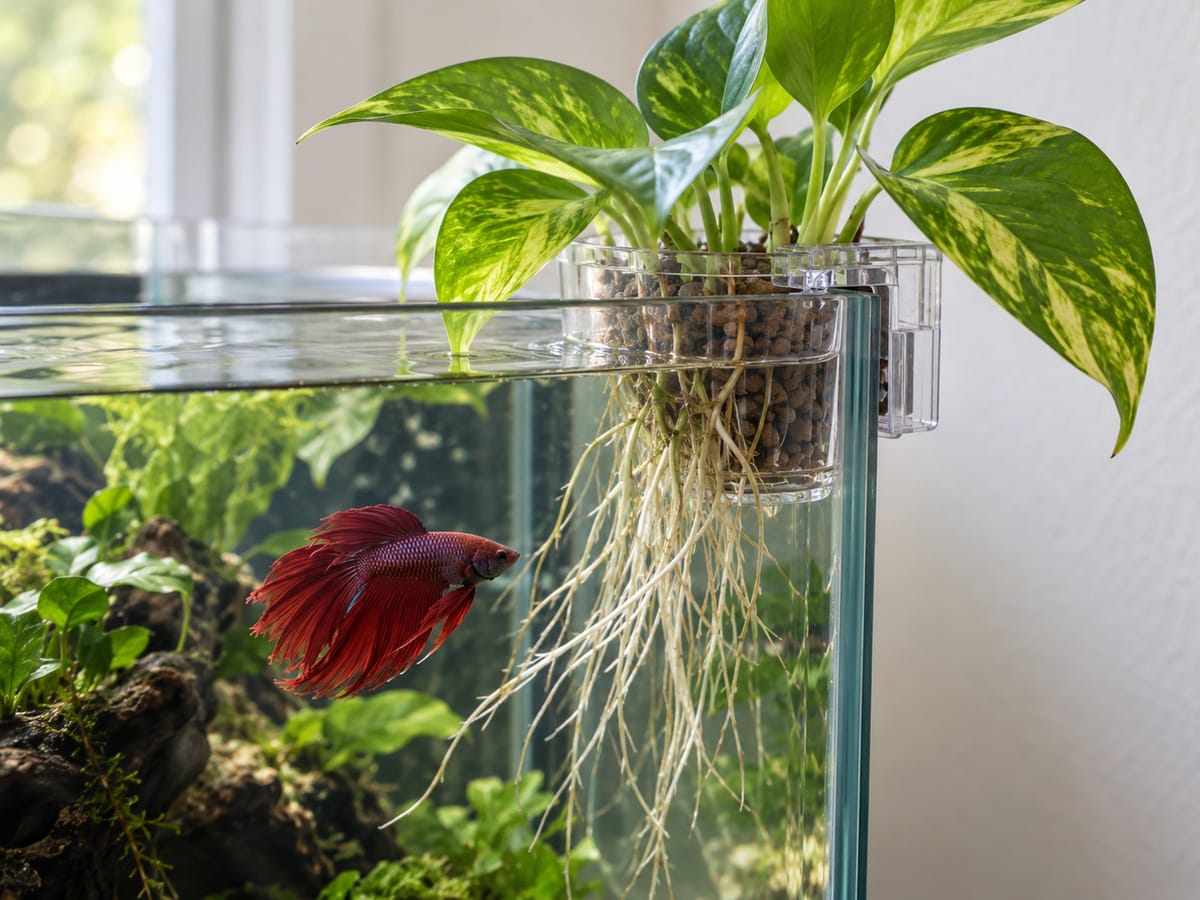
The quickest version, and the answer to the classic betta fish tank with plants on top, is a planter that hooks over the rim so a plant's roots trail into the water. Pothos, lucky bamboo, peace lily and spider plant cuttings are the usual choices because they root in water and do not mind low light. Each plant takes up a little nitrate, the end product of fish waste, which slows how fast it builds up between water changes. It is aquaponics in miniature: it helps, but it does not replace changing water. Our guide to the aquarium plant holder compares the hang-on cups and shows which plants suit them.

Borlech Large Aquarium Plant Holder (2 Pack)
A slotted plastic cup, 3.54 by 3.54 by 3.94 inches, that hooks over the tank edge (three hook sizes for glass or rims up to 1.57 inches) or sticks to the glass with suction cups. The slots let water flow through the roots, and the cup keeps fish from nibbling them. Sold with a houseplant cutting in mind, so it suits pothos and similar plants that grow out of the top of the tank.

Carpetsma Glass Aquarium Plant Pot
A small glass pot, 2.4 inches square, that hangs on the inside of the glass with two suction cups and has drainage holes in the base. It is sized for aquatic and semi-aquatic plants that live in or at the waterline rather than houseplants, so it is the better pick for a planted look than for growing anything to eat.
Option 2: A Raft Lid With Net Cups
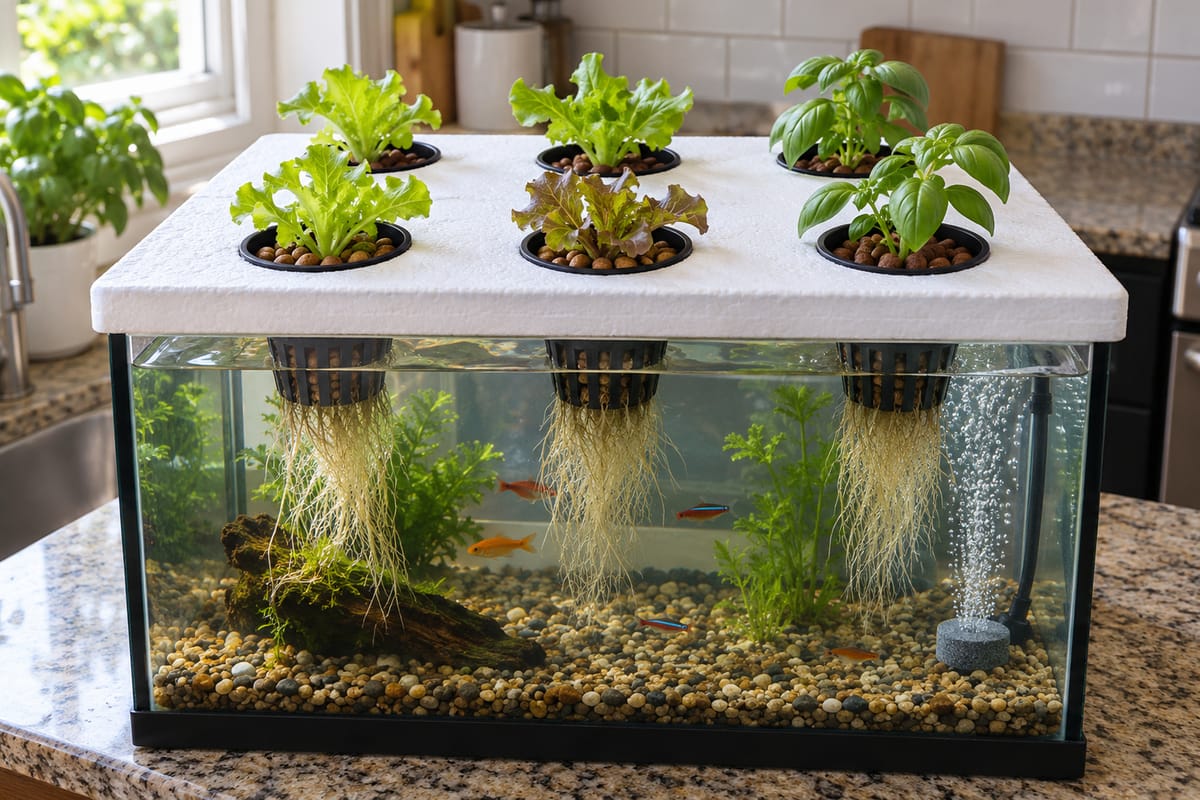
Cut a lid from acrylic or rigid foam to sit on the rim, drill holes for 2 or 3 inch net cups, and fill the cups with clay pebbles around each seedling. The roots hang straight into the tank water. This is a raft system, the same idea commercial growers use for lettuce, scaled down to an aquarium. It works well for leafy herbs, lettuce and watercress. Two rules make it work: run an air stone, because roots and fish now share the oxygen, and keep the fish load light, because there is no media bed filtering the water.
Option 3: A Pumped Grow Bed on Top
The most productive version sets a tray of grow media over the tank and pumps tank water up into it. The water trickles through the media, where bacteria convert the waste, and drains back down. A timer or a bell siphon lets the bed flood and drain so roots get air between waterings. You can buy this ready-made for a 10 gallon tank (the AquaSprouts Garden in our kits guide) or build it from a planter box, a small submersible pump and clay pebbles. SRAC publication 454 by Rakocy, Masser and Losordo recommends about 1 cubic foot of fish tank per 2 cubic feet of gravel in flood and drain systems. On an aquarium the bed is almost always smaller than that, which is fine: it simply means fewer fish and a lighter feeding schedule.
Setting Up, Step by Step
Whatever the option, the order is the same. Set up the tank and the bed or planters. Run the water and cycle it until ammonia and nitrite read zero and nitrate appears. Plant. Add a few fish, then more over the following weeks while you test. Keep the pH close to 7, the compromise SRAC 454 gives between the needs of the bacteria and the plants, and keep the tank out of direct sun.
Aquaponics Fish Tank Kit vs DIY
Both routes end with the same parts: a tank, a bed or raft for plants, a way to move water and something to grow in. A kit sells those parts matched to each other; a DIY build lets you pick the size and spend the money where you want it. The choice mostly follows tank size, which the comparison below makes plain.
What a Kit Includes
Kits come in three shapes, and our aquaponics kits guide reviews each in full. The AquaSprouts Garden is a grow bed with its pump and timer that fits a standard 10 gallon aquarium; the tank is not included. The Penn-Plax Aqua-Ponic is a 1.4 gallon planter with no pump, closer to a decorative pot with its roots in water than to a fish tank. The self-cleaning aquaponic fish tank is a small tank with a planting tray across the top and a siphon that raises and lowers the water so the roots can breathe. What you get is fit: the bed already matches the tank, and the pump is sized for it. What you give up is choice of size, because kits stop at the small end.
What a DIY Build Needs
A DIY aquaponics aquarium or stock tank needs six things:
- A watertight tank sized to the fish, such as the Tetra 10 and 20 gallon kits or the Tuff Stuff 50 gallon oval tank reviewed above.
- A grow bed: a plastic tray or planter box, or a raft lid, that sits over or beside the tank.
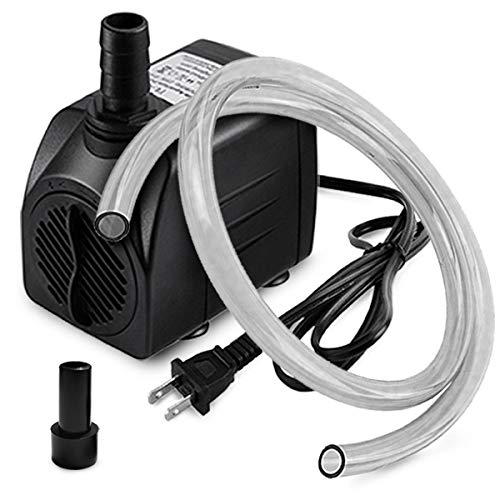
- A small submersible pump, such as the PULACO 160 GPH in the conversion kit below, with enough lift to reach the bed.
- Tubing and fittings between pump and bed, plus a drain or a bell siphon to bring the water back.
- Grow media, such as clay pebbles, or net cups for a raft lid.
- A water test kit, so you can see the cycle finish before the fish go in.
Most of these are the same parts as in the kits above, bought separately. The cost depends on the tank you start from and the bed you build, so we do not put a total on it. The one published breakdown we trust, a materials list for a repurposed IBC tote, is covered in our home aquaponics guide along with how to choose a size for your space. If you want a full build with plans, see how to build an aquaponics system.
10, 20 and 55 Gallon Setups Compared
The FAO's technical paper on small-scale aquaponics (Somerville and others, TP 589) caps fish at 20 kilograms per 1,000 liters of tank and halves that, to 1 kilogram per 100 liters, below 500 liters. That half rate is the ceiling in the table. It is written for food fish and is a limit, not a target: an ornamental community tank should sit well under it. For fish counts, see how many fish in a 10 gallon tank, and to find the volume of an odd-shaped tank, use our aquarium volume calculator.
| Tank | Liters | FAO ceiling at half rate | Grow bed fit | Kit or DIY | Cost |
|---|---|---|---|---|---|
| 10 gallons | 38 | 0.4 kg (0.8 lb) | Ready-made beds are built for the standard 20 by 10 by 12 inch footprint | Kit bed on a tank you buy | $$ |
| 20 gallons | 76 | 0.8 kg (1.7 lb) | No ready-made bed; build a tray or planter box on top | DIY | $$ |
| 55 gallons | 208 | 2.1 kg (4.6 lb) | Bed on a stand beside the tank | DIY | $$$ |
The pattern is simple. At 10 gallons a kit bed saves you the sizing work, and the small fish load keeps the feeding light. At 20 gallons you are building, because no bed is sold for the footprint. At 55 gallons the tank is closer to a stock tank than an aquarium, and a DIY bed on a stand is the usual route. A 50 gallon oval tank like the Tuff Stuff above sits just under the 55 gallon row. Cost tiers are relative: $ is the least, $$$ the most, and they move with the tank you pick.
Fish for an Aquaponics Fish Tank
Match the fish to the tank, not the other way round. In a 10 gallon aquarium, small hardy community fish such as guppies, platies, white cloud minnows or a single betta are the realistic choices. Goldfish produce a lot of waste, which plants like, but they grow large and need far more water than a small aquarium offers. Tilapia, perch, bluegill and catfish are stock tank and IBC fish. Our guides to the best fish for aquaponics and aquaponics tilapia go species by species, and the best plants for aquaponics guide covers what to grow over them.
What You Need to Convert an Aquarium
For options 2 and 3: a pump, cups, media and a way to see what the water is doing.
-
1Pump
PULACO 160 GPH Submersible Pump
An adjustable small pump with a maximum lift of 4 feet, enough to raise water from a 10 or 20 gallon tank into a bed on top.
-
2Net cups
ORIMERC 3 Inch Net Cups (12 Pack)
Slotted cups with a wide lip that will not drop through the holes in a raft lid.
-
3Grow media
Halatool Leca Clay Pebbles (2 lb)
Light, pH-neutral expanded clay for the cups or a small bed. Rinse before use.
-
4Water tests
API Freshwater Master Test Kit
pH, ammonia, nitrite and nitrate: the readings that tell you the tank has cycled and the fish are safe.


Yes, for a small herb bed and a few small fish. A 10 gallon tank holds about 38 liters, so the FAO's half rate for tanks under 500 liters puts the ceiling near 0.4 kilograms of fish. Think herbs and greens, not a harvest, and keep the stocking light.
The best aquaponics tank is a food-safe one sized to your fish: a glass aquarium of 10 to 29 gallons indoors, and a poly stock tank, fiberglass tank or IBC tote outdoors. Round or oval tanks circulate water better than square ones, and opaque tanks grow less algae in sunlight.
Aquaponics is easy to maintain once the tank has cycled. Daily care is feeding the fish and a quick look; weekly care is a water test, topping up evaporation and clearing roots or debris from the pump intake. The hard part is the first month, while the bacteria establish and readings swing.
Yes. Any established aquarium can become a DIY aquaponics system with hang-on planters, a lid with net cups over the water, or a grow bed on top fed by a small pump. Start with leafy herbs, keep the fish load light, and test the water weekly while the plants settle in.
Plants that root happily in water suit a betta tank best: pothos, lucky bamboo, peace lily, spider plant and philodendron cuttings, or herbs such as mint and watercress. Keep the leaves above the water and only the roots below, and leave the betta some open surface, since it gulps air from the top.
You can, on a small scale. A 5 gallon tank supports one small fish, such as a betta, and a planter or tray with a few herbs or houseplants. Expect it to behave like a planted aquarium with help from the plants, not a food system, and keep up regular partial water changes.
For an indoor aquarium, small hardy fish such as guppies, platies, white cloud minnows or one betta. For stock tanks and IBC totes, goldfish, koi, bluegill, catfish and, in warm water, tilapia. Pick fish that suit your water temperature without much heating, because that keeps running costs down.
Grow along with us
New guides and seasonal tips for fish, plants and DIY builds, about once a month.