Plants and media
Clay Pebbles for Aquaponics: Hydroton, LECA and the Best Brands
As an Amazon Associate we earn from qualifying purchases. How we choose products.
On this page
- What Are Clay Pebbles?
- Why Clay Pebbles Work So Well in Aquaponics
- Clay Pebbles vs Other Aquaponics Grow Media
- Pros and Cons of Clay Pebbles
- What Size Clay Pebbles Do You Need?
- How Many Clay Pebbles Do You Need for a Grow Bed?
- How to Prepare Clay Pebbles Before You Use Them
- Cleaning and Reusing Clay Pebbles
- The Best Clay Pebbles for Aquaponics
- Clay Pebbles Beyond the Grow Bed
Clay pebbles are the most popular grow media for small aquaponics systems, and for good reason: they are light, pH neutral, easy on your hands and they never break down in the grow bed. You will see them sold as clay pebbles, expanded clay, Hydroton, LECA or simply "grow rocks", and they are all the same kind of product. This guide explains what clay pebbles for aquaponics actually do, how they compare with gravel and other media, how many bags a grow bed really takes, and which brands we would buy.
Everything below is based on published sources, which we name as we go: mainly the FAO manual Small-scale aquaponic food production (Somerville and colleagues, FAO Fisheries and Aquaculture Technical Paper 589, 2014), the University of Maryland Extension build guide for an IBC system, and the manufacturers' own listings. If you are still choosing a system, start with our guide to home aquaponics; if you are building a bed right now, keep reading.
Editor's Choice
Mother Earth Hydroton Original Expanded Clay Pebbles, 50 Liter
The original Hydroton expanded clay, made in Germany, in the bag size that makes sense for a real grow bed. The maker lists it at 8 to 16 mm and says it is semi-porous and generally does not float like other products can.
-
Big bag alternative
GROW!T Expanded Clay Pebbles, 40 L
Hydrofarm's 4 to 16 mm clay, sold pre-washed and described as stable in both pH and EC.
-
For small and indoor setups
Hydroton Original Clay Pebbles, 10 Liter
The same Hydroton clay in a small bag, enough for net pots, a tabletop system or topping up a bed.
What Are Clay Pebbles?
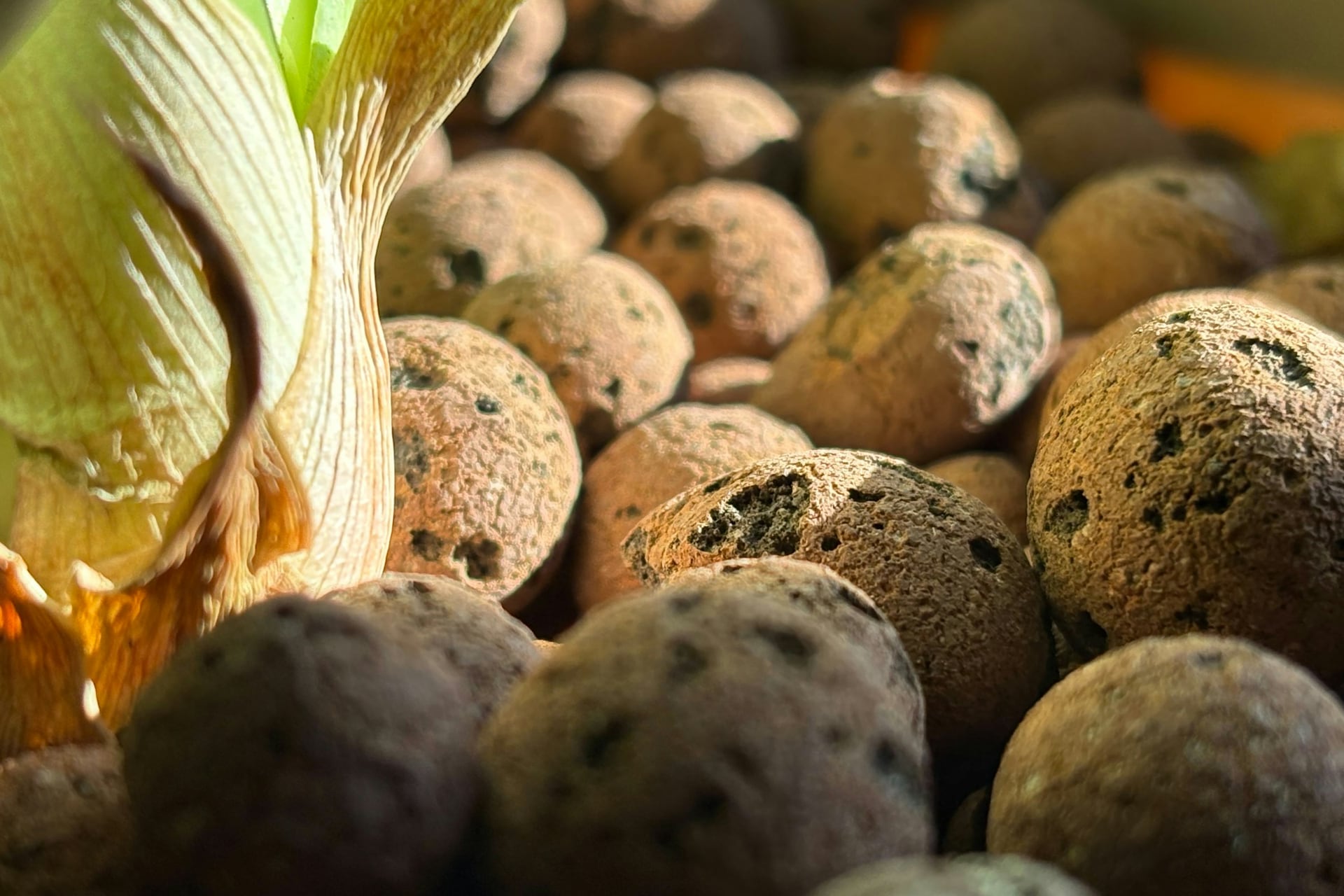
Clay pebbles are small balls of expanded clay. Mother Earth, which sells the Hydroton brand, describes the process on its listing: natural clay is mined, formed into pellets and then kiln fired at high temperature, which makes the clay expand into tough, lightweight balls full of tiny air pockets. The outside is hard and rough; the inside is honeycombed, which is why a pebble feels so light for its size.
The FAO manual notes that this material was originally manufactured for thermal insulation of building roofs and only later moved into hydroponics. That history explains two things you will notice when you buy it: it is sold in volume (liters) rather than weight in most grow shops, and some cheaper bags are aimed at houseplants rather than at grow beds.
Clay Pebbles, Expanded Clay, LECA and Hydroton: One Product, Many Names
LECA stands for lightweight expanded clay aggregate (the FAO writes it as "light expanded clay aggregate"). It is the generic, technical name. Hydroton is a brand of that same material, and it became so common in American grow shops that many gardeners use it as the generic word, the way people say "Kleenex" for tissues. Houseplant growers tend to say LECA, hydroponic growers say Hydroton or clay pebbles, and the bags on Amazon use all of the words at once. When you shop, compare the size range, whether the clay is pre-washed and the bag volume, not the name on the front.
Why Clay Pebbles Work So Well in Aquaponics
In a media bed system, the grow media is not just something for the roots to hold on to. It is also the biofilter. The University of Maryland Extension guide How to Build a Low-Cost, Small-Scale Aquaponic System (EM-2023-0698, updated 2024) puts it plainly: the grow media holds plants in position and serves as a biofilter. The nitrifying bacteria that convert ammonia from the fish into nitrate for the plants live on the surface of every pebble.
Surface Area for Bacteria
The FAO manual lists the surface area of expanded clay at about 250 to 300 square meters per cubic meter and calls that within the target range for aquaponics. More surface means more room for bacteria, which means a bed that can process more fish waste. Volcanic gravel scores a little higher, plastic bottle caps far lower.
Neutral pH and Inert
FAO sets out the essential criteria for any aquaponic medium: it must be inert, not dusty, non-toxic and pH neutral, so it does not change the water chemistry your fish and bacteria depend on. Expanded clay meets that bar, which is why it is the default choice for beginners. Limestone gravel is the classic mistake here: FAO rates it as basic, meaning it pushes the pH up over time.
Light and Easy to Work With
FAO describes LECA as very comfortable to work with and ideal for rooftop production because it is so light compared with other substrates. In practice that means a grow bed you can lift, move or rebuild, and roots you can pull out at harvest without wrestling a bucket of gravel.
Clay Pebbles vs Other Aquaponics Grow Media
The FAO manual compares the common media in its Table 4.1. We have reproduced the parts that matter for a home grower; the ratings are FAO's, the notes in the last column are ours.
| Media | Surface area (m²/m³) | pH | Cost | Weight | Ease to work with | Our note |
|---|---|---|---|---|---|---|
| Expanded clay (LECA) | 250 to 300 | Neutral | High | Light | Easy | The easy, clean choice for indoor and small systems |
| Volcanic gravel (tuff) | 300 to 400 | Neutral | Medium | Medium | Medium | FAO's top pick where it is sold locally; rinse the dust well |
| Volcanic gravel (pumice) | 200 to 300 | Neutral | Medium to high | Light | Easy | Light like clay, but some pieces float |
| Limestone gravel | 150 to 200 | Basic | Low | Heavy | Difficult | Cheap, but it raises pH; avoid it |
| Plastic bottle caps | 50 to 100 | Inert | Low | Light | Easy | Free if you collect them; poor plant support |
| Coconut fibre | 200 to 400 | Neutral | Low to medium | Light | Easy | Breaks down and can clog a bed over time |
Source: FAO, Small-scale aquaponic food production (2014), Table 4.1.
The trade-off is simple: clay pebbles cost more than gravel per cubic foot, and FAO notes they are not widely available in every country. In the United States they are easy to buy, so for most home growers the extra cost buys a lighter, cleaner bed that is easier to plant and harvest. If you are filling several large IBC beds on a tight budget, local lava rock or a mix is worth pricing too. Our guide to the aquaponics grow bed covers bed design in more detail.
Pros and Cons of Clay Pebbles
- ✅ Large surface area for nitrifying bacteria, inside FAO's target range.
- ✅ pH neutral and inert, so they do not fight your water chemistry.
- ✅ Light, which matters for indoor stands, shelves and anything on a deck or rooftop.
- ✅ Reusable. Mother Earth says Hydroton is reusable as long as it is cleaned thoroughly between uses.
- ✅ Easy planting and harvest. Loose pebbles let you pull out a root ball without tearing it apart.
- ❌ Higher cost than gravel or lava rock, as FAO points out.
- ❌ New pebbles can float. The hydroponics training site Upstart University notes that clay pebbles can float for the first few months until they are saturated, and floating pieces get sucked into filters and drain lines.
- ❌ Dust. Unrinsed pebbles shed fine red dust that clouds the water and can clog small pumps and drippers.
- ❌ Low water holding. Clay pebbles drain fast, which is perfect in a flood and drain bed but means seedlings in a slow or interrupted cycle can dry out.
What Size Clay Pebbles Do You Need?
Size matters more than brand. The FAO manual says that for aquaponics the larger sizes, with diameters of 8 to 20 mm, are recommended. Larger pebbles leave bigger gaps, so water drains quickly through a bell siphon cycle and fish solids are less likely to block the bed.
8 to 16 mm: Media Beds and Net Pots
Hydroton Original is sold at 8 to 16 mm according to its listing, which sits inside FAO's range. This is the size to fill a flood and drain grow bed or the net pots of a raft system.
4 to 16 mm Mixed: Houseplants and Small Pots
Many LECA bags sold for houseplants, including the Halatool and Legigo bags below, are a 4 to 16 mm mix. Halatool says the mixed grading is intentional so the pebbles settle into complex root systems, which is great for orchids and semi-hydro pots. In a big aquaponics bed, the small pieces can pack the gaps tighter, so we use these bags for small indoor systems, seed starting and topping up rather than for filling a whole IBC bed.
How Many Clay Pebbles Do You Need for a Grow Bed?
Work it out from the volume of the bed, then round up to whole bags. Clay pebbles are sold by the liter, so convert your bed to liters first.
Step 1: Choose the Bed Depth
FAO recommends a media depth of 30 cm (about 12 inches) for large fruiting crops such as tomatoes, okra or cabbage, and notes that small leafy greens only need 15 to 20 cm (about 6 to 8 inches). A shallower bed takes fewer bags but limits what you can grow.
Step 2: Calculate the Volume
Multiply length × width × depth in inches and divide by 1,728 to get cubic feet, then multiply by 28.3 to get liters. Or measure in centimeters and divide length × width × depth by 1,000 to get liters directly.
| Grow bed (L × W × depth) | Volume | 50 L bags | 10 L bags |
|---|---|---|---|
| 24 × 12 × 6 in (tabletop) | about 1 cu ft / 28 L | 1 (with some left) | 3 |
| 36 × 24 × 8 in | 4 cu ft / 113 L | 3 | 12 |
| 48 × 24 × 12 in | 8 cu ft / 226 L | 5 | 23 |
| 48 × 40 × 12 in (cut IBC tote) | about 13 cu ft / 377 L | 8 | 38 |
For a real-world check, the University of Maryland Extension IBC build lists four 50 liter bags of Hydroton for its grow bed, made from the top section of a 275 gallon tote cut about 12 inches from the top. Four bags is about 200 liters, roughly half the volume of the last row in our table, so treat that as a minimum and plan for more if you fill a tote bed to the top. Buy for the depth you will actually fill, and keep one spare bag for topping up as the pebbles settle.
Step 3: Size the Sump for the Water the Pebbles Leave
FAO points out that, depending on the medium, the media will occupy roughly 30 to 60 percent of the total bed volume. The rest is water when the bed floods. In a system with a sump tank, the sump has to hold at least the water from all the media beds so the pump never runs dry. Our aquaponics pump guide and bell siphon guide explain how that flood and drain cycle works.
How to Prepare Clay Pebbles Before You Use Them
- Rinse. Mother Earth's own instruction for Hydroton is to rinse all expanded clay before use. Put the pebbles in a bucket or a laundry basket with holes, hose them down and stir until the water runs clear. Do this outdoors; the red dust stains.
- Soak. Leave the rinsed pebbles in a bucket of water before they go into the bed. Pebbles that are already wet are heavier and less likely to float out over the standpipe. Overnight is a sensible default.
- Fill the bed. Put a guard around the bell siphon or standpipe first so pebbles cannot fall into the drain, then fill to the depth you planned.
- Run the system before adding fish. Cycle the system so the bacteria colonize the pebbles first. Our guide to fishless cycling walks through it step by step.
Do You Have to Soak Clay Pebbles Before Planting?
It is not strictly required, but it helps. Rinsing is the step that matters most, because it removes the dust that clouds the water. Soaking makes the pebbles sink and settle, and it means seedlings planted into the bed are not sitting in bone-dry clay that wicks moisture away from young roots. In a flood and drain bed, the first few cycles will finish the job either way.
Cleaning and Reusing Clay Pebbles
Expanded clay does not rot, so it lasts for years. Upstart University describes clay pebbles as reusable almost indefinitely, as long as you rinse out built-up silt and organic matter before reusing them.
In a Running Aquaponics Bed
You rarely need to clean the whole bed. Fish solids and old roots break down in the pebbles, and many growers add composting worms to media beds to help with that. If one area starts to smell or stays waterlogged, pull out the pebbles from that patch, rinse them in a bucket of system water rather than tap water so the bacteria survive, and put them back.
Between Uses
When you strip a bed down, shake out the roots, rinse the pebbles with a hose, soak them, rinse again and let them dry completely before storing them in bags. That is the moment to sterilize if you had a disease problem, before they go anywhere near fish again.
The Best Clay Pebbles for Aquaponics
We chose these bags from the listings with the largest number of buyer reviews and a solid average among the expanded clay sold on Amazon US, then checked each listing's size range and the maker's instructions. The notes are based on what each maker states, plus our reading of how that fits an aquaponics bed.

Mother Earth Hydroton Original, 50 Liter (Editor's Choice)
This is the clay the whole category is named after. The listing describes natural clay that is mined, formed into pellets and kiln fired until it expands into tough, lightweight balls, made in Germany. The 50 liter bag is the practical size for aquaponics: two of them fill a small bed, and a cut IBC bed takes several.
Mother Earth says Hydroton is semi-porous and generally does not float like other products can, and gives the size as 8 to 16 mm, which is inside the 8 to 20 mm range FAO recommends for aquaponics. It still needs a rinse before use, as the maker itself advises, and the big bags have an easy pour spout.

GROW!T Expanded Clay Pebbles, 40 L (Best Pre-Washed)
Hydrofarm's GROW!T clay is the main alternative to Hydroton in hydroponic shops. The listing describes it as made from 100% natural clay, pre-washed to aid stability, extremely stable in both pH and EC, and says the pebbles drain freely and will not float once fully wet.
The size is a 4 to 16 mm mix, slightly finer at the bottom end than Hydroton. That works in a media bed, though we would still guard the standpipe carefully. Pre-washed does not mean dust-free: give it a rinse anyway.

Hydroton Original Clay Pebbles, 10 Liter (Best Small Bag)
The same Hydroton clay in a 10 liter bag. It is the sensible buy for a tabletop or aquarium-top system, for filling net pots in a raft bed, or for topping up a bed that has settled. If your bed is bigger than about 30 liters, the 25 liter bag (Hydroton Original 25 L) or the 50 liter bag above will save you a lot of small packages.

Halatool LECA Clay Pebbles, 10 lb (For Indoor Pots and Small Systems)
A 10 pound bag of 4 to 16 mm LECA that Halatool describes as kiln-fired, inert and pH neutral, made to rinse clean fast without clouding the water. The maker pitches it at houseplants, orchids, DWC buckets and Kratky planters, and the mixed grading is deliberate.
For a tabletop aquaponics tank, a window-sill herb system or seed starting, it is an easy, compact buy. For a full flood and drain bed we prefer the larger, more uniform Hydroton size.

Legigo LECA Clay Pebbles, 10 lb
Another 4 to 16 mm LECA bag, sold in a resealable foil pouch, which is handy if you keep a stock of pebbles for repotting. Legigo describes the clay as natural, baked at high temperature, pH neutral and suitable for hydroponics and aquaponics as well as houseplants.
It is a close alternative to the Halatool bag. Pick whichever pouch size fits your system; Legigo sells sizes up to a 19 pound bag (Legigo 19 lb).
Clay Pebbles Beyond the Grow Bed
Net Pots in Raft and NFT Systems
Deep water culture (raft) and NFT systems do not need a full media bed, but each plant still sits in a net pot, and a handful of clay pebbles is the usual way to hold a seedling upright. Because these systems have no media bed acting as a biofilter, they need a separate filter; our guide to building an aquaponics system compares the three designs.
Tabletop Kits and Aquarium-Top Gardens
Most small kits, including several we cover in our aquaponics kits guide and on the aquaponics fish tank page, ship with a small bag of clay pebbles. When it runs low, a 10 liter bag is plenty.
Houseplants and Soil Gardens
The same LECA is widely used for semi-hydro houseplants, as a drainage layer at the bottom of pots and as a top dressing. Those are fine uses, but pebbles that have been in soil should not go back into an aquaponics system.
Grow along with us
New guides and seasonal tips for fish, plants and DIY builds, about once a month.