Buying guide
Best TDS Meters for Hydroponics, Aquaponics and Tap Water (and How to Read One)
As an Amazon Associate we earn from qualifying purchases. How we choose products.
Best Overall: HM Digital TDS-3 Check price on Amazon
On this page
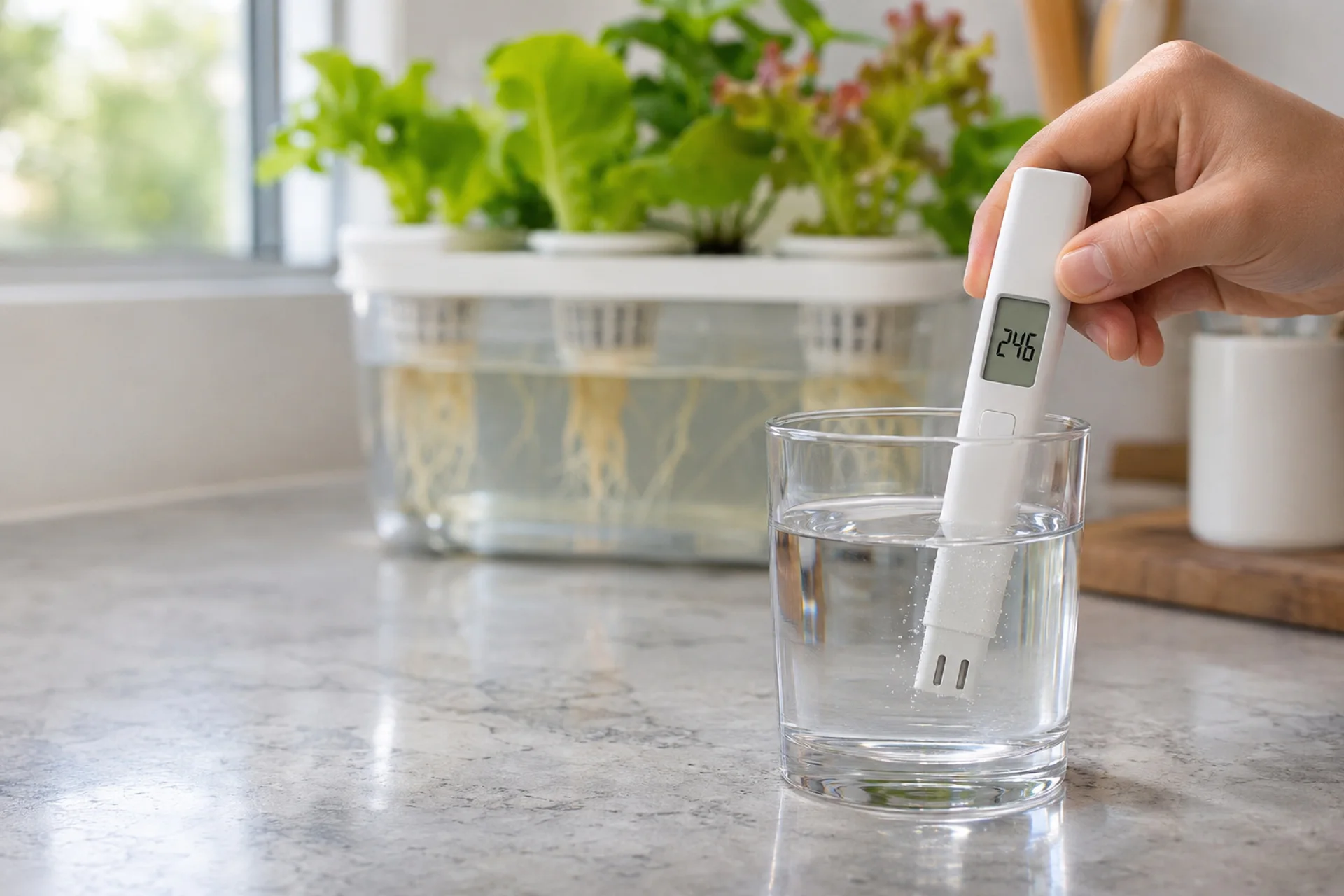
The best TDS meters do one job well: they measure how easily electricity passes through water and turn that into a parts per million number you can track from week to week. For hydroponics that number is your nutrient strength. For aquaponics it warns you when salts are building up. For tap water it shows what your filter is removing.
This guide compares six TDS and EC meters sold on Amazon US, from a basic pen to a waterproof nutrient meter, using the makers' published specifications rather than our own lab tests. Then it explains how to read a TDS meter, why two meters can show different ppm in the same glass, and the one thing every fish keeper needs to know: a TDS meter cannot see ammonia or nitrite.
Best Overall
A simple pen with a 0 to 9,990 ppm range, 1 ppm resolution, plus or minus 2 percent stated accuracy, a hold button and a built-in thermometer.
-
Best for hydroponic nutrients
Bluelab Truncheon Nutrient Meter
Waterproof, factory calibrated and shows EC, CF and both the 500 and 700 ppm scales, so you always know which scale a feed chart means.
-
Best budget
HoneForest TDS, EC and Temperature Meter
Reads TDS and EC with a backlit screen that locks the reading once it settles.
How to Choose a TDS Meter
TDS pens look identical in photos. Four specifications separate the ones worth buying.
TDS Only, or EC Too
A TDS meter does not count dissolved solids directly. As Hanna Instruments explains, it measures electrical conductivity (EC) and calculates TDS as a factor multiplied by EC. A meter that also shows EC lets you compare readings with any feed chart, because EC is the same on every meter while ppm is not.
Which Conversion Scale
Hanna gives the factor as 0.5 for strong ionic solutions and 0.7 for weak ionic solutions such as fertilizers, and says basic units are set to 0.5 automatically. So 1.0 mS/cm reads 500 ppm on a 0.5 meter and 700 ppm on a 0.7 meter. The Bluelab Truncheon prints both: 100 to 1,800 ppm on the EC x 500 scale and 140 to 2,520 ppm on the EC x 700 scale. Nutrient labels and growing guides are written for one scale or the other, so check before you adjust a reservoir.
Temperature Compensation
Conductivity rises as water warms. Meters with automatic temperature compensation (ATC) correct the reading to a reference temperature, so a cold reservoir in the morning and a warm one at night read alike. Apera lists ATC from 0 to 50 °C on its EC20, and Bluelab lists it on the Truncheon.
Calibration
Cheap pens drift. Some can be recalibrated: HM Digital says its TDS-EZ is calibrated with a 342 ppm sodium chloride solution and can be reset with a small screwdriver. The Apera EC20 kit ships with calibration solutions and recognizes them automatically. The Bluelab is sold factory calibrated and needs no calibration, according to the listing.
Best TDS Meters Compared
Picks are ordered by how well they serve a home grower or fish keeper, not by price. Specifications are as the makers list them on Amazon.
| Product | HM Digital TDS-3 Best Overall | Bluelab Truncheon Hydroponics | HoneForest TDS/EC Budget | Apera EC20 Calibratable EC | VIVOSUN pH + TDS set pH included |
|---|---|---|---|---|---|
| Product |  |  | 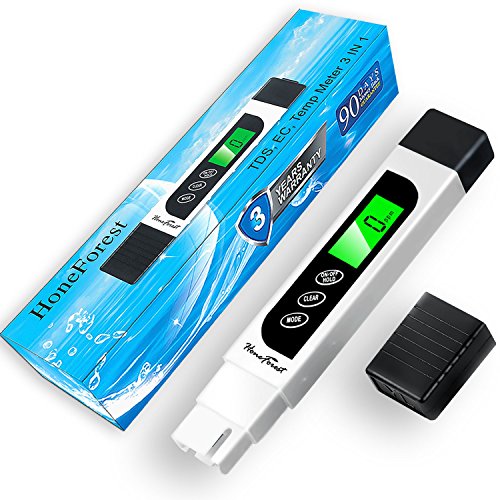 |  |  |
| Reads | TDS, temperature | EC, CF, ppm 500 and ppm 700 | TDS, EC, temperature | EC, TDS, temperature | pH (separate pen), TDS, EC, temperature |
| Range | 0 to 9,990 ppm | 0.2 to 3.6 EC | 0 to 9,990 ppm | 0 to 20 mS/cm | 0 to 9,990 ppm |
| Stated accuracy | ± 2% | Not stated | Not stated | ± 1% full scale | ± 2% |
| Temperature compensation | Not stated | Yes | Not stated | Yes, 0 to 50 °C | Not stated for TDS pen |
| Calibration | Not stated | Factory calibrated | Not stated | Auto, solutions included | pH buffers included |
| Price tier | $ | $$ | $ | $ | $ |
| Buy | Check price on Amazon | Check price on Amazon | Check price on Amazon | Check price on Amazon | Check price on Amazon |
Best Overall
HM Digital TDS-3
- Reads
- TDS, temperature
- Range
- 0 to 9,990 ppm
- Stated accuracy
- ± 2%
Show specifications
- Temperature compensation
- Not stated
- Calibration
- Not stated
- Price tier
- $
Hydroponics
Bluelab Truncheon
- Reads
- EC, CF, ppm 500 and ppm 700
- Range
- 0.2 to 3.6 EC
- Stated accuracy
- Not stated
Show specifications
- Temperature compensation
- Yes
- Calibration
- Factory calibrated
- Price tier
- $$
Budget
HoneForest TDS/EC
- Reads
- TDS, EC, temperature
- Range
- 0 to 9,990 ppm
- Stated accuracy
- Not stated
Show specifications
- Temperature compensation
- Not stated
- Calibration
- Not stated
- Price tier
- $
Calibratable EC
Apera EC20
- Reads
- EC, TDS, temperature
- Range
- 0 to 20 mS/cm
- Stated accuracy
- ± 1% full scale
Show specifications
- Temperature compensation
- Yes, 0 to 50 °C
- Calibration
- Auto, solutions included
- Price tier
- $
pH included
VIVOSUN pH + TDS set
- Reads
- pH (separate pen), TDS, EC, temperature
- Range
- 0 to 9,990 ppm
- Stated accuracy
- ± 2%
Show specifications
- Temperature compensation
- Not stated for TDS pen
- Calibration
- pH buffers included
- Price tier
- $
TDS Meter Reviews
HM Digital TDS-3 (Best Overall)
The TDS-3 is the pen most people picture when they say TDS meter. HM Digital lists a 0 to 9,990 ppm range, 1 ppm resolution and plus or minus 2 percent readout accuracy, with a built-in thermometer, a hold function that freezes the number on screen, and auto-off after 10 minutes. It comes with a carrying case and belt clip.
That range covers everything a home grower measures, from filtered drinking water near zero to a strong hydroponic reservoir. It is a TDS-only pen, so note that it reports ppm on its own scale; if your nutrient chart is written in EC, a meter that shows EC is easier.
- ✅ Wide range and fine resolution for tap water and reservoirs
- ✅ Hold button and built-in thermometer
- ✅ Case and belt clip included
- ❌ TDS only, no EC readout
- ❌ No waterproof rating stated
Bluelab Truncheon Nutrient Meter (Best for Hydroponic Nutrients)
The Truncheon is a long wand you dip straight into a reservoir while you mix. Bluelab lists it as factory calibrated, fully waterproof and with automatic temperature compensation, and it has no buttons or switches. Its range is 0.2 to 3.6 EC, which Bluelab also shows as 100 to 1,800 ppm on the 500 scale and 140 to 2,520 ppm on the 700 scale. It is made in New Zealand and carries a 5-year limited warranty.
The range is narrow on purpose: it starts where plant nutrition starts, so it is not the tool for checking a water filter near zero. For a hydroponic grower who mixes feed every week it removes the two common errors, the wrong scale and an uncalibrated pen. Pair it with one of our hydroponic nutrient picks.
- ✅ Shows EC and both ppm scales
- ✅ Waterproof, factory calibrated, ATC
- ✅ 5-year limited warranty
- ❌ Range starts at 0.2 EC, too high for drinking water checks
- ❌ The most expensive pick here ($$)
HoneForest TDS, EC and Temperature Meter (Best Budget)
The HoneForest pen reads TDS, EC and temperature in °F or °C over 0 to 9,990 ppm. The maker lists a titanium alloy probe, a backlit screen, and an auto-lock that holds the reading once it stabilizes, then switches off after 2 minutes without use. It is sold for drinking water, RO systems, aquariums and hydroponics.
It is the cheapest way to get EC as well as ppm on one screen. The maker does not state an accuracy figure or whether it compensates for temperature, so treat it as a trend meter: the same pen, the same water, the same time of day.
- ✅ TDS and EC on one cheap pen
- ✅ Backlit screen with auto-lock
- ❌ No published accuracy
- ❌ ATC not stated
Apera Instruments EC20 (Best Calibratable EC Meter)
The EC20 is a pocket tester from a lab-equipment brand. Apera lists plus or minus 1 percent full-scale accuracy from 0 to 20 mS/cm, a brush-resistant platinum black probe, automatic temperature compensation from 0 to 50 °C, auto calibration that recognizes the buffer, and a dual display of temperature and reading. The kit includes ready-to-use calibration solutions, batteries and a case, and Apera quotes 1,000 hours of operation on AAA batteries.
Choose it if you want to trust the number, not just the trend: you can check it against a known solution whenever you like. It suits growers who log EC for a DWC system or anyone who wants to catch salt build-up in an aquaponics loop early.
- ✅ Published accuracy and real calibration
- ✅ ATC over a wide temperature range
- ✅ Calibration solutions in the box
- ❌ Calibration solution is a consumable you will rebuy
VIVOSUN pH Meter and TDS Meter Set (Best With pH)
VIVOSUN sells two pens together: a pH meter covering 0 to 14 and a 3-in-1 TDS meter covering 0 to 9,990 ppm and 0 to 9,990 µS/cm, with plus or minus 2 percent stated accuracy. Three pH calibration buffers and a protective case are included. The maker notes that the meter cannot test sea water.
Hydroponics needs both readings, so the pair saves a second purchase. pH pens need regular calibration and careful storage to stay accurate, which is true of every cheap pH pen, not only this one.
- ✅ pH and TDS in one purchase
- ✅ pH buffers included
- ❌ Not for salt water
- ❌ Two pens to keep calibrated

HM Digital TDS-EZ (Simplest Recalibratable Pen)
HM Digital calls the TDS-EZ its economy model. It reads 0 to 9,990 ppm, in 1 ppm steps up to 999 and 10 ppm steps above, with 3 percent stated accuracy. It is calibrated at the factory with a 342 ppm sodium chloride solution and can be recalibrated with a mini screwdriver, and a TDS chart sticker on the back explains common values. HM Digital lists about 1,000 hours of battery life.
For checking a water filter or a top-up supply, it does the job at the lowest cost of any branded pen here.
- ✅ Can be recalibrated
- ✅ Reference chart on the meter
- ❌ Slightly lower stated accuracy than the TDS-3
How to Read a TDS Meter
Reading the number is easy. Knowing what it means depends on what is in the water.
Take a Clean Reading
Rinse the probe, dip it to the depth the maker marks, stir gently to clear air bubbles, and wait until the number settles or the meter locks it. Read at the same time of day and in the same spot if you are comparing readings, and rinse the probe again before you put the cap back.
Know Which Scale You Are On
Your meter's manual says whether it multiplies EC by 0.5, 0.7 or another factor. If a feed chart says 800 ppm and does not say which scale, convert it to EC first: 800 ppm is 1.6 mS/cm on the 500 scale but about 1.14 mS/cm on the 700 scale. That difference is enough to under-feed or over-feed a crop.
TDS Ranges for Tap Water
The US EPA lists a secondary standard of 500 mg/L for total dissolved solids, and names hardness, deposits, colored water, staining and a salty taste as the noticeable effects above it. Secondary standards are guidelines for taste and appearance, not health limits. A TDS reading does not identify what is dissolved, so it cannot tell you whether water contains a particular contaminant.
TDS Ranges for Hydroponics and Aquaponics
SRAC Publication 454 on aquaponics (Rakocy, Masser and Losordo, 2006) gives the recommended TDS for a hydroponic solution as 1,000 to 1,500 ppm, and says an aquaponic system gives good results at considerably lower levels, 200 to 400 ppm or an EC of 0.3 to 0.6, because fish supply nutrients continuously. It warns that plants suffer above 2,000 ppm, and that if readings climb toward that level you should change more water or reduce the fish and the feed. FAO's aquaponics manual adds a rule for source water: salinity is generally too high if it reads more than 1,500 µS/cm or 800 ppm.
| Water | Typical target or limit | Source |
|---|---|---|
| Drinking water | Below 500 mg/L (secondary standard) | US EPA |
| Source water for aquaponics | Below 800 ppm or 1,500 µS/cm | FAO Technical Paper 589 |
| Aquaponics system water | 200 to 400 ppm (EC 0.3 to 0.6) | SRAC 454 |
| Hydroponic solution | 1,000 to 1,500 ppm | SRAC 454 |
| Plant damage risk | Above 2,000 ppm | SRAC 454 |
Using a TDS Meter in Each System
Hydroponics
Measure your tap water first and write the baseline down, then add nutrients and measure again. The difference is what the plants are getting. Top up with plain water as the reservoir drops, and remix when the reading or the pH will not hold. Our beginner hydroponics guide covers the weekly routine.
Aquaponics
Here the meter is a warning light rather than a dosing tool. A slow rise over weeks is normal as the fish are fed. A steady climb toward the levels SRAC warns about means too much feed for the plant area, or not enough water exchange. Our grow bed sizing guide explains how feed and bed area should match.
Aquariums and Top-Up Water
For an aquarium, the most useful job for a TDS pen is checking top-up water and a reverse osmosis filter. Evaporation leaves salts behind, so topping up with hard tap water raises TDS over time even if the fish load is steady.
Best TDS Meters FAQ
Related: water test kits, hydroponic nutrients, aquaponics vs hydroponics and how to lower pH.
Grow along with us
New guides and seasonal tips for fish, plants and DIY builds, about once a month.