Fish guide
How Many Fish in a 10, 20 or 55 Gallon Tank
As an Amazon Associate we earn from qualifying purchases. How we choose products.
On this page
- The Rule of Thumb, and Why It Uses Adult Size
- How Many Fish in a 10 Gallon Tank
- How Many Fish in a 20 Gallon Tank
- How Many Fish in a 55 Gallon Tank
- How Many Gallons per Fish Do You Need?
- What Changes With Plants on Top
- Food Fish Need Far More Water
- Which Kit Fits a 10 Gallon Tank
- How Many Fish in a 10 Gallon Tank FAQ
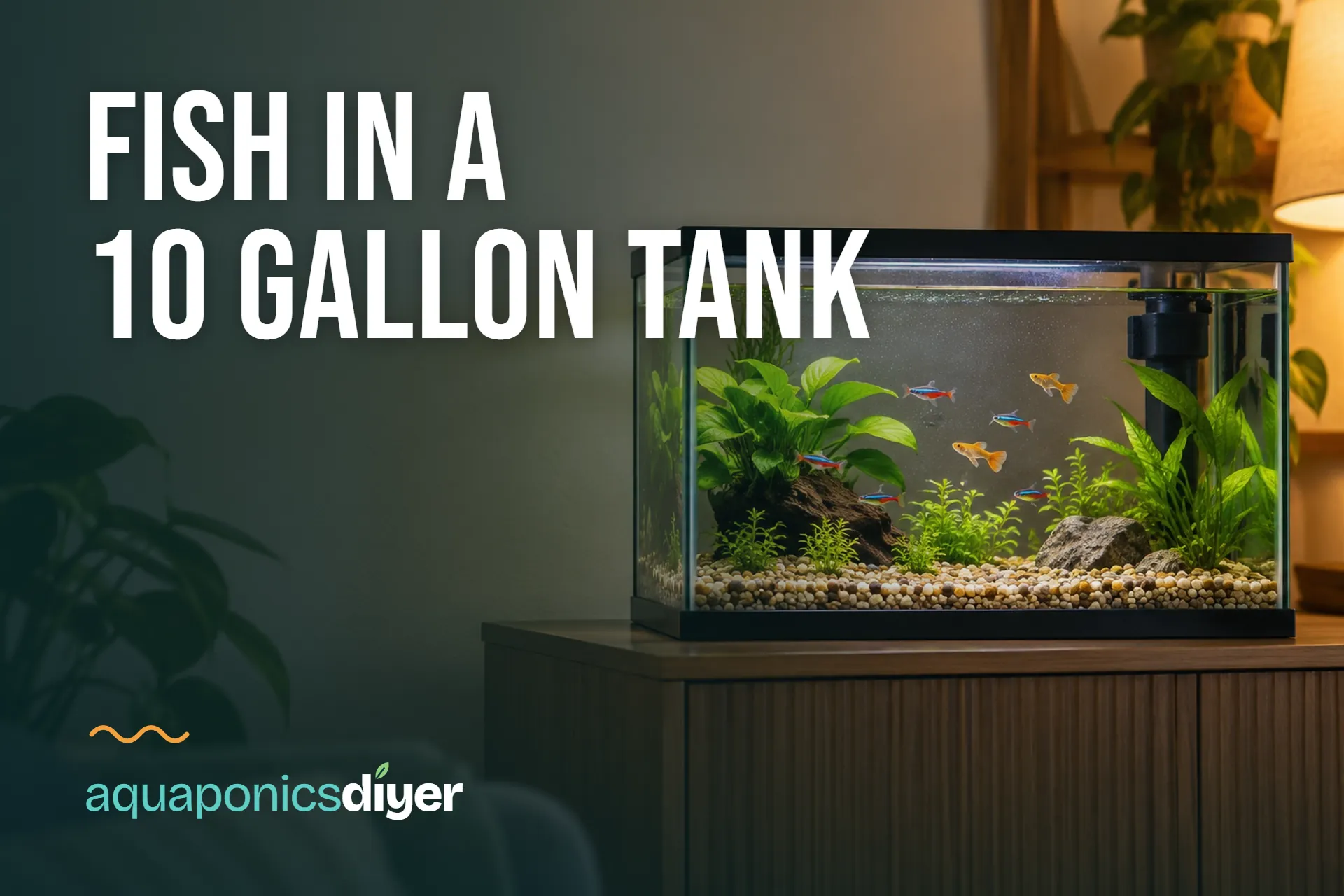
The short answer to how many fish in a 10 gallon tank is about 8 inches of adult fish in total. That is roughly eight neon tetras, four male guppies or a handful of white cloud mountain minnows, not a tank full of whatever looks good at the store. The same rule gives about 16 inches for a 20 gallon tank and about 45 inches for a 55 gallon tank. Below you will find the rule, why it counts adult size, example stocking for all three tank sizes, and what changes if the tank feeds plants on top.
The rule comes from Practical Fishkeeping. Adult lengths come from FishBase, which lists maximum length for each species, so real aquarium fish are often a little smaller. The aquaponics limits come from the FAO manual Small-scale aquaponic food production.
The Rule of Thumb, and Why It Uses Adult Size
Fish keepers have counted inches for decades because it is quick, and it is a decent first estimate. It is a rough guide, not a law. Practical Fishkeeping says outright that basic stocking densities ignore filter capacity, and that real capacity depends on things like filter surface area, flow rate and how much you feed.
Inches per Gallon
Practical Fishkeeping lists 2.5 cm of fish per 4.55 liters for both tropical and coldwater fish. That is one inch per imperial gallon, and a UK gallon is bigger than a US gallon. In US gallons the same density is about 1 inch of adult fish per 1.2 gallons. The table turns that into totals you can use.
| Tank | Liters | Inches of adult fish by the rule |
|---|---|---|
| 10 gallons | 38 | About 8 |
| 20 gallons | 76 | About 16 |
| 55 gallons | 208 | About 45 |
Totals are rounded down. They use the size printed on the tank, and a tank with gravel, rock and decor holds less water than the label says. Treat the numbers as a ceiling you should stay under, not a target to reach. For any other tank size or shape, the aquarium volume calculator works out the gallons and the inch budget from your own measurements.
Count Adult Length, Not Shop Size
Practical Fishkeeping tells you to use the adult size of the fish. Its reason is simple: if you add a full stock at once based on how big the fish are today, the tank can end up heavily overstocked as they grow. Tropical Fish Hobbyist Magazine makes a similar point for new tanks and suggests adding fish in small groups every couple of weeks while the filter catches up.
The easiest way to find an adult length is the species page on FishBase, which gives a maximum length and says whether it is a standard length (SL, nose to the base of the tail) or a total length (TL, nose to the tip of the tail). Those are maximums. Plan around them anyway, because an undersized estimate is the mistake that costs fish.
Where the Rule Breaks
Practical Fishkeeping says the guideline mostly works for small and medium fish and is too generous for a big fish: its example is a single adult oscar in a 36 inch tank. Large fish put a greater load on the filter, so a 10 inch fish is not equal to ten 1 inch fish.
Goldfish are the common trap. They grow large and make a lot of waste, and the Ornamental Aquatic Trade Association (OATA) asks for at least 100 liters (26 gallons) for the first adult and 50 liters (13 gallons) for each extra one. That is far more than the inch rule gives, which is why they have their own page: see aquaponics goldfish for the full numbers.
How Many Fish in a 10 Gallon Tank
A 10 gallon tank holds about 38 liters, which gives roughly 8 inches of adult fish under the rule. That favors fish with an adult length of 1 to 2 inches, kept in groups. Tropical Fish Hobbyist Magazine is more generous than the inch rule: it suggests starting at about one small fish per gallon and, once the tank is mature, up to two neon-tetra-size fish per gallon. This page uses the stricter inch figure as the baseline because it counts adult size, and you can always add a fish later but cannot easily remove one.
10 Gallon Stocking Examples
The table shows the most that the rule allows for one species at a time, using the FishBase maximum length. Keep these fish in groups and check each species’ care sheet for the group size it needs.
| Fish | FishBase max length | Adult size in inches | Most the rule allows in 10 gallons |
|---|---|---|---|
| Neon tetra | 2.5 cm SL | 1.0 | 8 |
| Ember tetra | 2.0 cm SL | 0.8 | 10 |
| White cloud mountain minnow | 4.0 cm TL | 1.6 | 5 |
| Guppy (males) | 5.0 cm SL | 2.0 | 4 |
| Pygmy corydoras | 2.1 cm SL | 0.8 | 10 |
| Kuhli loach | 12.0 cm TL | 4.7 | 1 |
Mixing is just addition. Six ember tetras (about 4.7 inches in all) plus four pygmy corydoras (about 3.3 inches) come to 8 inches, which is the whole budget. A single betta, listed by FishBase at 6.5 cm TL (about 2.6 inches), leaves room for a few small tank mates on length alone, but the inch rule says nothing about temperament, so look up how that species behaves with others before you mix. Cherry shrimp and nerite snails count for little on length, and Tropical Fish Hobbyist Magazine lists both as tank mates for a small tank.
Most of the fish above do well in a small tank because they stay small. A kuhli loach is the odd one out: at up to 12 cm it eats most of a 10 gallon budget alone.
How Many Fish in a 20 Gallon Tank
A 20 gallon tank holds about 76 liters, which gives roughly 16 inches of adult fish. Doubling the water more than doubles your options, because you can keep fish up to 3 inches long and still have a proper group of them. It is also the point where a mixed community becomes realistic. A bigger body of water is also more forgiving: there is more water to dilute a feeding mistake before it hurts anything.
20 Gallon Stocking Examples
| Fish | FishBase max length | Adult size in inches | Most the rule allows in 20 gallons |
|---|---|---|---|
| Neon tetra | 2.5 cm SL | 1.0 | 16 |
| Zebra danio | 3.8 cm SL | 1.5 | 10 |
| Harlequin rasbora | 5.0 cm TL | 2.0 | 8 |
| Cherry barb | 5.0 cm TL | 2.0 | 8 |
| Platy (males) | 4.0 cm | 1.6 | 10 |
| Bronze corydoras | 7.5 cm SL | 3.0 | 5 |
| Kuhli loach | 12.0 cm TL | 4.7 | 3 |
A sample mix: six cherry barbs (about 12 inches) plus four pygmy corydoras (about 3.3 inches) total about 15 inches, which sits under the 16 inch ceiling and leaves a little space for growth. Platies and guppies are livebearers, so a mixed group will breed. FishBase notes that platies mature in 3 to 4 months and breed readily, and says females give birth to 20 to 80 young after a gestation of 24 to 30 days. A 20 gallon tank with both sexes can overstock itself faster than you can add to it.
For fish in this size range, choose the filter and the water test kit first and the fish second. A liquid kit such as the API Freshwater Master Test Kit reads ammonia, nitrite and nitrate, which tells you whether your count is working.
How Many Fish in a 55 Gallon Tank
A 55 gallon tank holds about 208 liters and gives roughly 45 inches of adult fish. This is the size where the rule starts to say silly things if you read it literally: 45 neon tetras is a ceiling, not a plan. Use the extra room for larger fish and bigger groups, and stay well under the number.
55 Gallon Stocking Examples
| Fish | FishBase max length | Adult size in inches | Most the rule allows in 55 gallons |
|---|---|---|---|
| Harlequin rasbora | 5.0 cm TL | 2.0 | 22 |
| Zebra danio | 3.8 cm SL | 1.5 | 30 |
| Bronze corydoras | 7.5 cm SL | 3.0 | 15 |
| Kuhli loach | 12.0 cm TL | 4.7 | 9 |
| Green swordtail (males) | 14.0 cm TL | 5.5 | 8 |
| Green swordtail (females) | 16.0 cm TL | 6.3 | 7 |
A sample community: 12 harlequin rasbora (about 24 inches) plus six bronze corydoras (about 18 inches) come to roughly 42 inches. That is close to the ceiling, so it is a full tank rather than a starter tank. Start with half and add the rest in small groups, as Tropical Fish Hobbyist Magazine advises, while you watch ammonia and nitrite.
Angelfish and other tall-bodied fish are missing from the table on purpose. The FishBase page for the angelfish lists two different maximum lengths (10.5 cm TL in one field and 15 cm TL in another), and a tall, wide-bodied fish is exactly where the inch rule undercounts. Check a care sheet for the species and plan on more room than the rule says.
How Many Gallons per Fish Do You Need?
Turn the rule around and you get the number most beginners really want: about 1.2 US gallons for every inch of adult fish. A 1 inch neon tetra needs about 1.2 gallons of that budget, a 2 inch guppy about 2.4 gallons, and a 3 inch bronze corydoras about 3.6 gallons. These are budgets for sharing a tank, not minimum tank sizes. A school still needs the room to be a school, which is why a lone fish in a big tank is not the goal either.
What Changes With Plants on Top
In an aquaponics system the fish tank feeds a grow bed, and the plants pull nitrate out of the water. That helps water quality, but it does not change what kills fish first. FAO says ammonia is toxic to fish and that tilapia and carp can show symptoms of ammonia poisoning at levels as low as 1.0 mg per liter. Plants take up nitrate, which comes after ammonia and nitrite in the cycle, so they cannot rescue a tank that is making more ammonia than the bacteria can handle. Count fish exactly as above and do not assume plants buy you extra.
FAO ties the amount of fish feed to the plants through its feed rate ratio: 40 to 50 grams of feed per square meter of grow bed per day for leafy greens and 50 to 80 grams for fruiting plants, and it calls that a guide only. If the fish eat less because you have fewer of them, the bed needs to be small to match. A bed that is too big for the feed leaves the plants hungry.
Two related guides cover the details. The aquaponics fish tank guide explains how to turn a standard aquarium into a working system. Fishless cycling shows how to build the bacteria before any fish arrive, so the first inch of fish does not sit in ammonia.
Food Fish Need Far More Water
If you want fish to eat, forget the 10 gallon tank. FAO sets the maximum density at 20 kg of fish per 1,000 liters of water for any tank over 500 liters, and says that for a tank under 500 liters you should reduce it to one half, 1 kg per 100 liters, though it is not recommended to grow fish for consumption in a tank that small. Five hundred liters is about 132 US gallons.
By the same math, a 55 gallon tank (208 liters) has a weight ceiling of about 2.1 kg (4.6 lb) of fish, and a 20 gallon tank (76 liters) about 0.8 kg (1.7 lb). FAO puts the tilapia harvest weight at 500 g, so a 55 gallon tank would hold about four tilapia at harvest size, which is not a meaningful food system. FAO also says to keep to the 20 kg per 1,000 liters rate because at higher densities a short power cut can kill every fish within an hour.
| Tank | Liters | FAO weight ceiling |
|---|---|---|
| 10 gallons | 38 | 0.4 kg (0.8 lb) |
| 20 gallons | 76 | 0.8 kg (1.7 lb) |
| 55 gallons | 208 | 2.1 kg (4.6 lb) |
To grow tilapia, plan on a tank well above 500 liters and read the aquaponics tilapia guide first. For a comparison of the other species, see the best fish for aquaponics.
Which Kit Fits a 10 Gallon Tank
If you are starting small, a 10 gallon tank is a good place to learn the water. It will carry a school of nano fish and a small countertop grow tray, and nothing bigger. Our aquaponics kits guide compares ready-made options and says what each one can grow. The shortlist below covers a 10 gallon tank, the test kit that tells you if your count is right and a desktop tray.
What you need for a 10 gallon tank
A tank, a way to read the water and a small tray if you want plants on top. Keep the fish count inside the 8 inch budget.
-
1Starter tank
Tetra LED 10 Gallon Complete Fish Tank Kit
A complete 10 gallon starter, enough for a small school of nano fish within the 8 inch budget.
-
2Water test kit
API Freshwater Master Test Kit
Reads pH, ammonia, nitrite and nitrate, the readings that show whether your stocking is working.
-
3Desktop grow tray
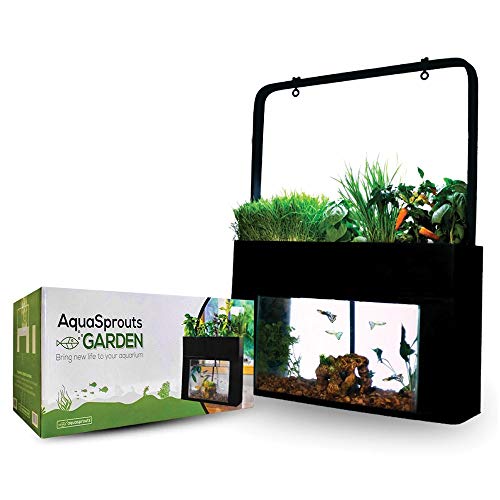
A countertop grow tray that our kits page lists as needing a 10 gallon tank, best with a light fish load and herbs.


Planning the rest? See fish tank options, the best fish for aquaponics, goldfish stocking and aquaponics kits.
How Many Fish in a 10 Gallon Tank FAQ
Grow along with us
New guides and seasonal tips for fish, plants and DIY builds, about once a month.