Systems and kits
Aquaponics Greenhouse: Planning, Heating and Running a System Under Cover
As an Amazon Associate we earn from qualifying purchases. How we choose products.
On this page
- Why Put Aquaponics in a Greenhouse?
- Do You Need a Greenhouse? A Quick Climate Check
- Choosing a Greenhouse for Aquaponics
- Laying Out Aquaponics Inside a Greenhouse
- Keeping the Water at the Right Temperature
- Cooling and Ventilation in Summer
- Pests, Power Cuts and Other Greenhouse Risks
- What to Grow in an Aquaponics Greenhouse
- Further Reading
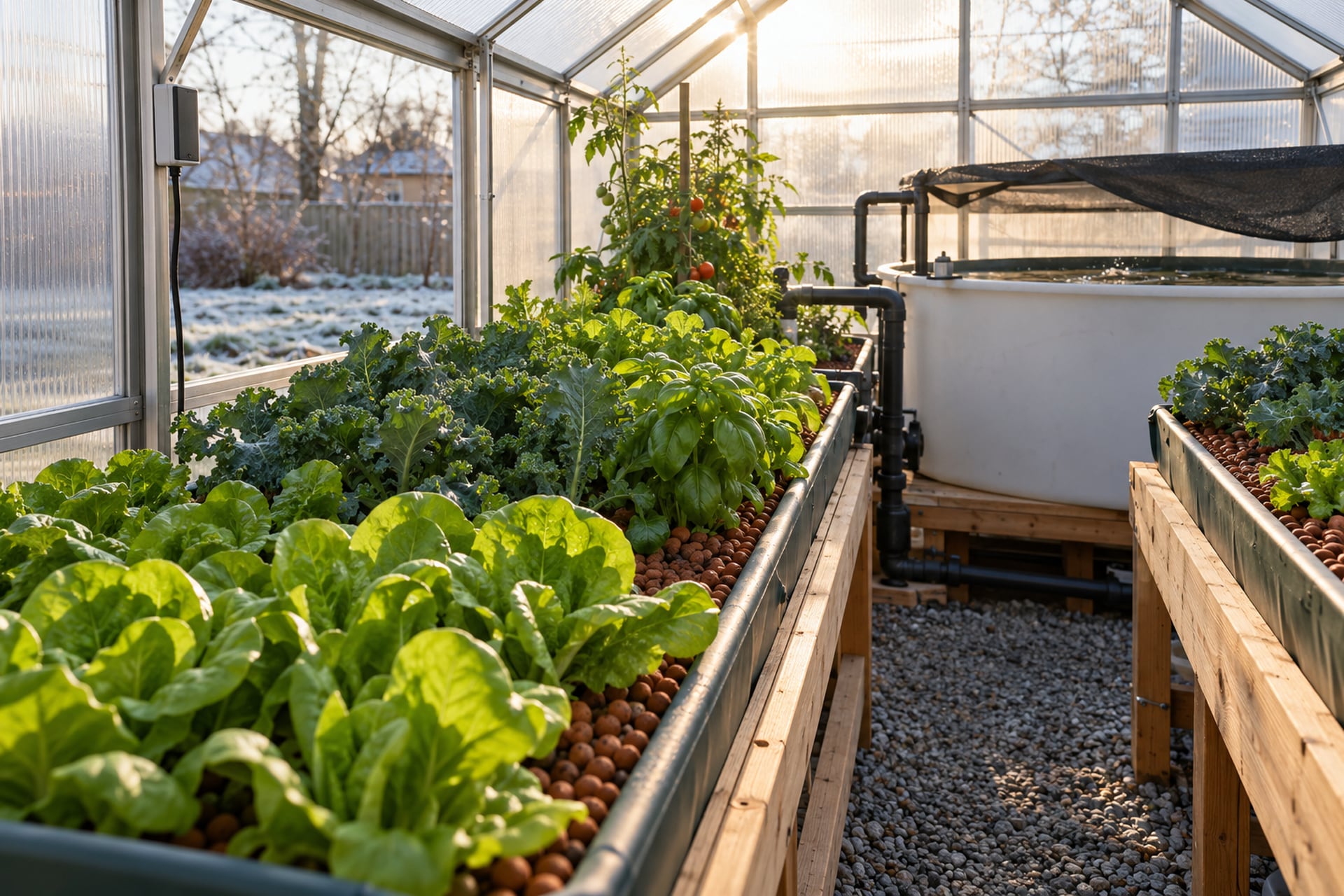
An aquaponics greenhouse is the most reliable way to grow fish and vegetables together for more than a few warm months a year. The greenhouse traps the sun's heat, keeps the fish water from swinging between hot afternoons and cold nights, and shields the beds from wind, heavy rain and hungry animals. It also brings new jobs: heating in winter, ventilation in summer, and a backup plan for the day the power goes out.
This guide covers the greenhouse side of aquaponics: when you need one, which kind of structure to buy, how to lay out tanks and beds inside it, and how to keep the water in the right temperature range for your fish. We lean on two public sources throughout: the FAO manual Small-scale aquaponic food production (Somerville and colleagues, 2014) and the Southern Regional Aquaculture Center fact sheet Controlling the Greenhouse Environment for Aquaponics (SRAC Publication No. 5008, Pickens and Danaher, 2016). If you have not built a system yet, start with our guide to home aquaponics.
Why Put Aquaponics in a Greenhouse?
The FAO manual is clear that greenhouses are not essential for small-scale aquaponic units, yet they may be useful in extending the growing season. It adds that this is particularly true in temperate and cooler regions, where a greenhouse can be used to maintain a warm water temperature during the cold months and so allow year-round production.
What a Greenhouse Does for an Aquaponics System
- Keeps the water warmer and steadier. Sunlight enters, heats the air and the water, and the walls and roof hold that heat into the night. FAO notes this gives a warmer and more stable temperature over 24 hours.
- Protects the system. Wind, snow and heavy rain stay outside. Rain diluting a small system or knocking over seedlings stops being a problem.
- Keeps animals out. Herons, raccoons and cats find an open fish tank very quickly. FAO also mentions security against theft.
- Supports climbing crops and shade. The frame holds trellis lines for tomatoes and cucumbers and is where you hang shade cloth.
The Downsides
FAO is just as direct about the costs. Initial capital costs can be high depending on how sophisticated the structure is, greenhouses add operating costs because fans are needed to prevent overheating and excess humidity, and some diseases and insect pests are more common under cover. A greenhouse makes aquaponics more productive, not easier.
Do You Need a Greenhouse? A Quick Climate Check
FAO suggests thinking about winter strategy when the cold season has average temperatures below 15°C (59°F) for more than three months. If that describes your area, you have three realistic options.
| Strategy | How it works | Best for |
|---|---|---|
| Greenhouse plus heating | Keep warm-water fish and summer crops going through winter | Growers who want year-round tilapia and tomatoes |
| Switch species with the seasons | FAO describes growing cold-adapted fish and plants in winter and switching back to warm-water species in spring | Unheated or lightly heated greenhouses |
| Harvest and shut down | Harvest fish and plants at the start of winter and restart in spring, as FAO also allows | Outdoor systems in cold regions |
For mild-winter areas, an unheated greenhouse often adds enough warmth on its own to keep hardy fish such as goldfish, koi or catfish going, with leafy greens in the beds. In hot climates the logic flips: FAO notes that in the tropics net houses are often more appropriate than closed greenhouses, because heat and humidity are the problem, not cold.
Choosing a Greenhouse for Aquaponics
Any greenhouse can house an aquaponics system, but three things matter more than usual: how well it holds heat, whether it is big enough for tanks plus beds plus a walkway, and whether the floor can take the weight of water.
Glazing: How Well It Holds Heat
SRAC 5008 explains that most heat loss happens through the walls and roof, and gives heat transmission coefficients (U-values, lower is better) for common glazing. Single-layer polyethylene film rates 1.2, inflated double-layer polyethylene 0.7 and 8 mm twin-wall polycarbonate 0.65. The same fact sheet says double-layered poly greenhouses can improve heat retention by more than 30 percent compared with single-layer houses. In plain terms: if you plan to heat through winter, pay for twin-wall panels or a double skin. If the greenhouse only stretches spring and fall, single film is fine.
Size: Room for Tanks, Beds and You
Lay out the system on paper before you buy. A home system with a 100 to 300 gallon tank, two or three media beds and a sump easily fills an 8 × 10 foot floor. Leave a walkway, and keep beds narrow enough to reach: FAO recommends that beds should not be so wide that you cannot reach at least halfway across.
Floor and Weight
Water weighs about 8.3 pounds per US gallon, so a 275 gallon IBC tote full of water weighs more than a ton before you add the media beds. Put tanks on a level, compacted gravel base or a concrete pad, never on a raised wooden floor that was not designed for it.
Greenhouse Types at a Glance
| Type | Cover | Heat retention | Best for |
|---|---|---|---|
| Pop-up walk-in | Single PE cover on a steel frame | Low | Extending spring and fall, small tabletop or tote systems |
| Tunnel (hoop) greenhouse | Reinforced PE cover on galvanized hoops | Low to moderate (better with a second layer) | Long, cheap floor space for IBC systems |
| Aluminum frame, polycarbonate panels | Twin-wall polycarbonate | Good | Heated, year-round systems |
| Custom build or dome | Varies | Good to excellent | Permanent systems with insulated walls and thermal mass |
Greenhouses That Suit an Aquaponics System
Picked from the walk-in greenhouses with the most buyer reviews and a solid average on Amazon US, one per type. Check the floor plan against your tank and beds before ordering.
-
1Pop-up, season extender
EAGLE PEAK 10x10 Portable Walk-in Greenhouse
A pre-assembled steel frame with a PE cover that the maker says one person can put up without tools, with zippered doors and mesh windows. Enough floor for a small tank and a couple of beds from spring to fall.
-
2Tunnel, most floor space
KING BIRD Premium 15x7x7 FT Greenhouse
A galvanized steel tunnel with a reinforced 150 g/sqm UV-stabilized PE cover, a zippered door and eight roll-up screen windows, plus a watering kit. The long floor suits an IBC tank with beds in a row.
-
3Polycarbonate, for heated systems
WUKHG 8x10 FT Aluminum Polycarbonate Greenhouse
An aluminum frame with 4 mm twin-wall polycarbonate roof panels, adjustable vents, a lockable door and a roof gutter. Twin-wall panels hold heat far better than single film, which matters if you heat the water all winter.


Laying Out Aquaponics Inside a Greenhouse
Put the Fish Tank Where Plants Do Not Need the Light
Growing Spaces, which makes geodesic dome greenhouses and has many aquaponics customers, recommends placing grow beds in the central area of its domes and the tank along the north wall. The same idea works in any greenhouse in the northern hemisphere: the north side gets the least direct light, so it is the right place for something that does not photosynthesize. A large tank there also soaks up the sun that does reach it and releases the heat at night.
Shade the Water Surface
FAO advises shielding the water surface of fish tanks, hydroponic units and biofilters from the sun with shade structures, because sunlit water grows algae and swings in temperature. A lid, a sheet of shade cloth or a floating cover on the tank does the job. Light-colored tanks help too: FAO notes white tanks reflect sunlight and keep the water cool.
Run Beds North to South
FAO recommends arranging grow beds so the longest side runs on a north-south axis, which makes the most efficient use of the sun as it travels from east to west. Put tall crops such as tomatoes and cucumbers at the north end of each bed so they do not shade the lettuce.
Leave Room for Plumbing and Power
Run power to the greenhouse before you build, as Growing Spaces also advises, and use outdoor-rated, GFCI-protected outlets mounted well above the water line. Keep the pump, air pump and heater on separate circuits or plugs so one failure does not take out everything at once. Our guides to the aquaponics pump, the aquaponics grow bed and the bell siphon cover the hardware in detail, and our clay pebbles guide covers what goes in the beds.
Keeping the Water at the Right Temperature
In an aquaponics greenhouse the temperature that matters most is the water temperature. FAO notes that fish are cold-blooded and have little ability to adjust to a large range of water temperatures, so a steady temperature within the right range keeps them growing and reduces disease. The bacteria care too: FAO gives their ideal range as 17 to 34°C (63 to 93°F), with productivity falling below 17°C and dropping by 50 percent or more below 10°C (50°F).
Choose Fish for the Temperature You Can Hold
| Fish | Survival range | Optimal range | Greenhouse fit |
|---|---|---|---|
| Nile tilapia | 14 to 36°C (57 to 97°F) | 27 to 30°C (81 to 86°F) | Heated greenhouse, or summer only |
| Channel catfish | 5 to 34°C (41 to 93°F) | 24 to 30°C (75 to 86°F) | Unheated or lightly heated |
| Common carp | 4 to 34°C (39 to 93°F) | 25 to 30°C (77 to 86°F) | Unheated or lightly heated |
| Rainbow trout | 10 to 18°C (50 to 64°F) | 14 to 16°C (57 to 61°F) | Cool season; needs cooling in summer |
Source: FAO, Small-scale aquaponic food production (2014), Table 7.1.
Tilapia are the classic greenhouse fish because they grow fast in warm water, but FAO also warns they do not feed or grow below 17°C and die below 12°C, so in a cold climate they need reliable heat. Our page on aquaponics tilapia covers stocking and feeding, and best fish for aquaponics compares the alternatives.
Heat the Water Directly in Small Systems
For tanks up to a few hundred gallons, submersible aquarium heaters are the simplest option. Size them by gallons, and use two smaller heaters rather than one large one: if one fails, the other keeps the tank from crashing. SRAC recommends exactly this approach for greenhouse equipment in general, dividing heating or ventilation among several smaller units so one failure does not cause a total loss.
Use the Tank as a Heat Battery
Water stores a lot of heat. By definition it takes one BTU to warm one pound of water by 1°F, so a 275 gallon tank (roughly 2,300 pounds of water) absorbs about 2,300 BTU for every degree it warms during a sunny day, and gives that heat back at night. More water means slower temperature swings. Some growers add black-painted barrels of water along the north wall for the same reason.
Insulate What You Can
FAO recommends thermally insulating tanks in very hot or cold areas, and protecting units against cool night temperatures. Foam board around the sides of a tank and a lid at night cut heat loss sharply. On the structure, SRAC notes that after the glazing, air leaks are the second greatest cause of heat loss, so weather-strip the door and patch tears in film covers.
Climate Gear for a Small Aquaponics Greenhouse
The basics for keeping fish water warm and knowing when something goes wrong.
-
1Tank heater
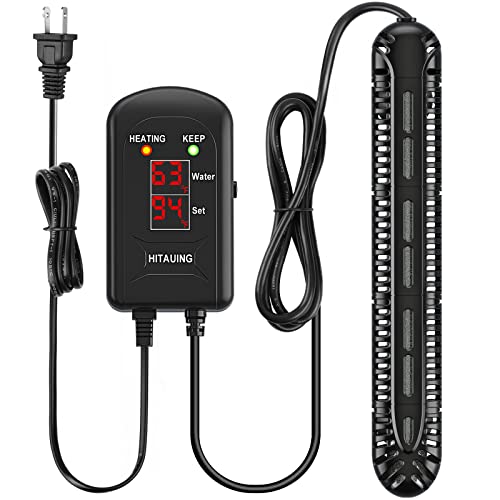
HiTauing 300W Aquarium Heater with LED Display
Rated by the maker for 40 to 75 gallon tanks, with an external digital controller and automatic shut-off if the heater leaves the water. Use two in larger tanks.
-
2Temperature alerts
Govee H5075 Bluetooth Thermometer Hygrometer
Shows min and max readings and sends an app alert when temperature or humidity leaves a range you set, within Bluetooth range of your phone.
-
3Summer shade
e.share 40 to 50% Shade Cloth, 12 x 6 ft
UV-stabilized HDPE mesh with grommets every 2 feet, sized to cover a small greenhouse roof or the fish tank.


Cooling and Ventilation in Summer
SRAC 5008 makes a point every greenhouse owner learns the hard way: heating a greenhouse is not difficult, but cooling it efficiently is almost an art. A closed greenhouse on a sunny day overheats in minutes, and warm water holds less oxygen for your fish.
Vents and Fans
Natural ventilation through roof and side vents is the cheapest option and works best in greenhouses with high ceilings and open sides, according to SRAC. In small kits, open the doors and roll-up windows early on hot days rather than waiting for the temperature to climb. Inside, SRAC suggests horizontal airflow fans above the crops to keep air moving, with a rule of thumb of 2 cubic feet per minute per square foot of floor. Moving air also keeps leaves drier and reduces disease.
Shade Cloth
Shade cloth comes in percentages such as 30, 50 or 60 percent. SRAC warns that the percentage describes light, not heat: 30 percent shade cloth may not lower the temperature by 30 percent. It also notes that black shade cloth, the cheapest and most durable, absorbs heat and radiates some of it back into the greenhouse, while white and reflective cloths lower temperatures more efficiently. FAO lists common shade materials from 25 to 60 percent sunblock. Lettuce and other leafy greens benefit most, because FAO notes they bolt and turn bitter in too much sun.
Humidity
An aquaponics greenhouse has open water and transpiring plants, so humidity runs high. SRAC notes that high humidity increases disease pressure, especially when water droplets sit on leaves, and that venting humid air and keeping air moving are the main fixes.
Pests, Power Cuts and Other Greenhouse Risks
Pests Without Pesticides
Anything you spray on the plants ends up in the fish water, so chemical pesticides are off the table. FAO recommends insect nets on doors and windows, with a mesh of about 0.5 mm for larger insects and a finer mesh for the small insects that spread viral diseases. Sticky traps, hand-picking and beneficial insects do the rest.
Power Failure Is the Biggest Risk
A greenhouse aquaponics system depends on pumps, air and, in winter, heat. SRAC recommends an emergency call system that monitors power outages and indoor temperatures, and states that alarms and backup generators are important for the conventional greenhouse grower, but are a must for the aquaponics grower. At home scale, a battery-powered air pump that switches on during an outage is the cheapest insurance you can buy, followed by a temperature alarm on your phone.
Too Much, Too Fast
Growing Spaces' own advice to greenhouse aquaponics beginners is to start small and simple, and scale up only once you have mastered the balance of nutrients, fish and plants. Cycle the system before you add fish, as explained in our fishless cycling guide, and add fish gradually.
What to Grow in an Aquaponics Greenhouse
A greenhouse widens the list of crops you can grow well. In winter, stick to cool-season crops such as leafy greens, herbs and brassicas; FAO notes that winter vegetables need temperatures of 8 to 20°C (46 to 68°F). In summer and in heated houses, fruiting crops such as tomatoes, peppers and cucumbers make the most of the extra space and the trellis. Greenhouse frames make vertical systems attractive too: an aquaponics tower can turn spare headroom into extra planting space. For crop-by-crop advice, see our list of the best plants for aquaponics.
If you are still deciding between growing with fish or with bottled nutrients under glass, our comparison of aquaponics vs hydroponics sets out the trade-offs.
Further Reading
If you are building or upgrading the greenhouse itself, The Year-Round Solar Greenhouse by Lindsey Schiller with Marc Plinke (New Society Publishers, 2016) is about designing and building a net-zero energy greenhouse, including thermal mass and insulation. For the aquaponics side, our pick of the best aquaponics books and aquaponics courses includes Nelson and Pade's online course on greenhouses and indoor farming and The Aquaponic Source's online course on aquaponic greenhouse planning.
Grow along with us
New guides and seasonal tips for fish, plants and DIY builds, about once a month.