Build guide
IBC Aquaponics: How to Build a System From IBC Totes
As an Amazon Associate we earn from qualifying purchases. How we choose products.
On this page
IBC aquaponics means building your system from intermediate bulk containers, the big plastic totes in a steel cage that liquids are shipped in. One tote gives you a fish tank or two grow beds; three give you a complete backyard system. It is the most popular DIY route for a reason: the containers are strong, cheap second hand, and the cage is already the stand.
This guide covers how to find a tote that is safe for fish, the two designs most people build (the one-tote chop and flip and FAO's three-tote unit), the cutting and plumbing step by step, how many fish and plants an IBC system supports, and the parts list. The measurements come from FAO's free aquaponics manual and from Oklahoma State, Clemson and Alabama extension.
What Is an IBC Tote?
An intermediate bulk container is a plastic inner tank, usually of 1,000 liters (about 264 gallons), held in a steel cage on a pallet base, with a screw cap on top and a valve at the bottom. Accessories sold for them in the US describe the common sizes as 275 and 330 gallon totes. FAO's manual (Somerville et al., Small-scale aquaponic food production, Technical Paper 589, 2014) builds its step-by-step units from IBCs because, in its words, they can be easily found all around the world.
Clemson Cooperative Extension shows IBC totes as a common building block in Aquaponics: System Layout and Components (Beecher, 2021), and Oklahoma State's Principles of Small-Scale Aquaponics lists them among suitable fish tanks and grow bed containers. The food grade plastic, the strength of the cage and the fact that the cage doubles as a bed frame are what make them so popular.
Finding a Food-Safe IBC
This is the one step you cannot shortcut. Oklahoma State says only used bulk containers that held food grade material, and have been thoroughly washed, should be used. Clemson says a tote that held harmful chemicals, or anything else that may harm fish, should be discarded or used for other purposes. FAO explains why washing will not save a bad tote: contaminants such as solvent-borne chemicals penetrate into the porous plastic itself and are impossible to remove with washing. Its advice is to choose used containers carefully and to know the seller if possible.
- Ask the seller what the tote held and look for the original label. Food syrups, juice concentrates and vegetable oils are the kind of history you want.
- Walk away from anything unknown, anything that smells of solvent, and anything labeled as a chemical.
- Wash it out with soap and warm water and let it dry, as FAO does: its plan leaves each cut container to dry in the sun for 24 hours.
Two Ways to Build an IBC Aquaponics System
The One-Tote Chop and Flip
The simplest build uses a single IBC. You cut the top part of the plastic container off, flip it upside down and set it on top of the cage as the grow bed, and the remaining lower part becomes the fish tank underneath. The grow bed drains straight down into the fish tank through a bell siphon, and a small pump in the tank sends water back up. It is compact and needs only one tote, but the fish tank is partly covered by the bed, which makes feeding and netting fish more awkward, and the bed is small for the amount of water. Alabama Extension specialist David Cline builds a single-tote system step by step in a free six-part video series (Building an IBC Aquaponics System); the introduction is below.
FAO's Three-Tote Media Bed Unit
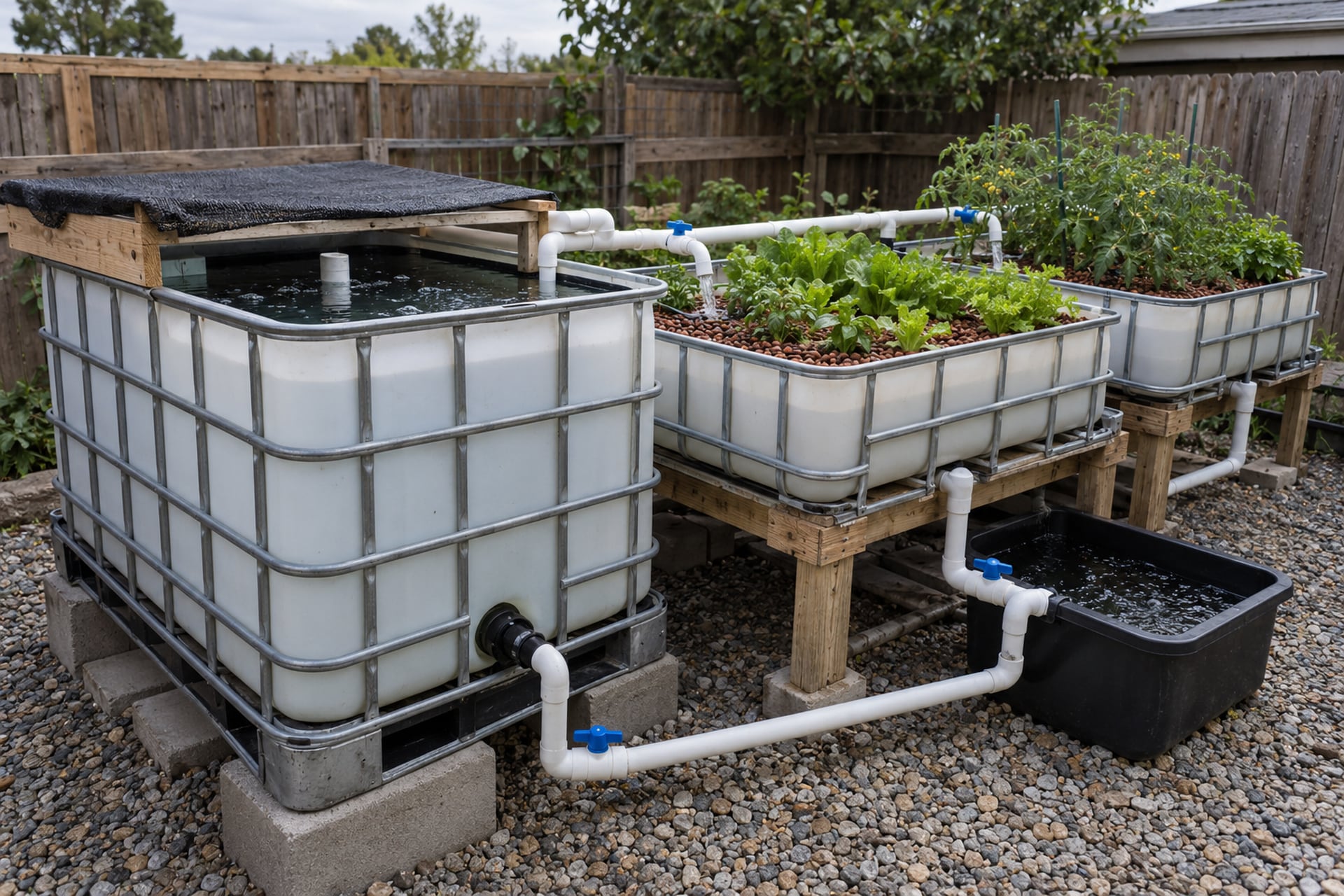
FAO's Appendix 8 gives full plans for a larger system built from three IBCs, and it is the design we would point most builders to. Its layout:
| Component | Made from | Details in FAO's plan |
|---|---|---|
| Fish tank | One whole IBC | The top cut out 5 cm in from the four sides; the cut piece becomes the lid. Raised about 15 cm off the ground on blocks |
| Two grow beds | A second IBC | Stood upright and cut into two containers 30 cm (12 in) deep, each sitting on part of the cut steel cage |
| Third grow bed and sump | A third IBC | Cut into one 30 cm bed and a 70 cm deep sump tank |
| Water flow | Gravity and one pump | Fish tank overflows to the beds, beds drain to the sump, a submersible pump returns water to the fish tank |
| Pump | Submersible | At least 2,000 L/h, about 530 GPH |
| Aeration | Air pump | About 10 W with two outlets, air stones in the tank |
| Bell siphons | PVC | 25 mm standpipe, 75 mm bell, 110 mm media guard, one per bed |
| Distribution pipe | 50 mm PVC | From the fish tank outlet to all three beds, with a valve for each bed |
Because the fish tank sits highest and drains to the beds by gravity, the water that reaches the plants comes straight from the fish. The sump sits lowest, so it is the only place the pump has to be.
How to Build the FAO IBC System, Step by Step
A condensed version of FAO's Appendix 8. The full plan, with photographs of every step, is free in the manual.
Building a three-tote IBC unit
-
Strip the cages
Remove the steel lengths that hold each inner container in place (FAO uses a star key; if the screws will not move, it cuts them with an angle grinder) and lift the plastic containers out.
-
Make the fish tank
Mark a square 5 cm in from the four sides of the top of the first container, cut it out with the angle grinder and keep the cut piece as a lid. Wash the tank with soap and warm water and let it dry for 24 hours.
-
Fit the fish tank outlet
FAO drills a 57 mm hole in one side of the tank, 12 cm from the top and 12 cm from the side, and fits a 50 mm Uniseal. Inside, a 50 mm pipe runs down to the floor and along it, cut with slits 2 to 3 mm wide so waste can enter but fish cannot. Then it drills a 2 to 3 cm hole in the elbow next to the Uniseal so air can get in if the pump stops. Without it, the pipe can keep siphoning until the tank is empty. FAO calls this step not optional.
-
Cut the grow beds and the sump
Stand the second container upright and cut it into two containers 30 cm deep. Cut the third container into one 30 cm bed and a 70 cm sump. Cut the steel cages along the same lines so each bed keeps a supporting frame, and wash everything.
-
Level the beds
Lay wooden lengths across the cut frames, set the beds on them, and check with a spirit level. FAO stresses that a horizontal bed is vital for the bell siphons to work.
-
Build and fit the bell siphons
One per bed, with a 25 mm standpipe through a fitting in the floor, a 75 mm capped bell with slots at its base and a 110 mm slotted media guard. Full dimensions and the build are in our bell siphon guide.
-
Plumb the distribution line and the drains
Run 50 mm PVC from the fish tank outlet along the beds at the height of their tops, with a T and a valve for each bed. Under each bed, pipe the drain from the standpipe into the sump.
-
Install the pump and air
Put the submersible pump in the sump and run 25 mm pipe back to the fish tank, with as few elbows as possible because each one costs flow. Add the air pump and stones, and keep the plugs in a waterproof electric box out of the sun.
-
Test for leaks, then add media
Fill the fish tank and sump, remove the standpipes and bells so water flows straight to the sump, and run the pump to check every joint. Fix leaks, refit the siphons, then fill the beds with rinsed media and test the flood-and-drain cycle.
-
Cycle before you add fish
Establish the bacteria first. Oklahoma State's guidance is to allow at least four weeks for nitrification before growing anything; our fishless cycling guide walks through it.
How Many Fish and Plants Does an IBC System Support?
Fish
Oklahoma State gives two numbers. For new and inexperienced growers, a common final density is 1 pound of fish per 10 gallons of water at harvest; its media bed fact sheet (Nitrification and Maintenance in Media Bed Aquaponics) calls 1 pound per 8 to 10 gallons a safe rate for beginners. The ceiling, from Rakocy's work with tilapia, is a critical standing crop of 0.5 pound per gallon, the most a system can hold without slowing growth. For a full 1,000 liter tote of about 264 gallons, the beginner rate works out to roughly 26 to 33 pounds of fish at harvest weight. Oklahoma State's own example stocked 40 bluegill fingerlings of 2 to 3 inches in 152 gallons.
Which fish depends on your water temperature. Tilapia are the classic choice in warm climates; Oklahoma State notes they grow best at about 85°F, grow little below 68°F and may start to die between 55°F and 45°F. See our guides to tilapia in aquaponics and the best fish for aquaponics.
Plants
FAO balances the system by feed rather than fish: 40 to 50 grams of feed a day per square meter of grow bed for leafy greens, 50 to 80 grams for fruiting crops, at about 20 to 25 leafy plants or 4 to 8 fruiting plants per square meter. Going by the measurements on FAO's diagram, each bed in its three-tote unit is about 1 by 1.2 meters, so the three together give roughly 3.6 square meters, or close to 39 square feet, which is room for around 70 to 90 heads of lettuce. More on balancing fish and beds in our grow bed guide.
Protecting the Tote: Light, Algae and Heat
An IBC's white, translucent plastic lets light through, and light on nutrient-rich water means algae. FAO's rule is that all water surfaces should be shaded, and it recommends covering fish tanks with shade cloth, tarps or lids; it also notes that nitrifying bacteria are sensitive to UV, especially while a new system is being colonized. Oklahoma State's media bed fact sheet suggests shade cloth blocking 30 to 60 percent of sunlight over fish tanks to cool the water and help prevent algae.
- Keep the cut-out lid on the fish tank, or cover it with shade cloth on a frame so you can lift it to feed.
- Wrap the outside of the tank. A zippered tote cover is the tidy option; painting the outside also works.
- Insulate in cold areas. Oklahoma State mentions reflective foil, soil or cloth to hold heat, and keeping tanks off a cold floor.
IBC aquaponics parts list
For FAO's three-tote layout: one fish tank, three 12 inch beds and a sump. Totes, PVC pipe and wood come from local suppliers.
-
1Bell siphon (one per bed)
Smoky Mountain Aquaponics Bell Siphon Kit for IBC Grow Beds
Made for IBC beds with 12 inches of media: 3 inch bell, 4 inch slotted guard, threaded bulkhead adapters and elbows.
-
2Water pump
VIVOSUN 1600 GPH Submersible Pump
FAO asks for at least 2,000 L/h. The listing gives 6,000 L/h at zero lift and up to 15 feet of lift, which leaves headroom for the climb to the fish tank.
-
3Air pump
EcoPlus ECOair 1 Commercial Air Pump
18 W with a six-valve manifold according to the listing, enough for stones in the fish tank and the sump.
-
4Air stones
VIVOSUN 4 x 2 Inch Air Stones, 2 Pack
Large stones that make fine bubbles for the fish tank.
-
5Bulkheads
1 Inch Uniseal Flexible Tank Adapter, 2 Pack
Seal pipes through the curved or ribbed tote walls, where rigid bulkhead fittings tend to leak.
-
6Bed valves
Homewerks 1 Inch PVC Ball Valve
One per bed on the distribution line, to balance the flow and tune each siphon.
-
7Drain adapter
IBC Tote Drain Adapter, 2 Inch Coarse Thread to Garden Hose
Fits the 2 inch coarse thread valve on many US totes so you can drain the fish tank with a hose; the seller asks you to check your valve type first.
-
8Light cover
NEVERLAND Zippered IBC Tote Cover, 275 Gallon
A 420D cover sized for 1,000 liter totes that keeps light off the water; measure your tote before ordering, as the maker asks.
-
9Grow media
Hydroton Original Expanded Clay Pebbles, 50 Liter
Light, pH neutral media for the beds. A 12 inch IBC bed takes several bags; volcanic gravel is the cheaper, heavier alternative.
-
10Water testing
API Freshwater Master Test Kit
For cycling and weekly checks of pH, ammonia, nitrite and nitrate.


IBC Aquaponics FAQ
Yes, it is one of the most common DIY builds, and FAO publishes free step-by-step plans for one. Use only totes that held food grade products, cut them into a fish tank, grow beds and a sump, and plumb them with PVC and bell siphons. A three-tote system fits in a small backyard.
Yes. A 1,000 liter tote holds about 264 gallons, enough for roughly 26 to 33 pounds of fish at Oklahoma State's beginner rate. The catch is temperature: tilapia grow best near 85°F and stop growing below about 68°F, so outdoors in cooler states you will need a heater, a greenhouse or a cold-water fish.
A food grade plastic or fiberglass tank, ideally round with a central drain so waste collects in one spot, according to Oklahoma State. White or light colors help you see the fish and keep the water cooler, FAO adds. Converted IBC totes are the budget favorite, while stock tanks and lined frames also work well.
No. Totes carry everything from fruit syrup to industrial solvents, and the plastic absorbs what it held. FAO warns that chemical residues soak into the plastic and cannot be washed out. Only use a tote whose previous contents you know were food products, and buy from a seller who can tell you.
Two, if you follow FAO's plan: it stands the container upright and cuts two beds 30 cm deep, keeping the steel cage as their frame. Alternatively one bed plus a 70 cm deep sump. The classic chop and flip turns one tote into a single grow bed on top of its own fish tank.
Not always. A chop and flip drains straight back into the fish tank, so the pump sits there instead. FAO's three-tote design adds a sump so the fish tank level stays constant and the pump lives at the lowest point. FAO says a sump should hold at least 70 percent of the media bed volume.
Related: bell siphon, aquaponics pump sizing, grow beds, clay pebbles and the full how to build an aquaponics system guide.
Grow along with us
New guides and seasonal tips for fish, plants and DIY builds, about once a month.