Buying guide
Best Aquarium Heaters: Watts, Size Charts and Picks for Fish Tanks and Aquaponics
As an Amazon Associate we earn from qualifying purchases. How we choose products.
Best Overall: hygger 300W Submersible Heater with Digital Controller Check price on Amazon
On this page
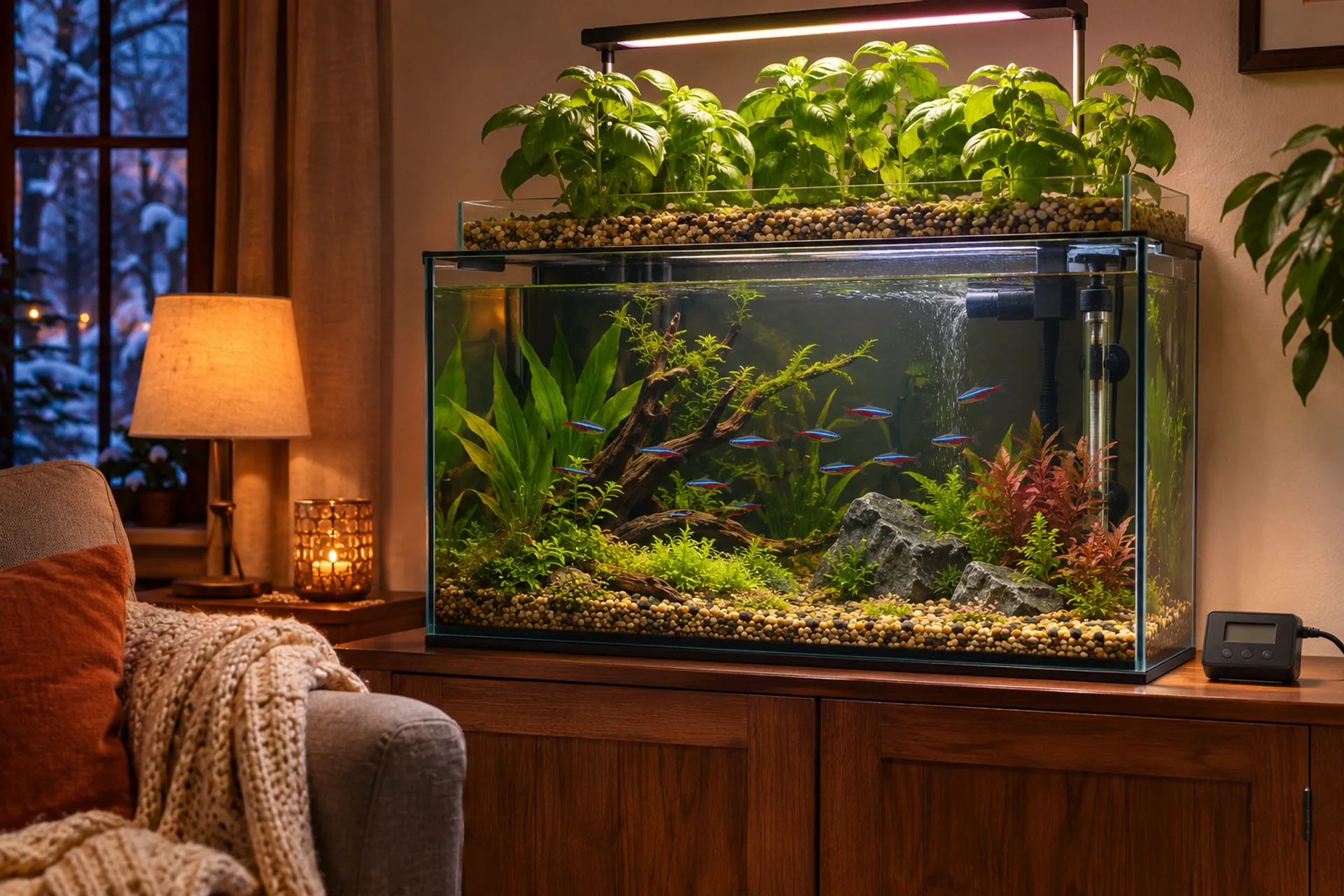
The best aquarium heater is the one sized to your tank, with a thermostat you can read and protection that switches it off if it ends up out of the water. That sounds basic, but most failures come from the wrong size or a heater left running in air during a water change. In an aquaponics system the stakes are higher, because the tank also feeds the bacteria and the plants.
This guide compares submersible heaters sold on Amazon US, from a 50 watt nano heater for a desk kit to 300 watt models and a two-outlet controller for large tanks. We compared the makers' published size ratings, temperature ranges and safety features rather than running our own heating trials. Then we cover the sizing question in plain numbers and what heating costs to run this winter.
Best Overall
hygger 300W Submersible Heater with Digital Controller
Rated by hygger for 40 to 80 gallon tanks, with an external digital controller, a 59 to 93 °F range, and shut-off with an alarm if the water passes 97 °F or the heater is exposed to air.
-
Best for desk aquaponics kits
Sized for 5 to 10 gallon tanks, with two temperature probes, dry-run and overheat protection, and settings that survive a power cut.
-
Best for big aquaponics tanks
Inkbird Two-Outlet Temperature Controller
Runs heaters from one external probe, with day and night set points and a maximum load of 1,200 W at 110 V, so two heaters can share one thermostat.
Does Your Tank Need a Heater?
Start with the fish, not the heater. FAO's aquaponics manual says fish are cold-blooded and cope poorly with a wide temperature range, that a steady temperature within their tolerance keeps them growing and less prone to disease, and that heaters can be costly where energy is expensive. Its advice is that it is often better to grow fish suited to local conditions.
Tropical Fish: Yes
FAO gives 22 to 32 °C (about 72 to 90 °F) as the range where tropical fish generally thrive. That covers tilapia, bettas, guppies and most aquarium fish kept with desk kits. In a typical US home in winter, a tropical tank needs a heater. See our guide to tilapia in aquaponics for the temperatures that species needs to grow.
Cold-Water and Temperate Fish: Often Not
FAO says cold-water fish prefer 10 to 18 °C, and that some temperate fish such as common carp and largemouth bass tolerate 5 to 30 °C. Goldfish are the classic no-heater choice for an indoor system. Read goldfish in aquaponics or trout in aquaponics if you would rather not heat at all.
What Cold Does to an Aquaponics System
FAO's troubleshooting table warns that when the water is too low, below about 15 °C, the bacteria stop working, some fish may not eat and plants begin to wilt. Its winter remedy is to insulate the fish tanks first, then use solar or electric heaters, and reduce the amount of fish food and the number of plants in the unit.
What Size Aquarium Heater Do You Need?
Heater makers publish the tank sizes each wattage is rated for. The charts differ from brand to brand, so we lined them up from the listings of the heaters on this page.
| Wattage | Tank size the maker states | Watts per gallon | Maker |
|---|---|---|---|
| 20 W | 1 to 5 gallons | 4 to 20 | hygger mini |
| 50 W | 5 to 10 gallons | 5 to 10 | hygger ECO Precise |
| 100 W | 10 to 30 gallons | 3.3 to 10 | Tetra |
| 100 W | 10 to 20 gallons | 5 to 10 | HANLESHUKA |
| 200 W | 20 to 40 gallons | 5 to 10 | HANLESHUKA |
| 300 W | 40 to 80 gallons | 3.75 to 7.5 | hygger |
| 300 W | 45 to 65 gallons | 4.6 to 6.7 | HITOP |
| 300 W | 40 to 70 gallons | 4.3 to 7.5 | HANLESHUKA |
| 500 W | 70 to 120 gallons | 4.2 to 7.1 | HANLESHUKA |
The watts-per-gallon column is our arithmetic on the makers' figures. Across these brands, most ratings fall between about 4 and 10 watts per gallon, with more watts per gallon for small tanks, which lose heat faster for their size.
Use the Low End of the Range in a Cold Room
Every chart assumes an ordinary indoor room. A heater has to make up the difference between room and water temperature, so the colder the room, the fewer gallons a given heater can hold at temperature. If your tank sits in a basement, garage or greenhouse, choose the wattage whose rated range starts at or below your tank size, or add a second heater.
Two Heaters Beat One Big One
Splitting the wattage between two heaters at opposite ends of the tank spreads the heat and adds a safety margin: if one thermostat sticks on, the other half of the wattage is not enough to overheat the tank quickly, and if one fails off, the tank cools slowly instead of all at once.
Sizing for an Aquaponics Tank
Aquaponics tanks are usually much bigger than aquariums. On the HANLESHUKA chart, a 250 gallon IBC tank would need three or four 500 W heaters, and that is before the heat lost from an open grow bed. Most growers with tanks that size heat the room or the greenhouse, insulate the tank, or choose fish that do not need heat. Our aquaponics greenhouse guide covers heating a whole space.
Best Aquarium Heaters Compared
Picks are ordered by how well they serve a home fish tank or a small aquaponics system. Ratings and features are as the makers list them on Amazon.
| Product | hygger 300W digital Best Overall | HITOP 300W Budget 300W | Tetra 100W Preset 78 °F | hygger ECO 50W Desk kits | Fluval E 300W Premium |
|---|---|---|---|---|---|
| Product |  |  |  |  |  |
| Rated tank size | 40 to 80 gal | 45 to 65 gal | 10 to 30 gal | 5 to 10 gal | Not stated in listing |
| Temperature setting | 59 to 93 °F | 68 to 93 °F | Fixed at 78 °F | 59 to 93 °F | 0.5 degree steps |
| Display | External digital controller | None (sticker thermometer included) | Red and green light | External digital controller | Real-time temperature display |
| Dry-run or overheat protection | Both, with alarm | Not stated | Not stated | Both, with alarm | Dual sensors, fish guard |
| Price tier | $ | $ | $ | $ | $ |
| Buy | Check price on Amazon | Check price on Amazon | Check price on Amazon | Check price on Amazon | Check price on Amazon |
Best Overall
hygger 300W digital
- Rated tank size
- 40 to 80 gal
- Temperature setting
- 59 to 93 °F
- Display
- External digital controller
Show specifications
- Dry-run or overheat protection
- Both, with alarm
- Price tier
- $
Budget 300W
HITOP 300W
- Rated tank size
- 45 to 65 gal
- Temperature setting
- 68 to 93 °F
- Display
- None (sticker thermometer included)
Show specifications
- Dry-run or overheat protection
- Not stated
- Price tier
- $
Preset 78 °F
Tetra 100W
- Rated tank size
- 10 to 30 gal
- Temperature setting
- Fixed at 78 °F
- Display
- Red and green light
Show specifications
- Dry-run or overheat protection
- Not stated
- Price tier
- $
Desk kits
hygger ECO 50W
- Rated tank size
- 5 to 10 gal
- Temperature setting
- 59 to 93 °F
- Display
- External digital controller
Show specifications
- Dry-run or overheat protection
- Both, with alarm
- Price tier
- $
Premium
Fluval E 300W
- Rated tank size
- Not stated in listing
- Temperature setting
- 0.5 degree steps
- Display
- Real-time temperature display
Show specifications
- Dry-run or overheat protection
- Dual sensors, fish guard
- Price tier
- $
Aquarium Heater Reviews
hygger 300W Submersible Heater with Digital Controller (Best Overall)
hygger rates this 300 W heater for 40 to 80 gallon tanks and puts the controls outside the water: a digital controller shows the real-time temperature and lets you set and save a target between 59 and 93 °F. It stops heating at the set point, and it shuts off with an EE or ER warning if the water passes 97 °F or the heater is exposed to air. The element is explosion-proof quartz glass with silicon carbide, in a compact 8.1 inch body.
The external display is the feature that matters most in daily use, because you can see the temperature at a glance without a separate thermometer. hygger's own usage tips are worth following with any heater: submerge it fully before powering on, place it where water circulates, and unplug it and let it cool for 15 minutes before water changes.
- ✅ Readable digital controller outside the tank
- ✅ Overheat and dry-run shut-off with alarm
- ✅ Wide 59 to 93 °F setting range
- ❌ Rated range is wide; in a cold room treat it as a 40 gallon heater
HITOP 300W Adjustable Aquarium Heater (Best Budget 300W)
HITOP rates this 300 W model for 45 to 65 gallons, a narrower and more conservative range than some competitors. The listing describes 2 mm quartz glass, a 10.4 inch body, a 5 ft cord, an adjustable range of 68 to 93 °F, and a built-in thermostat that holds the set temperature within plus or minus 2 °F. A sticker thermometer and three suction cups are included.
There is no digital display, so you set a dial and check the sticker thermometer. It is a simple, honest heater for a mid-size aquarium or a small aquaponics tank indoors.
- ✅ Conservative size rating
- ✅ Thick quartz glass, long cord
- ❌ No digital readout
- ❌ Dry-run protection not stated
Tetra 100W Submersible Heater (Simplest for Small Tanks)
The Tetra heater has no dial at all. Tetra says its electronic thermostat keeps water at a consistent 78 degrees, a red light shows when it is heating and a green one when it is on standby, and the 100 W model is for 10 to 30 gallon aquariums. It is UL listed and attaches to the tank wall with a suction cup.
78 °F sits inside FAO's tropical range and suits most community fish, which makes this the no-decisions option for a 20 gallon aquarium with a grow bed on top. If your fish need a different temperature, choose an adjustable heater instead.
- ✅ Nothing to set
- ✅ UL listed
- ❌ Fixed at 78 °F
- ❌ No display of the actual temperature
hygger ECO Precise 50W (Best for Desk Aquaponics Kits)
Desk aquaponics kits and 10 gallon aquariums with a planter on top need a small heater that does not crowd the tank. hygger's 50 W ECO Precise is 5.9 inches long, rated for 5 to 10 gallons, and uses two independent temperature sensors with a PRECISE mode for tight control and an ECO mode to save energy. The external controller has a child lock, adjusts in 0.5 °F steps from 59 to 93 °F, and remembers its settings after a power outage. It shuts off with an alarm when it is out of water or overheating.
For an even smaller kit of 1 to 5 gallons, hygger sells a 20 W mini heater with a similar external controller. Check our aquaponics kits guide for which kits need a heater at all.
- ✅ Two probes and two modes
- ✅ Dry-run and overheat protection
- ✅ Remembers settings after a power cut
- ❌ No protective shell around the quartz tube
Fluval E 300 Watt Electronic Heater (Premium Pick)
Fluval's E series is the long-established premium option. The listing describes continuous real-time monitoring and display of the water temperature, a microprocessor system with dual temperature sensors, settings in 0.5 degree steps, and an integrated fish guard. The Amazon listing does not state a tank size, so size it against your own tank and room as described above.
Choose it when a heater sits in a display tank where you want a clear readout on the heater itself and a guard between the glass and the fish.
- ✅ Dual sensors and on-heater display
- ✅ Built-in fish guard
- ❌ Tank size not given in the listing

Inkbird Aquarium Temperature Controller (For Large Aquaponics Tanks)
This is not a heater but a thermostat that sits between your heaters and the wall. Inkbird lists two heating outlets with on and off control, a probe with a suction cup, separate day and night temperatures within each 24 hours, temperature calibration, a sensor fault alarm, and a maximum output load of 1,200 W at 110 V. If the temperature goes out of range it sounds a buzzer and turns off all outputs. It heats only; it has no cooling function.
On a large aquaponics tank this lets you run two heaters from one accurate probe, so a stuck internal thermostat cannot overheat the water. It is also the cheapest way to add an alarm to heaters that have none.
- ✅ One probe controls two heaters
- ✅ Over and under temperature alarm
- ✅ Day and night set points
- ❌ Heaters sold separately
- ❌ No cooling output
Where to Put an Aquarium Heater
In the Flow
Put the heater where water moves past it: near the filter outlet, the pump intake or an air stone. Moving water spreads the heat and stops hot and cold layers forming. hygger's instructions say to place its heaters in an area with good water circulation.
Fully Submerged, Away From the Gravel
Most submersible heaters must be fully under water when switched on. Mount them with the suction cups on the tank wall, clear of the gravel and of decorations that would trap heat against the glass.
In Aquaponics: the Tank or the Sump
Heat the fish tank or the sump, never the grow bed. A sump heater warms the water that the pump sends back to the fish, and it is easier to reach. Keep the heater away from the pump intake screen so fish cannot get trapped against it.
Safe Power
Use ground-fault protected outlets, give every cord a drip loop below the outlet, and unplug heaters before you lower the water level. A dry heater can crack when it meets water again, which is why the dry-run protection in our top picks is worth having.
Cutting the Cost of Heating
A heater draws its full wattage only while it is on, so the bill depends on how cold the room is. As an example, a 300 W heater running eight hours a day uses 2.4 kWh a day, about 72 kWh a month. At the US Energy Information Administration's average residential price for August 2026, 18.16 cents per kWh, that is about 13 dollars a month. The arithmetic is ours; use your own rate and a plug-in energy meter to find your real number.
Insulate and Cover
FAO recommends insulating fish tanks with standard insulation in winter, and notes that a significant amount of heat is lost through the activity of air stones, so it is best to cover and insulate the biofilter too. A lid on the tank also cuts evaporation, which carries heat away.
Free Heat From the Sun
FAO describes spiral heating: circulating system water through black hose pipe coiled in a spiral in the sun, optionally inside a small glass box. For its small units it suggests a 25 mm pipe 40 to 80 meters long. It works best as a daytime boost in a sunny spot, not as the only heat source in winter.
Change the Fish, Not the Thermostat
FAO's simplest winter advice is to change fish species to ones suited to the climate. If your heating bill is the biggest cost of your system, compare it with our breakdown of what an aquaponics system costs to run, and consider a cold-tolerant fish for next season.
Best Aquarium Heaters FAQ
Related: aquaponics fish tanks, tilapia, greenhouses and water test kits.
Grow along with us
New guides and seasonal tips for fish, plants and DIY builds, about once a month.