Build guide
Aquarium Volume and Stocking Calculator
As an Amazon Associate we earn from qualifying purchases. How we choose products.
On this page
Aquarium volume, stocking, grow bed and pump
Enter your tank size to see the results.
This aquarium volume calculator turns your tank measurements into gallons and liters, then shows how many fish the water can hold, how big a grow bed that fish feed can support and how much pump flow the system needs. It handles a rectangle tank, a round tub or any tank whose volume you already know, such as a 275 gallon IBC tote. Choose ornamental fish, goldfish or a food fish like tilapia, and the stocking answer follows the published rule for that kind of fish.
Most fish tank volume calculators stop at gallons, and most stocking tools count fish at the size you see in the shop. This one is built for people who plan to grow plants on top of the tank. Every rule it uses is named and linked below: Practical Fishkeeping for ornamental fish, the Ornamental Aquatic Trade Association (OATA) for goldfish, and the FAO manual Small-scale aquaponic food production (technical paper 589) for food fish, grow beds and pumps.
How the Aquarium Volume Calculator Works
The first result is plain geometry. Everything after it, the fish count, the bed and the pump, starts from that one number, so it pays to measure the tank carefully.
Rectangle and Cylinder Tanks
For a rectangle tank the calculator multiplies length by width by water height, all in inches, then by 0.004329, because one cubic inch holds 0.004329 US gallons. For a round tub or barrel it uses the area of the circle, pi times the radius squared, times the water height. Switch the units to metric and it converts centimeters to inches first, then reports liters at 3.785 liters per US gallon.
Measure the inside of the tank, not the outside, because glass or plastic walls take up room. Substrate, rocks and decor also displace water, so a tank with a deep gravel bed holds less than the sum of its dimensions suggests. Use the calculator for a ceiling, then subtract if the tank is heavily decorated.
Water Height, Not Tank Height
Nobody fills a tank to the rim. The water height field is optional, and when you leave it empty the calculator assumes the water sits 1 inch (2.5 cm) below the top. If you know the real waterline, enter it. Nothing else in the tool moves volume as much as this one measurement: on a 12 inch tall tank, an inch of height is more than 8 percent of the volume.
IBC Totes, Barrels and Known Volumes
Choose Known volume when you already have a number, for example 275 gallons for a standard IBC tote, which is 1,041 liters. Enter the water you actually put in, not the capacity printed on the container, if the two differ. Our IBC aquaponics guide covers how totes are turned into fish tanks and grow beds.
Does Extra Water Count?
The optional field for other system water, such as a sump or the water held in grow beds, changes only the pump result. FAO states its stocking limit per volume of the fish tank, and its pump rule per total water volume of the unit. The calculator keeps those two apart for the same reason.
How Many Fish the Tank Can Hold
Three kinds of fish keeper use this page, and each gets a different rule. The calculator switches rule when you change the fish type, so you never read a goldfish number that was built for tilapia.
Ornamental Fish: Adult Inches
The old inch-per-gallon rule survives because it is quick. Practical Fishkeeping lists 2.5 cm of adult fish per 4.55 liters for both tropical and coldwater fish. That is one inch per imperial gallon, and in US gallons it works out to roughly 1 inch of adult fish per 1.2 gallons. The calculator shows the total as inches of adult fish the tank holds. Add up the full-grown lengths of everything you plan to keep and stay under the total.
Count adult length, not the size in the shop, or the tank is overstocked within months. It is a rough guide, and big fish and heavy feeders need more room than the rule gives. For a worked example with a 10 gallon tank, see how many fish in a 10 gallon tank.
Goldfish: The OATA Space Rule
Goldfish grow large and make plenty of waste, so the inch rule is too generous for them. The OATA care sheet asks for at least 100 liters (26 gallons) for the first adult and 50 liters (13 gallons) for each additional adult. Below 100 liters the calculator says none, because the tank is a nursery at best. The FAO weight ceiling for the same volume is shown next to it. The FAO manual gives no typical goldfish weight, so the two rules cannot be converted into one another. Use the OATA count, keep the total under FAO's weight, and take the lower number if they disagree. The aquaponics goldfish guide has the full setup.
Food Fish: The FAO Weight Limit
For fish you plan to eat, FAO sets a maximum of 20 kg of fish per 1,000 liters of tank water and strongly advises new growers not to exceed it. For tanks under 500 liters it halves the rate to 1 kg per 100 liters, and it does not recommend food fish in tanks that small, so the calculator prints that warning in the result. The number of fish is the weight limit divided by the weight at harvest, which defaults to 500 grams, FAO's figure for tilapia. The limit is a safety margin as much as a growth target: FAO notes that at high densities a brief power cut can kill every fish within an hour. For species, permits and feeding, read the aquaponics tilapia guide.
Examples for Common Tank Sizes
The table runs the calculator for six sizes. Ornamental inches are rounded down. The tilapia column assumes 500 gram fish at harvest, and the 10 and 20 gallon rows are shown only to make the point that food fish do not fit tanks that small.
| Tank | Liters | Ornamental adult inches | Adult goldfish (OATA) | FAO weight limit | Tilapia at 500 g |
|---|---|---|---|---|---|
| 10 gallons | 38 | 8 | None | 0.4 kg | 0 |
| 20 gallons | 76 | 16 | None | 0.8 kg | 1 |
| 40 gallons | 151 | 32 | 2 | 1.5 kg | 3 |
| 55 gallons | 208 | 45 | 3 | 2.1 kg | 4 |
| 100 gallons | 379 | 81 | 6 | 3.8 kg | 7 |
| 275 gallon IBC tote | 1,041 | Not used | 19 | 20.8 kg | 41 |
If you are choosing a species rather than a count, start with the best fish for aquaponics.
Grow Bed Size From Your Fish
In aquaponics the plants eat what the fish produce, so the bed is sized from fish feed, not from the tank. The calculator does this in two steps and shows the result in square feet and square meters, as a range.
Feed Sets the Bed
FAO's worked example has fish eating 1 percent of their body weight per day, which is the rate for fish above 100 grams. Daily feed is therefore stock weight times 0.01. FAO then gives a feed rate ratio: 40 to 50 grams of feed per square meter of bed per day for leafy greens and herbs, and 50 to 80 grams for fruiting plants such as tomatoes. FAO calls the ratio only a guide, and so does this tool. Divide the daily feed by the high and low ratio and you get the bed area range.
Take the 275 gallon IBC from the table. Forty-one tilapia at 500 grams weigh 20.5 kg, which means 205 grams of feed a day. For leafy greens that is a bed of about 4.1 to 5.1 square meters, or 44 to 55 square feet. Our aquaponics grow bed guide covers media, depth and how to build one that size.
Ornamental and Goldfish Tanks
The sources used here, OATA and Practical Fishkeeping, give no typical adult weight for ornamental fish, so the tool cannot work out a feed figure on its own for them. Enter the grams of feed you give per day in the optional field and the bed size appears. A small tank usually needs only a small bed, which is why desktop kits come with a tray rather than a full bed.
Pump Flow for Your Tank Volume
FAO's rule of thumb is to cycle the water two times per hour in a densely stocked system and one time per hour at low density. Its example: a unit with 1,000 liters of total water needs 2,000 liters per hour. The calculator reports both ends as a range in gallons per hour and liters per hour, using the tank water plus any extra system water you entered.
Treat the range as the flow you want at the point where water leaves the pump, not the number printed on the box. A pump delivers less as it lifts water higher, and the calculator does not guess at that loss because it needs the pump's own performance curve. Take the range to the aquaponics pump guide, which explains lift and shows how to read a pump chart. FAO also says to pump the whole fish tank volume through the grow beds every hour to keep the filtration adequate.
Which Kit Fits Your Tank Size
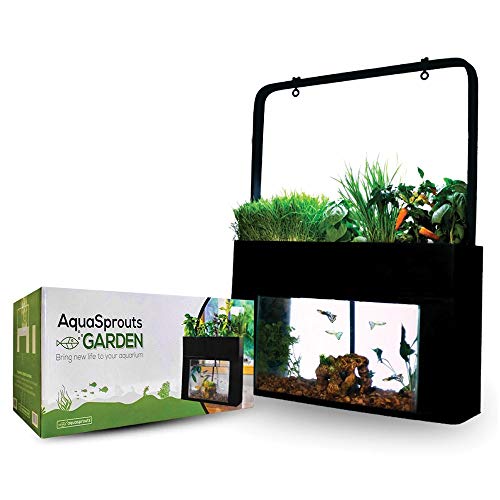
Once you know your volume, the match is straightforward. At about 10 gallons, a desktop kit sits on top of the tank you already have: the aquaponics kits page compares AquaSprouts and Penn-Plax. Between roughly 20 and 55 gallons, you are in converted aquarium territory, and the aquaponics fish tank guide shows how to add a grow bed to a standard tank. At IBC size the project becomes a small farm, with its own build in the IBC aquaponics guide. If you are still deciding between a kit and a build, see how to build an aquaponics system.
Gear for the small end of the range
For tanks around 10 gallons, these are the pieces that turn the tank you measured into a planted one.
-
1Desktop grow tray
A countertop grow tray that our kits page lists as needing a 10 gallon tank, suited to herbs and a few small fish.
-
2Planter and tank combo
A planter and aquarium in one whose listing names betta fish, so it belongs at the very bottom of the size range.
-
3Water test kit
API Freshwater Master Test Kit
Reads pH, ammonia, nitrite and nitrate, the readings that tell you if the stocking number you chose is working.


Planning the rest? See how many fish in a 10 gallon tank, the goldfish and tilapia guides, and the aquaponics pump chart.
Aquarium Volume Calculator FAQ
Grow along with us
New guides and seasonal tips for fish, plants and DIY builds, about once a month.