Buying guide
Aquaponics Tower: Vertical Aquaponics Systems and How to Run One
As an Amazon Associate we earn from qualifying purchases. How we choose products.
On this page
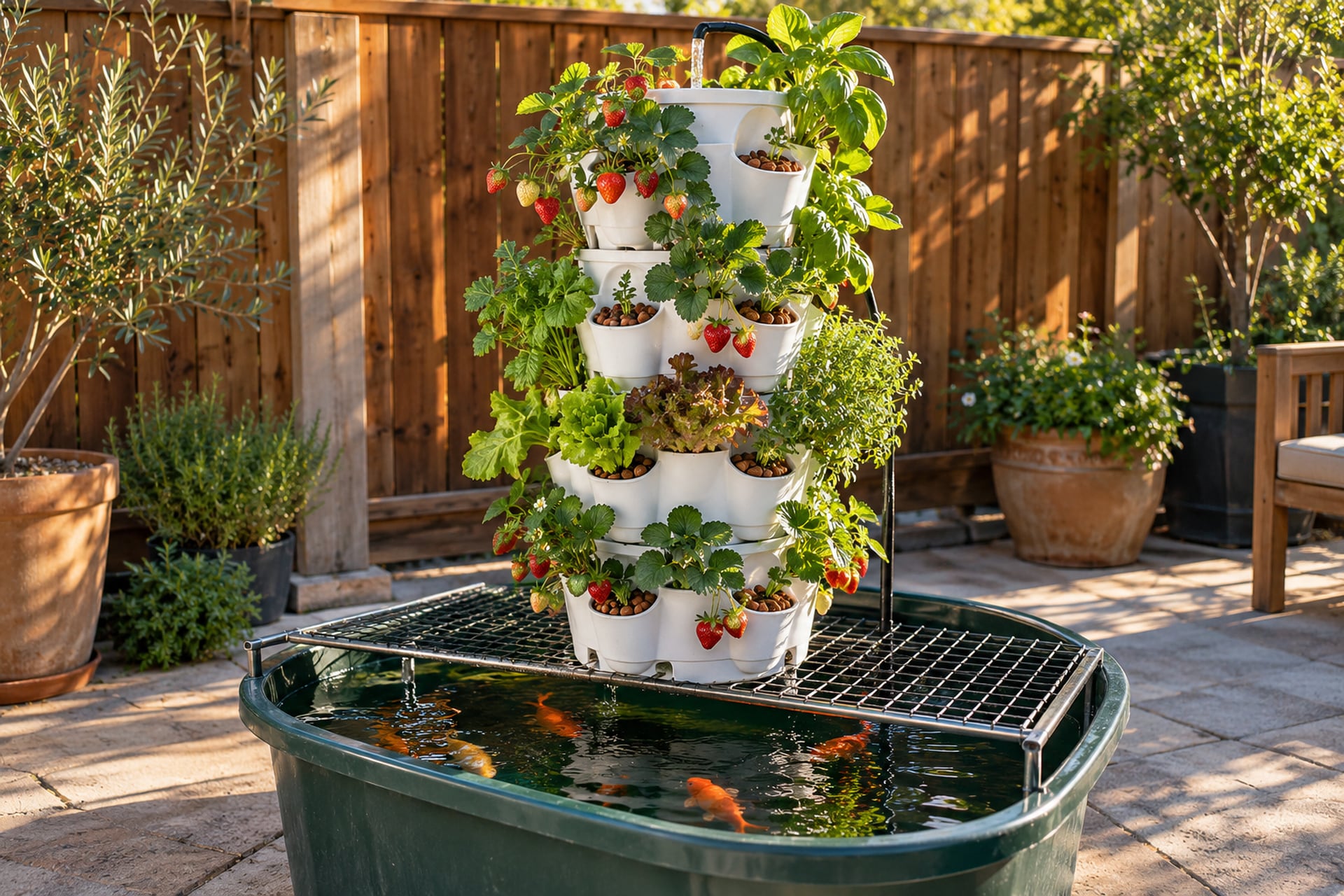
An aquaponics tower is a vertical grow column fed with water from a fish tank. A pump lifts the tank water to the top, it trickles down past the roots of plants set into the sides or into stacked pots, and it drains back into the tank cleaner than it left. Vertical aquaponics fits many more plants into a few square feet than a flat grow bed, which is why towers suit patios, balconies and the corner of a greenhouse.
There is a catch worth knowing before you shop. Almost every tower sold on Amazon is built for hydroponics, with a small nutrient reservoir in the base. They work for aquaponics when you swap that reservoir for a fish tank, but no one sells them that way. This guide explains how vertical aquaponics works, which towers adapt best, and how to set one up so the fish and the plants both do well.
Editor's Choice
Mr. Stacky 5 Tier Stackable Planter
Five food-safe polypropylene pots that stack into a 28 inch column with a flow-through design: water the top pot and it drains through every tier. Filled with clay pebbles and fed by a pump from a fish tank, it is the simplest aquaponics tower to set up.
-
Best tower with pump and lights
SJZX 5 Tier Hydroponic Tower with Grow Lights
A 25-pod tower with a 360 degree grow light, pump and smart plug, for indoor greens.
-
Most plant sites
VIVOSUN 108 Site Hydroponic Grow Kit
Three layers of food-grade PVC pipes with 108 sites and a timed pump, for lettuce in quantity.
-
Premium pick
ALTO Garden GX Hydroponic Tower
A 24-pot tower with thick walls, LED lights, a wheeled reservoir and no subscription.
How Vertical Aquaponics Works
A tower runs the same cycle as any aquaponics system, only stood on end. Fish produce ammonia; bacteria in the system turn it into nitrite and then nitrate; the plants take up the nitrate and other nutrients through their roots; the cleaner water returns to the fish. The difference is gravity. In a tower the water falls through the plants once on every pass, so the pump runs either continuously or on a short timer, and the roots are never left sitting in a flooded bed.
The Three Kinds of Tower
Stacked pots are planters that nest on top of each other, offset so each tier has planting pockets. Filled with clay pebbles or another inert media, they behave like a small vertical media bed: the media traps solids and gives bacteria a home, which is exactly what aquaponics needs. Vertical column towers are tubes with net pot sockets up the sides and water dripping down the inside; the roots hang in the falling water, as in aeroponic towers. Stacked pipe systems run horizontal pipes in layers on a frame, with a thin film of water along each pipe (the nutrient film technique). Commercial vertical farms also use media-filled towers such as ZipGrow, which hang from rails and are usually sold to growers rather than through Amazon.
Why the Fish Tank Has to Be Separate
Hydroponic towers sit on a reservoir of 3 to 5 gallons, which is too small and too dark for fish to live in and too hard to clean. For aquaponics, the tower stands beside or over a proper aquaponics fish tank. A submersible pump in the tank lifts water to the top of the tower, and the tower's base drains back into the tank through a hose or by sitting directly over it. The tower's own pump and reservoir can stay in the box.
What Grows Well in a Tower
Towers suit plants with small roots and a short harvest cycle: lettuce, kale, chard, bok choy, basil, mint, parsley, cilantro, and strawberries, which are the classic stacked-pot crop. Tomatoes, peppers and cucumbers grow too heavy and too rooty for a tower pocket; give them a deep aquaponics grow bed instead. Our guide to the best plants for aquaponics sorts crops by how much they demand.
Aquaponics Towers Compared
All four are sold for hydroponics; the table shows what each needs to run on fish water instead.
| Tower | Mr. Stacky 5 Tier Editor's Choice | SJZX 5 Tier Tower | VIVOSUN 108 Site Kit | ALTO Garden GX |
|---|---|---|---|---|
| Product |  | 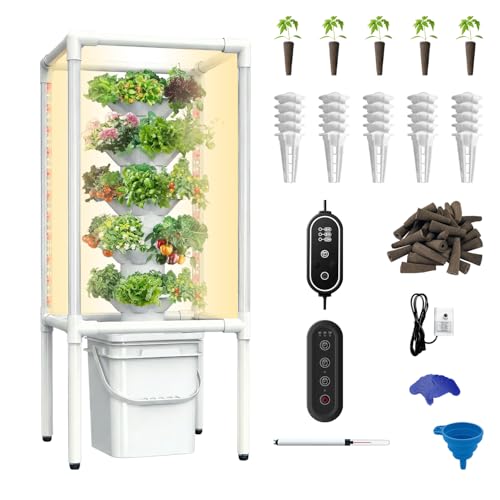 |  | 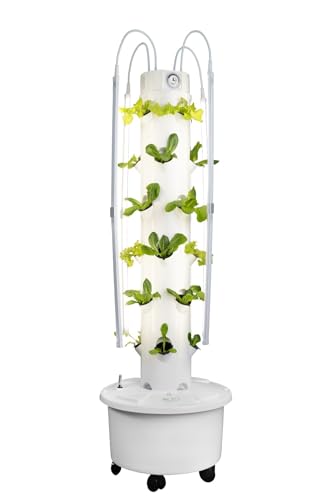 |
| Type | Stacked pots | Vertical column | Stacked pipes (NFT) | Vertical column |
| Plant sites | Pockets on 5 tiers | 25 pods | 108 sites | 24 net pots |
| Size | 12 x 12 x 28 in | About 2.3 sq ft of floor | 39.4 x 20.1 x 38.6 in | 20 x 20 x 66 in |
| Pump and timer | ❌ Add your own | ✅ Pump and smart plug | ✅ Pump and timer | ✅ Pump and timer |
| Lights | ❌ No | ✅ 360° grow light | ❌ No | ✅ LED with timer |
| Aquaponics fit | Best: media filters solids | Good with a screened intake | Good for lettuce; pipes need flushing | Good with a screened intake |
| Price | $ | $$ | $$ | $$$ |
| Buy | Check price | Check price | Check price | Check price |
Editor's Choice
Mr. Stacky 5 Tier
- Type
- Stacked pots
- Plant sites
- Pockets on 5 tiers
- Size
- 12 x 12 x 28 in
- Pump and timer
- ❌ Add your own
- Lights
- ❌ No
- Aquaponics fit
- Best: media filters solids
- Price
- $
SJZX 5 Tier Tower
- Type
- Vertical column
- Plant sites
- 25 pods
- Size
- About 2.3 sq ft of floor
- Pump and timer
- ✅ Pump and smart plug
- Lights
- ✅ 360° grow light
- Aquaponics fit
- Good with a screened intake
- Price
- $$
VIVOSUN 108 Site Kit
- Type
- Stacked pipes (NFT)
- Plant sites
- 108 sites
- Size
- 39.4 x 20.1 x 38.6 in
- Pump and timer
- ✅ Pump and timer
- Lights
- ❌ No
- Aquaponics fit
- Good for lettuce; pipes need flushing
- Price
- $$
ALTO Garden GX
- Type
- Vertical column
- Plant sites
- 24 net pots
- Size
- 20 x 20 x 66 in
- Pump and timer
- ✅ Pump and timer
- Lights
- ✅ LED with timer
- Aquaponics fit
- Good with a screened intake
- Price
- $$$
The Best Towers for Aquaponics
Mr. Stacky 5 Tier Stackable Planter (Editor's Choice)
Mr. Stacky makes stackable planters in the USA from food-safe polypropylene, and its patented flow-through design is the reason it adapts so well to aquaponics: you water the top pot and the water runs down through every tier below. The 5 tier set is five pots plus a bottom saucer, 12 by 12 by 28 inches, holding 25 quarts in total, with planting pockets around every tier.
For aquaponics, fill the pots with rinsed clay pebbles instead of soil, run a tube from a submersible pump in your fish tank to the top pot, and swap the saucer for a drain back to the tank, or stand the column on a grid over the tank itself. The media does double duty as a filter and a home for nitrifying bacteria. Mr. Stacky markets it for strawberries and herbs, which are exactly what grows best this way.
Best for: a first aquaponics tower on a patio or beside a 20 to 50 gallon tank. Missing: pump, tubing, media and the fish tank.
SJZX 5 Tier Hydroponic Tower with Grow Lights
This is a true column tower: five tiers with 25 planting pods in about 2.3 square feet of floor, a 360 degree full-spectrum grow light around it, and a pump with smart plugs set to run 30-minute water cycles. SJZX lists a 12 liter tank, a water level gauge, planting baskets and biochar plugs, and BPA-free materials.
The light is what makes it the indoor choice: a tower in a room needs light on all sides, and this one brings its own. For aquaponics, the 12 liter base is too small for fish, so feed the tower from a separate tank with a pump that can lift water to the top, and put a sponge prefilter on the intake so solids do not clog the pods. Leave the hydroponic nutrient routine out; the fish provide the feed.
Best for: indoor greens and herbs beside an aquarium. Missing: a fish tank and a pump sized for the lift.
VIVOSUN 108 Site Hydroponic Grow Kit (Most Plant Sites)
Not a tower in the round, but the most plants per square foot on this page: three layers of twelve food-grade PVC pipes, each 31.1 inches long and 2.8 inches across, with 108 planting sites in a frame about 39 by 20 by 39 inches. The timer runs the pump for 5 minutes every 30 by default, sending a thin film of water along each pipe. VIVOSUN aims it at leafy vegetables such as lettuce, celery and bok choy.
Pipe systems are the least forgiving for aquaponics because there is no media to catch fish waste, so solids settle in the pipes. Run it from a tank with a mechanical filter or a settling container before the pump, flush the pipes every few weeks, and keep the fish load moderate. Done that way it turns a stock tank of fish into a steady supply of salad.
Best for: lettuce in quantity on a patio or in a greenhouse. Missing: fish tank, prefilter and a cover if it stands in strong sun.
ALTO Garden GX Hydroponic Tower (Premium Pick)
The ALTO GX is the sturdiest tower here. ALTO Garden lists 2 mm tower walls with each layer molded as one solid ring, so there are no seams to leak, 24 net pots spaced wide for full-grown plants, adjustable LED grow lights with a built-in timer, a pump and pump timer, a reservoir on wheels, a germination light, a pH pen and A and B nutrients. There is no subscription, which ALTO makes a point of.
For aquaponics, use the tower and lights and leave the nutrients aside: hydroponic salts are formulated for plants, not fish. Feed it from a fish tank beside it, and use the included pH pen to keep the water near neutral, which suits fish, bacteria and plants together.
Best for: a long-term indoor or patio tower where looks and build quality matter. Missing: the fish tank and a prefilter for the pump.
How to Set Up an Aquaponics Tower
The setup is the same for any tower: the fish tank is the reservoir, the tower is the grow bed, and the pump joins them.
Setting Up a Tower on a Fish Tank
-
Choose the tank
Pick a tank of at least 20 gallons for a small tower and 50 or more for a large one. Rutgers Cooperative Extension sizes aquaponics tanks at about 10 gallons of water per pound of adult fish, so the tank decides how many fish, and therefore how many plants, the system can carry.
-
Size the pump for the lift
A pump's flow drops as it pushes water higher, so check the maximum lift on the listing against the height of your tower plus the depth of the tank. A 5 foot tower needs a pump rated well above 5 feet; the extra keeps a steady trickle at the top.
-
Screen the intake
Fit a sponge prefilter on the pump intake, or pump from a small settling container, so fish waste and leaves do not block emitters and pods. In a stacked-pot tower the clay pebbles handle most of the rest.
-
Route the drain back to the fish
Stand the tower over the tank on a sturdy grid, or run a drain hose from its base back into the tank. Check there is no point where water can escape onto the floor if the drain clogs.
-
Cycle before you add fish
Run the water and build up the bacteria first; our guide to fishless cycling takes you through it. Plant seedlings once ammonia and nitrite read zero, then add fish a few at a time.
-
Test and adjust
Test pH, ammonia, nitrite and nitrate weekly at first. The aquaponics fact sheet by Rakocy, Masser and Losordo (SRAC publication 454) explains why systems are kept close to pH 7: it is the compromise between the needs of the bacteria and the plants.
What You Need Besides the Tower
The pump, media and tests that turn a hydroponic tower into an aquaponic one.
-
1Pump
VIVOSUN 800 GPH Submersible Pump
Adjustable flow with a maximum lift of 10 feet, enough headroom for a tower of 5 to 6 feet over a tank.
-
2Grow media
Halatool Leca Clay Pebbles (2 lb)
Inert, pH-neutral expanded clay for stacked pots and net pots. Rinse before use; a 5 tier stack needs several bags.
-
4Water tests
API Freshwater Master Test Kit
pH, ammonia, nitrite and nitrate, so you know the fish are safe and the plants are fed.


DIY Aquaponics Tower
A homemade tower costs less and can be sized to your tank. The common designs are a 4 inch PVC pipe stood upright with angled holes cut for net cups, water entering at the top through a cap and falling down the inside; a stack of food-grade buckets or planters, each drilled to drain into the one below, filled with clay pebbles; or a gutter rack of horizontal channels on a frame. Whatever you build, use food-safe plastics, keep every joint draining toward the tank, and plan for cleaning: a tower you cannot take apart will clog eventually. Our guides on how to build an aquaponics system and the aquaponics pump cover the plumbing, and if you want the system ready-made instead, see our aquaponics kits.

Yes, for the right crops. Hydroponic towers grow lettuce, herbs, greens and strawberries in a fraction of the floor space of a bed, and they use water efficiently because it recirculates. They are poor for large fruiting plants, and they depend on a pump, so a power cut or clogged emitter shows up quickly.
Stacking planters you adapt yourself sit in the budget tier. Complete towers with pump and grow lights are mid-range, and large towers with thick walls, wheeled reservoirs and full lighting are premium. For aquaponics, add the fish tank and a stronger pump, while the nutrient solution most towers come with goes unused.
Towers need a reliable pump, and plants dry out fast if it stops. Upper and lower tiers can get uneven water and light, small pockets limit root size, and emitters or pods clog, especially on fish water. Indoors they need lighting on all sides, which adds cost and electricity.
The plastic body of a good tower lasts many years indoors; outdoors, sunlight slowly makes cheaper plastics brittle, so UV-protected materials last longer. The pump is the part that wears out first and is usually replaced every few years, along with timers and grow lights. Keeping intakes clean extends pump life.
Not much for the pump. A 50 W pump running around the clock uses 1.2 kWh a day, and on a timer of 5 minutes every half hour about a sixth of that. Grow lights are the bigger draw indoors, depending on wattage and hours; outdoor towers in sunlight need none.
For plants alone, tap water usually works. In aquaponics it needs treating first, because the chlorine or chloramine added by water utilities harms fish and the bacteria that feed the plants. Use a water conditioner that neutralizes both; letting water stand removes chlorine but not chloramine.
Yes. The simplest DIY aquaponics tower is a stack of food-safe planters filled with clay pebbles, fed by a submersible pump from the fish tank and draining back into it. Upright PVC pipes with net cup holes work too. Size the pump for the height and screen its intake.
Grow along with us
New guides and seasonal tips for fish, plants and DIY builds, about once a month.