Buying guide
Best Hydroponic Nutrients: Three-Part, Powder and Single-Bottle Picks
As an Amazon Associate we earn from qualifying purchases. How we choose products.
Best Overall: General Hydroponics Flora Series (quart trio) Check price on Amazon
On this page
The best hydroponic nutrients put every element a plant needs into the water in a form its roots can absorb, because a hydroponic plant has no soil to fall back on. The real decision is between a multi-part system you can tune, a dry powder kit that stretches furthest, and a single bottle that trades flexibility for fewer steps.
This guide compares four hydroponic nutrient options sold on Amazon US: General Hydroponics' Flora three-part series, Masterblend's 4-18-38 combo kit, FoxFarm's Grow Big Hydroponic and Botanicare's Pure Blend Pro Grow. We compared published label data from the makers and the Amazon listings rather than running grow trials. If you keep fish, read the warning section first: these products are for fishless systems.
Best Overall
General Hydroponics Flora Series (quart trio)
Three separate bottles (FloraMicro, FloraGro and FloraBloom) let you shift the mix from leafy growth to fruiting, which suits lettuce today and tomatoes next season.
-
Best budget powder
Masterblend 4-18-38 Complete Combo Kit
A 2.5 lb kit of three dry components: the 4-18-38 base, calcium nitrate and Epsom salt, packed in the ratio the recipe calls for.
-
Simplest single bottle
One liquid concentrate that the maker says is specifically formulated for hydroponic use, so there is no mixing order to remember.
How to Choose Hydroponic Nutrients
Nutrient labels look confusing, but only three questions decide which product suits you: how many parts it comes in, which numbers are on the label, and what water you start with.
One-Part, Two-Part or Three-Part
Multi-part systems exist because some ingredients should not share a concentrated bottle. Calcium is the usual reason: kept apart from phosphates and sulfates, it does not precipitate before it reaches the water. A classic two-part is an A and B pair. General Hydroponics splits its Flora series into three, so you can also change the ratio as a plant moves from leaves to flowers, at the cost of three bottles and a fixed mixing order. The Masterblend kit does the same job with three dry components. A one-bottle formula puts everything in one container: easy, but you cannot adjust the ratio.
What the NPK Numbers Mean
The three numbers on a label are nitrogen, phosphate (P2O5) and potash (K2O) as a percentage by weight. They are not a measure of quality. A 4-18-38 powder is not stronger than a 3-2-6 liquid in any useful sense, because a powder is sold dry and a liquid is mostly water. What matters is the ratio between the numbers and the dose you mix. Compare products by what ends up in the reservoir, not by the size of the digits on the front of the pack.
Water Hardness and Starting Water
Hard tap water already carries calcium and magnesium, which changes how much of those you add. Measure your tap water with an EC meter first and write the base reading down. The opposite problem appears with reverse osmosis water, which carries almost nothing: Botanicare, for example, tells users of RO water to add 5 ml of its Cal-Mag Plus per gallon alongside Pure Blend Pro. We do not give a single recommended dose here, because it depends on your water, the crop and the system. Follow the label for your first reservoir and adjust with a meter.
Best Hydroponic Nutrients Compared
Picks are ordered by how well they serve a typical home grower running a deep water culture system, a Kratky jar or a tower, not by price. All four sit in the budget market tier ($), though the Flora trio costs the most upfront because you are buying three bottles.
| Product | GH Flora Series Best Overall | Masterblend 4-18-38 Combo Kit Budget powder | FoxFarm Grow Big Hydroponic Single bottle | Botanicare Pure Blend Pro Grow |
|---|---|---|---|---|
| Product |  | 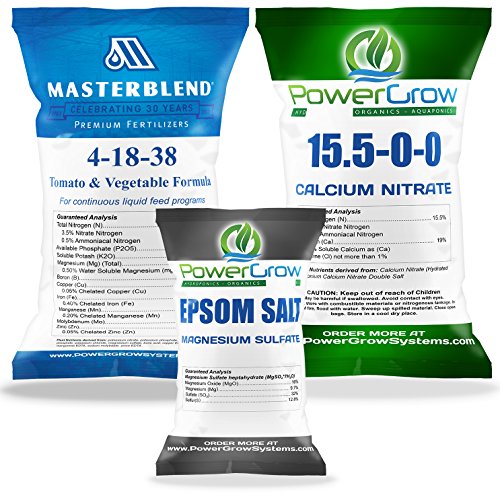 |  |  |
| Format | Three liquids | Three dry components | One liquid | One liquid |
| Size in this listing | 3 bottles, 32 oz each | 2.5 lb kit (1 lb, 1 lb, 0.5 lb) | 1 pint | 1 quart |
| NPK | Micro 5-0-1, Gro 2-1-6, Bloom 0-5-4 | Base 4-18-38, calcium nitrate 15.5-0-0 | 3-2-6 | 3-2-4 |
| Plant stage | Growth and bloom | Growth and bloom, by recipe | Vegetative growth | Vegetative growth |
| Best for | Changing crops, leaf to fruit | Growers happy to weigh powders | Beginners with leafy crops | Hydro and soil users |
| Price tier | $ | $ | $ | $ |
| Buy | Check price on Amazon | Check price on Amazon | Check price on Amazon | Check price on Amazon |
Best Overall
GH Flora Series
- Format
- Three liquids
- Size in this listing
- 3 bottles, 32 oz each
- NPK
- Micro 5-0-1, Gro 2-1-6, Bloom 0-5-4
Show specifications
- Plant stage
- Growth and bloom
- Best for
- Changing crops, leaf to fruit
- Price tier
- $
Budget powder
Masterblend 4-18-38 Combo Kit
- Format
- Three dry components
- Size in this listing
- 2.5 lb kit (1 lb, 1 lb, 0.5 lb)
- NPK
- Base 4-18-38, calcium nitrate 15.5-0-0
Show specifications
- Plant stage
- Growth and bloom, by recipe
- Best for
- Growers happy to weigh powders
- Price tier
- $
Single bottle
FoxFarm Grow Big Hydroponic
- Format
- One liquid
- Size in this listing
- 1 pint
- NPK
- 3-2-6
Show specifications
- Plant stage
- Vegetative growth
- Best for
- Beginners with leafy crops
- Price tier
- $
Botanicare Pure Blend Pro Grow
- Format
- One liquid
- Size in this listing
- 1 quart
- NPK
- 3-2-4
Show specifications
- Plant stage
- Vegetative growth
- Best for
- Hydro and soil users
- Price tier
- $
NPK figures come from each maker's product page, except calcium nitrate, which comes from the Masterblend kit's Amazon listing. Sizes come from the listings. Other pack sizes exist, so check the size on the page before you buy.
General Hydroponics Flora Series (Best Overall)
The Amazon listing is a trio of 32 oz bottles. General Hydroponics gives the guaranteed analysis as 5-0-1 for FloraMicro, 2-1-6 for FloraGro and 0-5-4 for FloraBloom. Because FloraBloom carries no nitrogen and FloraGro carries more potash than phosphate, shifting the ratio between them really does change what the plant gets. FloraMicro also supplies the chelated trace elements, which the maker lists as boron, cobalt, copper, iron, manganese, molybdenum and zinc.
The maker is firm about order: FloraMicro goes into fresh water first and is mixed thoroughly, then FloraGro, then FloraBloom, stirring between additions and never combining the concentrates undiluted. Rates are on the label and in the maker's feed charts. The same trio serves a Kratky jar or a tower.
- ✅ Adjustable ratio from leafy growth to fruiting
- ✅ Published NPK and a clear mixing order from the maker
- ✅ Quart bottles are a sensible starting size for a few reservoirs
- ❌ Three bottles and a mixing order to follow
- ❌ Costs more upfront than a single-bottle formula
Masterblend 4-18-38 Complete Combo Kit (Best Budget Powder)
The kit is hydroponic in practice: Masterblend's hydroponics page lists 4-18-38 Tomato among its hydroponic formulas, for drip, DWC, wick and aeroponic systems. The maker guarantees 4% nitrate nitrogen, 18% phosphate and 38% potash, with 0.40% chelated iron among the micronutrients. This Amazon listing packs 1 lb of the base, 1 lb of calcium nitrate (15.5-0-0) and 0.5 lb of Epsom salt, a ratio of 1 to 1 to 0.5 by weight.
Do not read the 4-18-38 on the bag as the final mix. Calcium nitrate adds nitrogen and calcium, so equal weights of base and calcium nitrate work out at about 1 part nitrogen, 1 part phosphate and 2 parts potash, by our arithmetic from the labels. That is a usable growth mix, not only a tomato feed.
Dose is the catch, because sources differ. The maker's retail formula page says 1 tablespoon per gallon as a weekly feed, with 1/2 teaspoon of Epsom salt and 1 teaspoon of calcium nitrate. One grower's published reservoir recipe is far lighter: 2 g each of base and calcium nitrate plus 1 g of Epsom salt per gallon for vegetative growth, and 3 g, 3 g and 2 g for fruiting. At the lighter rate this 2.5 lb kit mixes about 225 gallons, against a little under 50 gallons from the FoxFarm pint at its general feeding rate. Use a meter to set your own strength, and dissolve each component fully in the water before adding the next. Never blend them dry.
- ✅ Goes a long way for a budget-tier kit
- ✅ Nitrate-only nitrogen in the base, per the maker
- ✅ All three components in the right proportions
- ❌ You need a gram scale and patience
- ❌ Dose guidance varies, so a meter is essential
- ❌ Powders are less convenient for a single jar
FoxFarm Grow Big Hydroponic (Simplest Single Bottle)
FoxFarm says Grow Big Hydroponic is a liquid concentrate specifically formulated for hydroponic use, and its guaranteed analysis is 3-2-6 with 2.0% calcium and 0.5% magnesium. Do not confuse it with soil-range Grow Big, which is a different product. The Amazon listing is 1 pint and suggests 2 teaspoons per gallon for general feeding and 3 for heavy feeding, checked with a conductivity or ppm meter.
It is the easiest on-ramp for a first beginner hydroponic system, and there is no mixing order because there is only one bottle. The limit is that it is a growth formula: the listing says to move to FoxFarm's bloom products at the first signs of flowering, so a fruiting crop means buying more bottles later.
- ✅ One bottle, no mixing order
- ✅ Made for hydroponics, per the maker
- ✅ Calcium and magnesium on the label
- ❌ Growth stage only, so fruiting crops need a bloom product
- ❌ This listing is a pint, which goes quickly in a large reservoir
Botanicare Pure Blend Pro Grow (Single Bottle Alternative)
Botanicare's page gives 3.0% nitrogen, 2.0% phosphate and 4.0% potash, plus 1.0% calcium and 0.5% magnesium, and labels the product for soilless hydroponic applications as well as soil, coco and container gardens. The Amazon listing here is 1 quart. The maker says to use it with every watering during the vegetative stage and points to the label and its nutrient calculator for rates, and to reduce the rate by 25% if you also use supplements.
Treat it as the second single-bottle choice, or the first if you run soil containers beside your hydroponics and want one product for both. Like FoxFarm's formula it is for vegetative growth, so flowering crops need a bloom feed.
- ✅ One bottle for hydroponics, soil and coco
- ✅ Calcium and magnesium on the label
- ✅ A quart lasts longer than a pint
- ❌ Growth stage only
- ❌ Fixed ratio, like any one-bottle formula
Which Hydroponic Nutrients Should You Buy?
For Lettuce and Leafy Greens
A growth-stage single bottle is enough for hydroponic lettuce, and the Flora trio or a light Masterblend mix works too. Masterblend also lists a separate 8-15-36 Lettuce formula among its hydroponic products, though that is not the kit reviewed here.
For Tomatoes and Strawberries
Fruiting crops benefit from a bloom stage, so choose the Flora trio or the Masterblend kit rather than a growth-only bottle. Our hydroponic strawberries page shows what that system needs.
For a Single Kratky Jar
A pint of FoxFarm is plenty, and you avoid buying a scale. A powder kit makes more sense once you are filling reservoirs measured in gallons.
How to Mix and Feed Hydroponic Nutrients
Mix in Clean Water, in Order
Fill the reservoir first, then add each part one at a time, stirring between them, and never pour concentrates together. For Flora that order is Micro, Gro, Bloom. For anything else, follow the label. Check pH after the nutrients are in, not before.
Aim for the Right Numbers
Writing in Greenhouse Grower in 2012, Robert Hansen of Ohio State University gave a pH target of about 5.5 to 6.5 depending on the crop, and said EC targets are often 1.0 to 2.0 mS/cm, varying by crop. He advised staying below 4.0 mS/cm. Because water and inert media have very little buffering, he reported pH swings of 1 to 2 units in a single day, which is why you measure rather than assume.
Top Up and Change the Reservoir
Plants take up some elements faster than others, so the mix drifts even when the EC reading looks fine. The sources we read do not agree on a single interval, so let the crop, reservoir size and meter decide. Small reservoirs drift faster than large ones. Replace the solution sooner if it turns cloudy or smells off, or if pH will not hold steady. Kratky systems are the exception, because they are filled once and left alone.
Why Hydroponic Nutrients Do Not Belong in a Fish Tank
Hydroponics and aquaponics look alike from the plant's side, but the water has to keep very different things alive. See aquaponics vs hydroponics for the full comparison. Three differences matter when you are holding a bottle.
Copper and Other Trace Metals
Plants need traces of copper and zinc, so these products contain them. FoxFarm's label lists 0.05% chelated copper and 0.05% chelated zinc, Masterblend's lists the same two figures, and General Hydroponics names copper and zinc among FloraMicro's trace elements. The US EPA says copper is an essential nutrient at low concentrations but toxic to aquatic organisms at higher ones, and that chronic exposure can affect survival, growth and reproduction. A dose meant for lettuce was never tested on your fish.
A Different pH Target
Hydroponic solutions run at about pH 5.5 to 6.5, while aquaponic systems sit near 7.0, a balance that suits fish, plants and bacteria together. Hydroponic pH Down products are made to pull a reservoir down quickly, which is the opposite of what a fish tank needs. If your tank really is too alkaline, use a gentler route from our guide on how to lower pH in an aquarium.
What to Do If Aquaponic Plants Look Hungry
Fish waste supplies most of what plants need, though not everything. As our guide on whether fish tank water is good for plants explains, FAO notes that aquaponic systems tend to run short of iron, potassium and calcium over time. Test the water first with one of the best water test kits, then treat the specific shortage with a supplement sold as safe for aquaponics. Keep buckets, syringes and measuring jugs from your hydroponic setup separate from anything that touches the fish tank.
Related: build a DIY hydroponic system, try the Kratky method, or pick a unit from the best hydroponic tower gardens.
Grow along with us
New guides and seasonal tips for fish, plants and DIY builds, about once a month.