Hydroponics guide
NFT Hydroponics: How the Nutrient Film Technique Works and How to Build a System
As an Amazon Associate we earn from qualifying purchases. How we choose products.
On this page
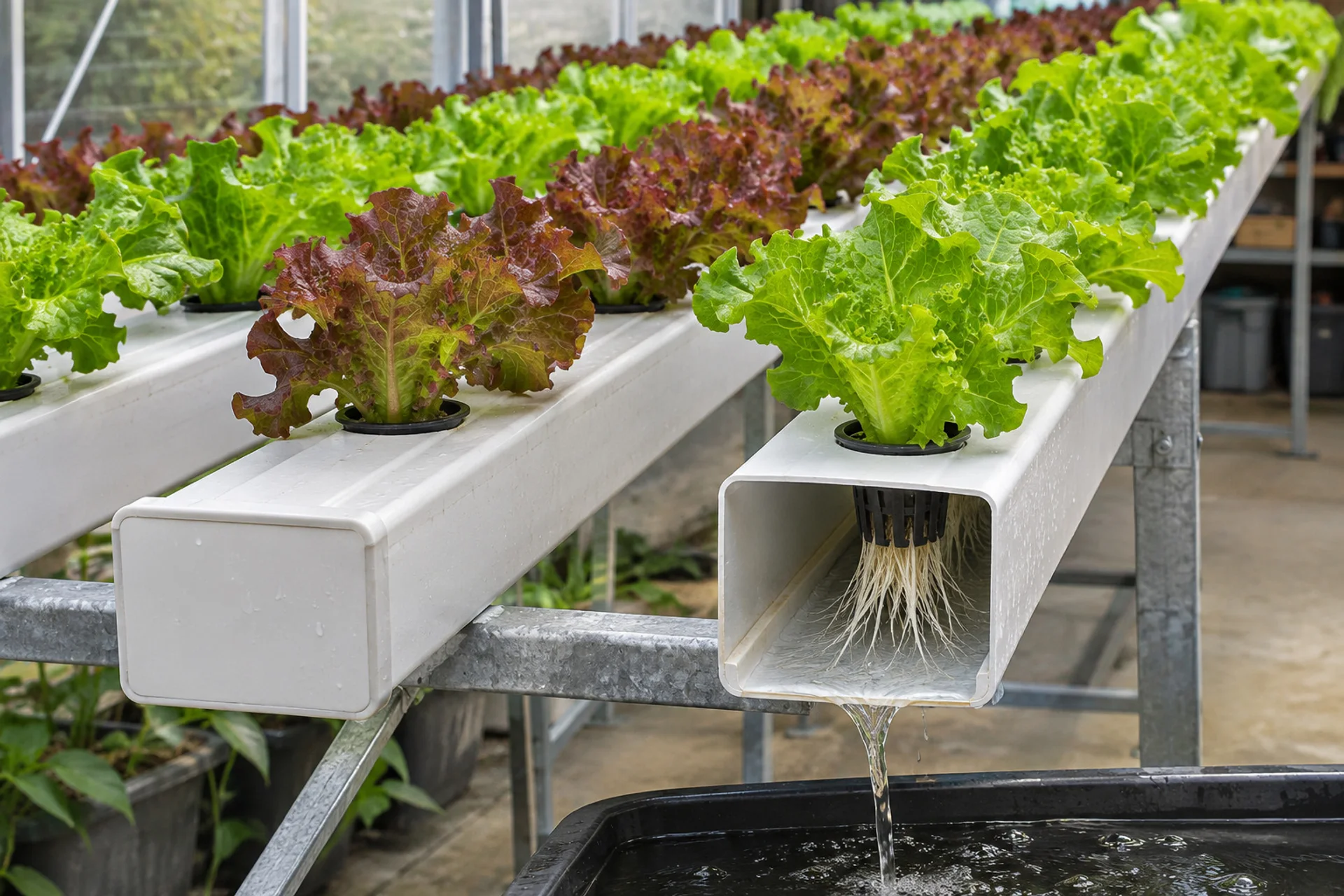
NFT hydroponics, short for nutrient film technique, grows plants in sloped channels with a thin stream of nutrient solution running along the bottom. The roots sit partly in that film and partly in the moist air above it, so they get water, nutrients and oxygen at the same time. A pump lifts the solution from a reservoir to the high end of the channels and gravity brings it back.
It is the system behind most commercial hydroponic lettuce and herbs, and it scales well at home once you understand the three numbers that make it work: slope, flow and channel length. This guide explains them, shows a simple DIY build, compares two ready-made NFT kits on Amazon US, and is honest about NFT's main weakness: it has almost no water to fall back on if the pump stops.
What Is NFT Hydroponics?
The nutrient film technique was pioneered in 1965 by Allen Cooper at the Glasshouse Crops Research Institute in Littlehampton, England, according to the Wikipedia entry on NFT. The idea is to give roots a very shallow stream instead of a tank of water. Plants sit in net cups or plugs through holes in the top of a closed channel, the roots grow down and spread along the channel floor into a mat, and the solution flows over and under that mat.
What NFT Stands For
NFT stands for nutrient film technique. The film is the key word: the stream should be only a few millimeters deep, so the upper part of the root mat stays in humid air. That is how NFT supplies oxygen without an air pump.
How It Differs From DWC
In deep water culture roots hang in a large volume of aerated solution. In Growing Hydroponic Leafy Greens (GPN, 2016), Cornell's Neil Mattson names DWC and NFT as the two most common hydroponic systems for leafy greens. He notes that DWC's large volume of water avoids rapid changes in temperature, pH, EC and nutrient composition. NFT gives up that buffer in exchange for less water, lighter channels and easy access to every plant.
The Three Numbers That Make NFT Work
Channel Slope
The channel has to fall steadily from the inlet end to the drain end so the film keeps moving without pooling. Mattson describes commercial lettuce channels sloped at 1 to 4 percent away from a center aisle and drained at the ends back to the reservoir. One percent is a drop of 1 inch for every 100 inches of channel. Wikipedia notes that 1 in 100 has been recommended but is hard to build truly flat enough, so steeper slopes of 1 in 30 to 1 in 40 are sometimes used. At home, aim for the steeper end: a slight extra fall is easier to live with than a channel that ponds in the middle.
Flow Rate
As a general guide, Wikipedia gives about 1 liter per minute for each channel, which is roughly a quarter of a gallon per minute, or about 16 gallons per hour per channel. An 8 channel system therefore needs a pump delivering around 130 GPH at the height of the inlet manifold, plus some spare for adjustment. Too little flow and the far end of the channel runs short of oxygen and nutrients; too much and the film becomes a stream deep enough to drown the root mat.
Channel Length
Along a long channel, the plants at the top take nutrients and oxygen out of the solution before it reaches the plants at the bottom. For that reason Wikipedia says channel length should not exceed 10 to 15 meters. Home systems are far shorter, typically 3 to 8 feet, so length is rarely the limit. If you go longer, feed the channels from both ends or split them.
NFT vs DWC vs Kratky
| NFT | DWC | Kratky | |
|---|---|---|---|
| Water volume | Low, a thin film | High, a full tub | Fixed, no circulation |
| Pumps | Water pump, always on | Air pump, always on | None |
| Buffer if power fails | Very little | Hours to a day | Not affected |
| Best crops | Lettuce, herbs, strawberries | Lettuce, herbs, larger leafy crops | Lettuce, herbs, one crop at a time |
| Scales up by | Adding channels | Adding tubs or a bigger raft | Adding containers |
| Weight | Light, easy on shelves and walls | Heavy | Moderate |
If you are choosing a first system, our hydroponic system for beginners guide compares all of them, and the Kratky method is the simplest place to start without a pump.
NFT Hydroponic System Kits
Ready-made NFT kits on Amazon are usually PVC pipe systems: square or round pipes with holes, end caps, a small pump and net baskets. You supply the reservoir. They are a quick way to try NFT, and the two below are sized differently enough to suit most homes.
| Kit | INTBUYING 72 Holes, 8 Pipes Leafy greens | INTBUYING 20 Holes, 2 Layers Larger plants |
|---|---|---|
| Kit |  |  |
| Plant sites | 72 | 20 |
| Pipe diameter | 2.5 in | 4.33 in |
| Hole diameter | 1.2 in | 1.96 in |
| Hole spacing | 2 in | 3.9 in |
| Included | 110 V pump, baskets, sponges | 110 V pump (1.5 m head), baskets |
| Reservoir | Not included, 15 to 20 L suggested | Not included, 15 to 20 L suggested |
| Price tier | $$ | $$ |
| Buy | Check price on Amazon | Check price on Amazon |
Leafy greens
INTBUYING 72 Holes, 8 Pipes
- Plant sites
- 72
- Pipe diameter
- 2.5 in
- Hole diameter
- 1.2 in
Show specifications
- Hole spacing
- 2 in
- Included
- 110 V pump, baskets, sponges
- Reservoir
- Not included, 15 to 20 L suggested
- Price tier
- $$
Larger plants
INTBUYING 20 Holes, 2 Layers
- Plant sites
- 20
- Pipe diameter
- 4.33 in
- Hole diameter
- 1.96 in
Show specifications
- Hole spacing
- 3.9 in
- Included
- 110 V pump (1.5 m head), baskets
- Reservoir
- Not included, 15 to 20 L suggested
- Price tier
- $$
INTBUYING 72 Holes, 8 Pipes (Best for Leafy Greens)
Eight food grade PVC-U pipes, 2.5 inches across, with 72 holes of 1.2 inches spaced 2 inches apart, a 110 V pump, net baskets and sponges. The listing suggests a dark, covered reservoir of 15 to 20 liters, which you buy separately.
The tight spacing suits baby leaf, herbs and small lettuce. Full heads of butterhead or romaine need more room, so plant every other hole for those. With only 15 to 20 liters in the loop, check pH and EC more often than you would in a DWC tub.
- ✅ Many plant sites in a small footprint
- ✅ Pump and baskets included
- ✅ Easy to see and reach every plant
- ❌ 2 inch spacing is tight for full heads
- ❌ Small reservoir means faster swings in pH and EC
INTBUYING 20 Holes, 2 Layers (Best for Larger Plants)
Four wider pipes, 4.33 inches across, in two layers, with 20 holes of 1.96 inches spaced 3.9 inches apart, extra-large baskets and a 110 V pump the listing rates at 1.5 meters of head. Again, the reservoir is not included.
The wider pipe and spacing suit strawberries, full lettuce heads and larger herbs such as basil. The listing pitches it for strawberries, which NFT handles well; see our hydroponic strawberries guide for varieties.
- ✅ Wide pipes leave room for big root mats
- ✅ Generous spacing for full heads and strawberries
- ✅ Two layers save floor space
- ❌ Only 20 sites
- ❌ The lower layer gets less light under one overhead lamp
How to Build a DIY NFT System
A home NFT system needs only a few parts, and building one teaches you how the slope and flow interact. Our DIY hydroponic system guide covers other builds if you would rather not run a pump.
Parts List
- Channels: square downspout or vinyl fence post, or round PVC pipe, in white or another light color to stay cool
- End caps for each channel, with a drain hole at the low end
- A dark, lidded reservoir of at least 10 to 20 gallons
- A small submersible pump, plus 1/2 inch tubing and a manifold with a valve or drip line per channel
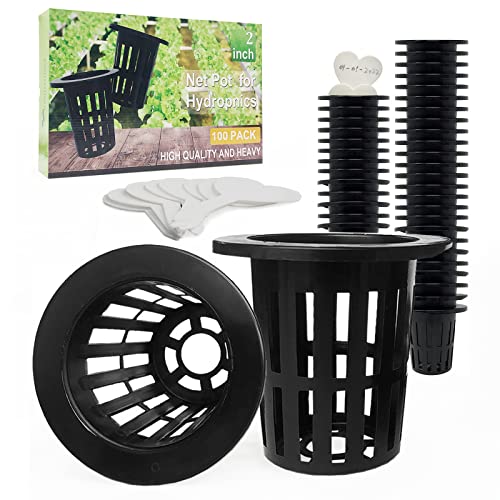
- 2 inch net cups and starter plugs
- A stand that holds the channels at a steady slope
Choosing Channel Size
Narrow channels suit lettuce and herbs; wide ones suit plants with large root mats. Round pipe is cheap but its curved floor can let the film run in a narrow line; flat-bottomed channels spread the film across the roots.
Building an NFT System, Step by Step
-
Build the stand at a fixed slope
Set the inlet end higher than the drain end, around 1 to 4 percent. Check every channel with a level; a sag in the middle will pond.
-
Drill the plant sites
Use a hole saw to match your net cups, typically 2 inches, spaced 6 to 8 inches apart for full lettuce heads and closer for herbs.
-
Fit end caps and drains
Cap both ends. At the low end, drill a drain hole big enough that water cannot back up, and run it back to the reservoir.
-
Plumb the pump and manifold
Run tubing from the pump to a manifold at the high end, with one valve or drip line per channel so you can balance flows.
-
Test with plain water
Run the system with no plants. Each channel should carry a shallow, even film from end to end and drain freely. Adjust the valves until it does.
-
Add nutrients, then plants
Mix the solution, set pH last, then place rooted seedlings in net cups so the plug just touches the film.
Parts That Fit Any NFT System
Net cups, starter plugs and a nutrient for a home NFT system, whether you build it or buy a kit.
-
1Net cups
Tmtamye 2 Inch Net Pots, 100 Pack
Heavy duty wide-lip cups that sit in a 2 inch hole, enough for a full set of channels.
-
2Starter plugs
General Hydroponics Rapid Rooter Plugs, 50 Count
Seed starting plugs that hold their shape in a net cup and pass roots through to the film.
-
3Nutrients
General Hydroponics Flora Series
Three-part nutrient that lets you shift the mix from leafy growth to fruiting crops such as strawberries.


What Grows Best in NFT
Lettuce and Leafy Greens
Lettuce is the classic NFT crop: shallow roots, a short cycle and a light plant that the channel holds easily. Our hydroponic lettuce guide covers varieties and nutrient targets.
Herbs
Basil, mint, parsley, cilantro and chives all do well. Basil grows large root mats, so give it a wider channel or thin the plants.
Strawberries
Strawberries suit NFT because the fruit hangs clear of the channel and stays clean.
Harder Crops
Tomatoes, cucumbers and peppers can grow in NFT, but their large root mats can block a narrow channel and their weight needs separate support. They are usually easier in Dutch buckets or a media bed.
Running an NFT System
Nutrients, pH and EC
Writing in Greenhouse Grower in 2012, Robert Hansen of Ohio State University gave a pH target of about 5.5 to 6.5 depending on the crop and said EC targets are often 1.0 to 2.0 mS/cm. He also reported pH changes of 1 to 2 units in a day in hydroponic solutions. In a small NFT reservoir that means measuring daily, not weekly. The best hydroponic nutrients guide covers what to buy and how to mix it.
Oxygen and Temperature
Mattson's article puts dissolved oxygen for lettuce at about 7 to 8 ppm and reports crop failure below 3 ppm. NFT gets its oxygen from the air over the film, so a warm reservoir is the main risk: warm water holds less oxygen. Keep the reservoir shaded and in the coolest part of the room.
Root Mats and Clogs
As plants mature, roots can dam a channel. Look along each channel weekly: water backing up at the inlet end is the first sign. Harvest on time and do not let one crop run on for months.
Cleaning Between Crops
Drain the system, scrub the channels and reservoir, and run a cleaning solution before replanting. Algae and biofilm build up fastest where light reaches the water, so cap every unused hole.
NFT With Fish: Can You Use It in Aquaponics?
Yes, but NFT is the trickiest aquaponic bed. Fish water carries solids that settle in shallow channels and coat the roots, and NFT channels give nitrifying bacteria little surface to live on. Aquaponic NFT systems therefore need a mechanical filter and a separate biofilter before the channels. If you want fish with leafy greens, a raft system or a vertical aquaponics tower is usually easier.
Related: compare with a DWC hydroponic system, try the Kratky method, or light it with our beginner system guide.
Grow along with us
New guides and seasonal tips for fish, plants and DIY builds, about once a month.