Hydroponics
EC Meter for Hydroponics: How to Read EC, Target Ranges and Which to Buy
As an Amazon Associate we earn from qualifying purchases. How we choose products.
Editor's Choice: Bluelab Truncheon Digital Nutrient Meter Check price on Amazon
On this page
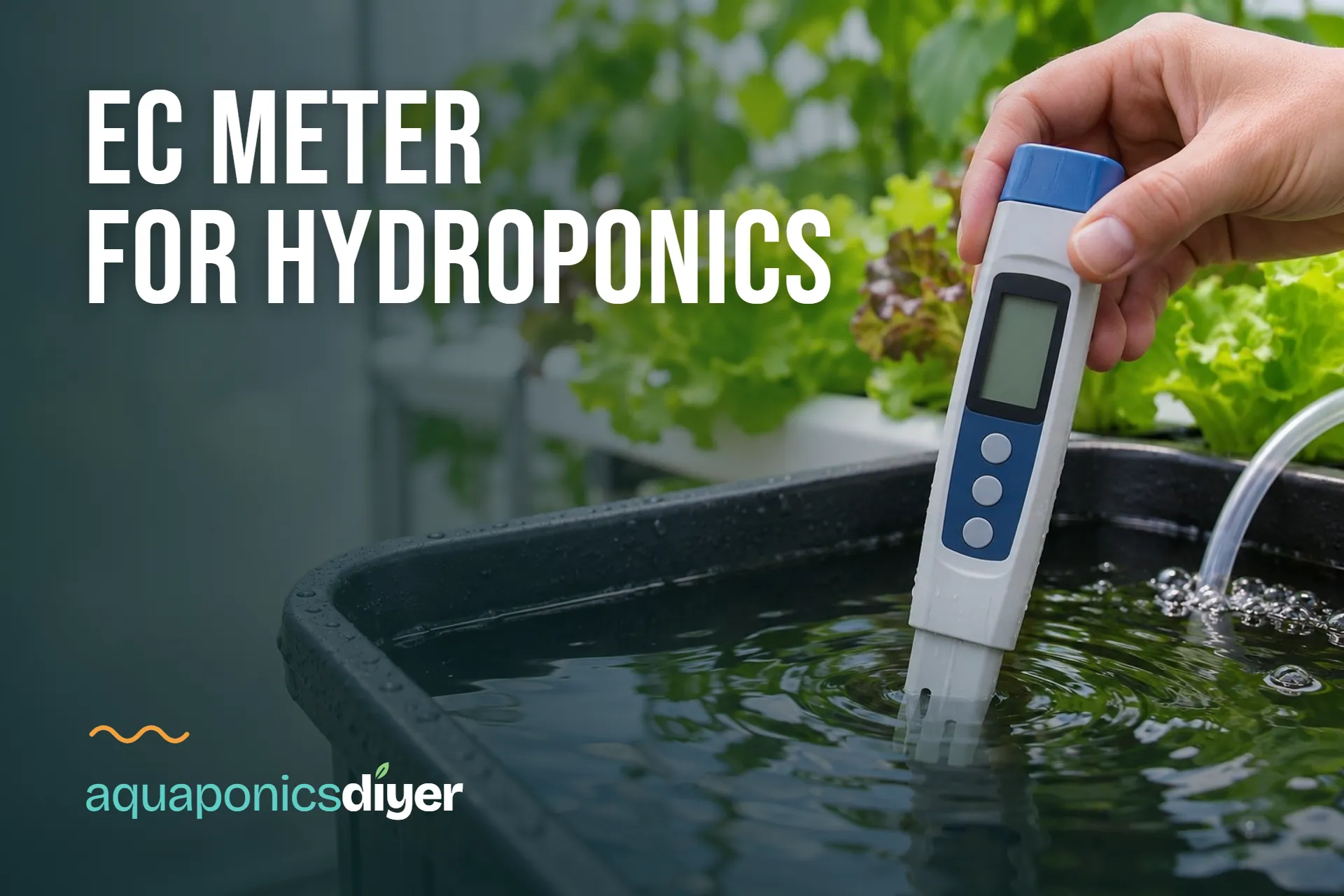
An EC meter tells you how strong your nutrient solution is. Electrical conductivity (EC) is the one number that moves when you add fertilizer, top up with water or let the plants drink the reservoir down, and it is the reading hydroponic growers check more often than anything except pH. This guide explains what an EC meter measures, how EC relates to TDS and ppm (the source of most of the confusion), how to test EC properly, what target EC to aim for by crop, how to calibrate the meter and which models to buy.
The numbers come from named sources: an Oklahoma State University Extension fact sheet on EC and pH for hydroponics (HLA-6722, Singh and Dunn, 2016), Hanna Instruments and Bluelab for the scales, the FAO manual Small-scale aquaponic food production (Technical Paper 589, 2014) for aquaponics, and the listings of the meters we link. Our guide to the best TDS meters covers TDS-only pens; this page is about EC.

Editor's Choice
Bluelab Truncheon Digital Nutrient Meter
A waterproof wand you dip into the reservoir while you mix. Bluelab lists a 0.2 to 3.6 EC range, shows EC, CF and both the 500 and 700 ppm scales, and ships it factory calibrated with automatic temperature compensation.
-
Best for accuracy
Apera EC20 Conductivity Pocket Tester Kit
A wide-range tester that Apera rates at plus or minus 1 percent full scale from 0 to 20 mS/cm, with auto calibration and calibration solutions in the box.
-
Budget pH and TDS pair
VIVOSUN Digital pH Meter and TDS EC Meter
Two pens in one purchase, a pH meter and a 3-in-1 TDS, EC and temperature meter, for growers who need both readings on a small budget.


What Is an EC Meter?
An EC meter is a probe and a display that measure electrical conductivity, how easily an electric current passes through water. Oklahoma State's fact sheet explains why that is useful: fertilizers are salts, and when salts dissolve they break into ions that carry current, so the conductivity of the solution rises with every ion you add. A higher EC means a higher salt concentration and a lower EC means a lower one. The sheet adds that too much nutrient causes osmotic stress, ion toxicity and imbalance, while too little causes deficiencies and slower growth.
The Units: mS/cm and µS/cm
Most hydroponic guides give EC in millisiemens per centimeter (mS/cm). Lab and water-quality sources, including the FAO, use microsiemens per centimeter (µS/cm), which is a thousand times smaller: 1 mS/cm equals 1,000 µS/cm. Some sources write the same value as dS/m, which is numerically equal to mS/cm. If a feeding chart and a meter use different units, convert before you dose.
What an EC Meter Cannot Tell You
EC reads the total of everything that conducts, not which nutrient it is. The FAO makes the point for aquaponics: EC and TDS meters measure the total amount of nutrient salts, but they do not give a precise reading of nitrate, which is better monitored with a test kit. Treat EC as the strength of the feed, not as a nutrient analysis.
EC vs TDS vs PPM
EC is the measurement. TDS (total dissolved solids) and ppm are calculated from it by multiplying with a factor. Hanna Instruments gives the formula as TDS = factor × EC at 25°C, with a factor of 0.5 for strong ionic solutions and 0.7 for weak ionic solutions such as fertilizers, and notes that basic meters fix the factor at 0.5. Bluelab expresses the same idea in mS/cm: its ppm 500 scale is EC × 500 and its ppm 700 scale is EC × 700. Its example is an EC of 2.4, which reads 1,200 ppm on the 500 scale and 1,680 on the 700 scale.
| Reading | How it relates to EC | Where you see it | Example at 1.8 EC |
|---|---|---|---|
| EC | The measurement itself, in mS/cm | Every EC meter | 1.8 mS/cm |
| CF | EC × 10 | Bluelab and some European charts (the Truncheon listing gives 0.2 to 3.6 EC and 2 to 36 CF) | 18 CF |
| ppm 500 (TDS) | EC × 500 | Bluelab, and Hanna's 0.5 factor | 900 ppm |
| ppm 700 | EC × 700 | Bluelab, and Hanna's 0.7 factor for fertilizers | 1,260 ppm |
Sources: Hanna Instruments, "EC TDS: what is the relationship between TDS and EC"; Bluelab support, "What are the different conductivity scales". The 1.8 EC row is our arithmetic from those formulas. Bluelab's article also mentions a ppm 650 scale without giving a formula, and meters from other makers use their own factors, so read the manual.
Why the Scale Matters
A feeding chart that says 1,000 ppm can mean 2.0 EC on the 500 scale and about 1.4 EC on the 700 scale, a 40 percent difference in strength. Bluelab says to match the meter's scale to the one your feeding schedule uses, that the true ppm of a solution can only be found by chemical analysis, and recommends using EC to avoid the problem altogether. We agree: log EC, and treat ppm as a label.
Is a TDS Meter the Same as an EC Meter?
Almost. As Hanna explains, a TDS meter measures EC and applies the factor itself. A meter that shows EC directly gives you the real reading and lets you convert to any scale. Our TDS meter guide compares pens that show ppm only.
How to Test EC in Hydroponics
A reliable EC reading comes from a calibrated meter, a stirred sample and a consistent routine. Oklahoma State's fact sheet gives the steps; the notes below add what the meter listings say about temperature.
Testing EC in a nutrient reservoir
-
Calibrate the meter
Place the probe in a buffer solution of known EC (usually 1.41 mS/cm, Oklahoma State says) and set the meter to that value. Auto-calibrating models such as the Apera EC20 recognize the buffer for you.
-
Stir the solution
Mix the reservoir and let the reading stabilize, which may take a couple of minutes, according to the same sheet.
-
Check the temperature
EC changes with temperature, and the readings are referenced to 25°C. Oklahoma State gives 72 to 75°F (22 to 24°C) as the optimal water temperature. Meters with automatic temperature compensation (ATC), such as the Bluelab Truncheon and the Apera EC20, correct the reading for you.
-
Read and compare
Dip the probe, wait for the number to settle and compare it with the target for your crop in the table below.
-
Adjust
If EC is above the target, dilute the solution with water. If it is below, add nutrient concentrate and test again, as the sheet instructs.
-
Then check pH
Oklahoma State's rule is to check pH after EC is in range, and to test both daily and at the same time of day. Rinse the probe in tap water afterwards and store it as the maker advises.
How Often to Test
Oklahoma State says pH and EC should be checked daily and at the same time of day, and advises replacing the nutrient solution completely every two weeks, because salts such as sodium chloride build up with constant top-ups and adjustments. A fresh mix resets that drift.
Keep a Log
Write the number down each time. A single reading tells you little, but a week of readings shows how fast the plants are drinking and whether salts are creeping up, which is the signal to change the solution.
EC Targets by Crop
Target EC depends on the crop and on the growth stage. The table uses Oklahoma State's Table 2 (Singh and Dunn, 2016), which lists an optimum EC range for each hydroponic crop. The ppm columns are our conversion of those ranges at the 500 and 700 factors above, so you can compare them with whichever scale your meter shows.
| Crop | EC (mS/cm) | ppm 500 | ppm 700 | Our guide |
|---|---|---|---|---|
| Lettuce | 1.2 to 1.8 | 600 to 900 | 840 to 1,260 | Hydroponic lettuce |
| Basil | 1.0 to 1.6 | 500 to 800 | 700 to 1,120 | Hydroponic basil |
| Spinach | 1.8 to 2.3 | 900 to 1,150 | 1,260 to 1,610 | Hydroponic spinach |
| Strawberry | 1.8 to 2.2 | 900 to 1,100 | 1,260 to 1,540 | Hydroponic strawberries |
| Pak choi | 1.5 to 2.0 | 750 to 1,000 | 1,050 to 1,400 | None yet |
| Cucumber | 1.7 to 2.0 | 850 to 1,000 | 1,190 to 1,400 | Hydroponic tomatoes and cucumbers |
| Peppers | 0.8 to 1.8 | 400 to 900 | 560 to 1,260 | Hydroponic peppers |
| Tomato | 2.0 to 4.0 | 1,000 to 2,000 | 1,400 to 2,800 | Hydroponic tomatoes and cucumbers |
Source: Hardeep Singh and Bruce Dunn, Electrical Conductivity and pH Guide for Hydroponics, Oklahoma Cooperative Extension Service HLA-6722 (October 2016), Table 2.
Read the Range, Not Just the Middle
The ranges are wide, and the sheet does not split them by stage. A nutrient maker's chart for your product is more specific than any general table, so use the table as a sanity check. Our hydroponic nutrients guide covers the products.
Compare With Our Crop Guides
Our crop guides cite the sources they used. Our basil guide, for example, uses 1.4 mS/cm from Johnny's Selected Seeds, which sits inside the Oklahoma State range, so the two agree.
How to Calibrate an EC Meter
Calibration means telling the meter what a known solution should read. Oklahoma State describes the standard method: place the probe in a buffer solution of known conductivity, wait for the reading, then set the meter to the buffer's value. Every buffer has a specific EC, usually 1.41 mS/cm.
Meters That Calibrate Themselves
Models differ. The Apera EC20 listing describes auto calibration with automatic buffer recognition, and reminders on the display when calibrations are complete, plus ready-to-use calibration solutions in the kit. The Bluelab Truncheon is listed as factory calibrated and needs no calibration, which is why it suits growers who want a dip-and-read tool. For the VIVOSUN pair, the listing names three calibration buffers for the pH meter, so check the product page for whether a conductivity standard is included before you buy.
Keeping the Probe Accurate
Rinse the probe after every use, store it as the maker says and replace calibration solution when it is old. Oklahoma State advises rinsing the probe in tap water and storing it in probe-cleaning fluid. If a reading looks wrong, check the meter against a fresh buffer before you change your feed.
EC in Aquaponics
EC works differently in an aquaponics system, where the nutrients come from fish waste rather than from a bottle, so the hydroponic targets above do not apply directly. The FAO manual uses conductivity mainly to judge the water you start with.
Check Source Water
The FAO says new water sources should be tested for pH, hardness, salinity, chlorine and pollutants. Salinity can be measured with an EC meter, and seawater, for reference, has a conductivity of 50,000 µS/cm. The manual sets a rule of thumb: salinity is generally too high if the source water has a conductivity above 1,500 µS/cm, which is 1.5 mS/cm, or a TDS above 800 ppm. Rainwater, it notes, has almost zero salinity, which suits replenishing a system without long-term salt buildup.
Watch the Trend, and Test the Fish Water Separately
In a running system, a slowly rising EC after months of top-ups points to salt build-up, the same effect Oklahoma State describes for hydroponics. For nitrate, ammonia and the rest, the FAO recommends test kits; see our guide to water test kits. If you are still deciding between system types, read aquaponics vs hydroponics.
Which EC Meter to Buy
We chose three meters from current Amazon US listings, checked that each listing was live and compared them on what each maker states: range, calibration and temperature compensation. We did not run our own lab tests, so we describe each as its maker does.
EC meters we would buy
Pick by how you grow: a dip-and-read wand for a reservoir, a calibratable tester for numbers you can check, or a cheap pair if you also need pH.
-
1Best for hydroponic reservoirs
Bluelab Truncheon Digital Nutrient Meter
Waterproof and factory calibrated, with ATC and a 5-year limited warranty. The range starts at 0.2 EC, so it is a nutrient-strength tool and not a check for pure or drinking water.
-
2Best for accuracy
Apera EC20 Conductivity Pocket Tester Kit
A wide 0 to 20 mS/cm range, plus or minus 1 percent full scale, auto calibration, ATC from 0 to 50°C and 1,000 hours on AAA batteries. A good choice if you also want to check source water for an aquaponics system.
-
3Budget pH and TDS pair
VIVOSUN Digital pH Meter and TDS EC Meter
A pH meter and a 3-in-1 meter reading 0 to 9,990 ppm and 0 to 9,990 µS/cm with plus or minus 2 percent stated accuracy. The maker says it cannot test sea water.
Related: compare TDS-only pens in the best TDS meters, choose feed in best hydroponic nutrients, and see EC for a specific crop in hydroponic tomatoes or hydroponic lettuce.
Grow along with us
New guides and seasonal tips for fish, plants and DIY builds, about once a month.