Hydroponics guide
Hydroponic Spinach: How to Grow It Indoors Without It Bolting
As an Amazon Associate we earn from qualifying purchases. How we choose products.
On this page
Spinach grows hydroponically, but it is fussier than lettuce. It is slow and unreliable to germinate, it bolts when the room gets warm or the days get long, and its roots are prone to rot if the water is warm. Growers who treat it like lettuce usually lose the crop to one of those three problems.
The numbers in this guide come mainly from University of Georgia Extension Circular 1304 (Ferrarezi and Qin, published November 2024), which tested 22 spinach varieties in deep water culture through a hot Georgia summer. The guide covers varieties, germination, the best systems, temperature and the fixes for bolting and root rot. For leaf lettuce, see our hydroponic lettuce guide, which is the easier place to learn the basics.
Can You Grow Spinach Hydroponically?
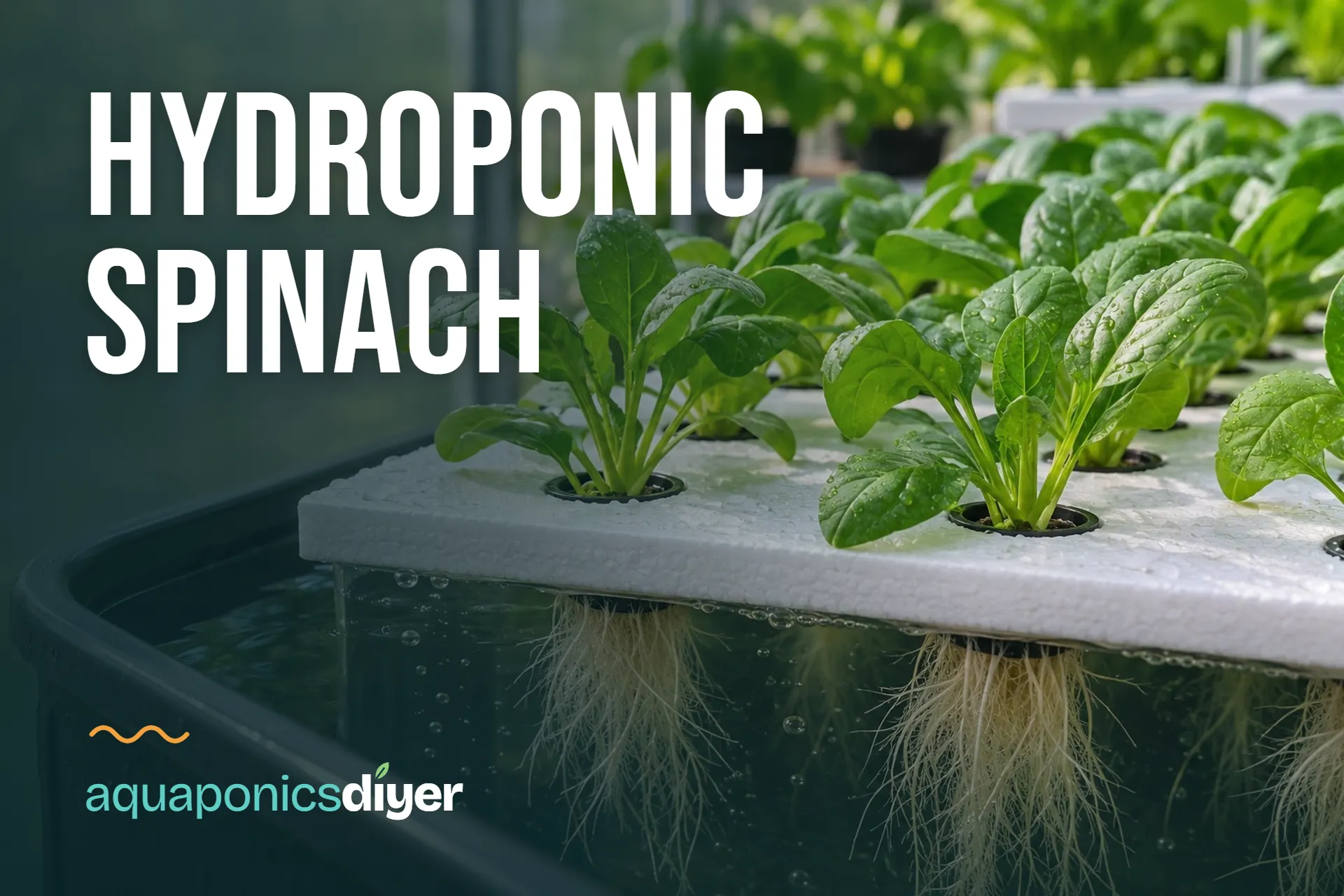
Yes. The University of Georgia trial grew spinach in deep water culture trays, 50 gallon trays measuring 4 by 4 feet and 8 inches deep, covered with 1 inch foam boards, with air stones and an aeration pump. Plants in 1.75 inch holes spaced 6 inches apart reached harvest. The nutrient solution was a 15-5-20 fertilizer at 150 ppm nitrogen. So the method is sound.
Why It Is Harder Than Lettuce
Lettuce forgives a warm room and germinates in a day or two. Spinach germinates best in the cool range the Georgia authors give, 65 to 70°F, and in their summer greenhouse many varieties barely germinated at all. Spinach also flowers (bolts) in heat and long days, and flowered spinach goes bitter and stops producing useful leaves. The Georgia authors name bolting and sunburn as the main losses for marketable yield. If you grow lettuce comfortably but your spinach keeps failing, temperature is almost always the reason.
What You Get
Spinach is a cool-season crop, which makes it a good fit for a cellar, a garage with a light, or a window in the cool half of the year. That is the time to try it. In midsummer indoors without cooling, it is a poor bet, and you are better off with hydroponic basil or other heat-tolerant crops.
Best Spinach Varieties for Hydroponics
Most home growers pick spinach seed by name at a garden center, and few of those packets say how a variety behaves in water. The University of Georgia trial is the useful guide, because it compared 22 commercial varieties in the same system.
Varieties That Did Well for Summer Production
The Georgia authors recommend Kona, Lizard, Seaside, Space, Sunangel and SV3580VC for summer production. They note that Space has lower yield and tartness and is more susceptible to sunburn. Bolting resistance was named as very important, so choose a bolting-resistant variety wherever you can.
Germination Rates Vary a Lot
The trial's germination table is a warning about seed choice. In direct-seeded rockwool in a summer greenhouse, Banjo reached 66 percent, Sunangel 57 percent, Flamingo Improved 41 percent, Seaside 39 percent and Space 37 percent. Several others germinated in single digits. Because the trial ran in summer heat, the figures show how heat-sensitive spinach seed is, not what to expect in a cool room, but they make the point that variety and temperature both matter. Sow extra seeds and thin.
Germinating Spinach Seeds
Keep It Cool
The Georgia guide gives 65 to 70°F (18 to 21°C) as the best range for spinach germination. Warm rooms are where spinach seed fails, so start seeds in the coolest spot you have, and keep seed trays off heat mats.
Soak or Prime the Seed
The authors list priming methods used to improve germination. The simplest is a soak in water or in 0.3 percent hydrogen peroxide for 18 hours, then sowing into pre-soaked rockwool. Their other methods involve bleach leaches or strong acid, and the acid method is hazardous, so skip it.
Allow Time
The Georgia seedlings needed 2 to 3 weeks after sowing before they were ready to transplant. Do not move them into the system before roots show at the base of the plug.
Best Systems for Hydroponic Spinach
| System | Fit for spinach | Why |
|---|---|---|
| Deep water culture | Excellent | The system used in the Georgia trial; big volume buffers temperature |
| NFT | Good | Fine at scale; thin film warms quickly in a warm room |
| Kratky jar or tub | Fair | Simple for a few plants in a cool room; no oxygen control |
Deep Water Culture
A large reservoir changes temperature slowly, which is why DWC suits a fussy cool-season crop. Use an air stone and a lid, and see our DWC hydroponic system guide to build one.
NFT
Channels work for spinach, but the thin film of water warms quickly. If you use NFT, keep the reservoir large and shaded, and run the room cool.
Kratky
The Kratky method can grow a few spinach plants in a bucket or jar through the cool months. The trade-off is that you cannot add oxygen, so root rot is the risk if the water warms.
Temperature, pH and EC
| Factor | Target | Source |
|---|---|---|
| Air temperature for growth | 60 to 77°F (15 to 25°C) | University of Georgia Extension, 2024 |
| Air temperature for germination | 65 to 70°F (18 to 21°C) | University of Georgia Extension, 2024 |
| Seedling stage | 2 to 3 weeks before transplanting | University of Georgia Extension, 2024 |
| Crop time after transplanting | 3 to 4 weeks (trial) | University of Georgia Extension, 2024 |
| Nutrient solution (trial) | 15-5-20 at 150 ppm nitrogen | University of Georgia Extension, 2024 |
pH and EC
The Georgia circular does not give a pH or EC target, and we have not printed one we could not source. Follow the leafy green range on your nutrient label, start toward the low end of the EC range, and measure rather than guess. Cornell University's Controlled Environment Agriculture program lists a hydroponic spinach handbook on its crops page if you want a commercial reference. Our EC meter guide explains how to read and calibrate a meter, and the VIVOSUN pH and EC meter in the kit below measures both.
Air Temperature
The Georgia authors report that their greenhouse could easily reach 90 to 95°F, far above the 60 to 77°F range they give for growth, which explains the poor germination and the bolting and sunburn. Indoors, hold the room in the range, and shade or cool it if it climbs.
What You Need to Grow Hydroponic Spinach
A meter to track the solution, net cups, and a nutrient. Seed and a cool room are on you.
-
1pH and EC meter
VIVOSUN Digital pH Meter TDS EC Meter
Measures pH and EC in one handheld, so you can hold a mild solution for a fussy crop.
-
2Net cups
Cz Garden 3 Inch Net Pots, 25 Pack
Wide-rim cups that hold a seedling plug in a DWC lid or raft.
-
3Nutrient
General Hydroponics Flora Series Trio
Three-part liquid you can mix at a mild leafy ratio.


Stopping Bolting and Root Rot
Heat and Long Days
The Georgia authors say high temperature and light can cause bolting and sunburn, and that bolting resistance is very important. Their fixes are bolting-resistant varieties and shade cloth. Indoors, the equivalent is to cool the room, keep the light off for part of the day instead of running it continuously, and harvest on time rather than letting plants stand.
Continuous Light
Running lights around the clock is a common mistake with leafy greens. Spinach reads long days as a signal to flower, so give it a regular dark period.
Pythium Root Rot
Pythium is the usual root disease in hydroponic spinach, and warm, poorly oxygenated water is what lets it spread. Healthy roots are white. Brown, slimy roots and wilting plants mean the water is too warm or too stagnant. Keep the reservoir cool and aerated, keep light out of it, clean the system between crops, and remove affected plants early. If rot returns every crop, switch to a larger reservoir and start from clean seed.
Water Spinach Is a Different Plant
If you searched hydroponic spinach and found videos of long, hollow-stemmed shoots growing in ponds, that is water spinach, also called kangkong. It is a different species and a warm-weather plant that grows in water by nature, which makes it far easier hydroponically than true spinach. Spinach is a cool-season leafy plant, and the advice in this guide does not apply to kangkong, which wants heat rather than cool water.
Hydroponic Spinach FAQ
Related: hydroponic lettuce, DWC hydroponic system, NFT hydroponics, the Kratky method, aquaponics vs hydroponics and EC meters.
Grow along with us
New guides and seasonal tips for fish, plants and DIY builds, about once a month.